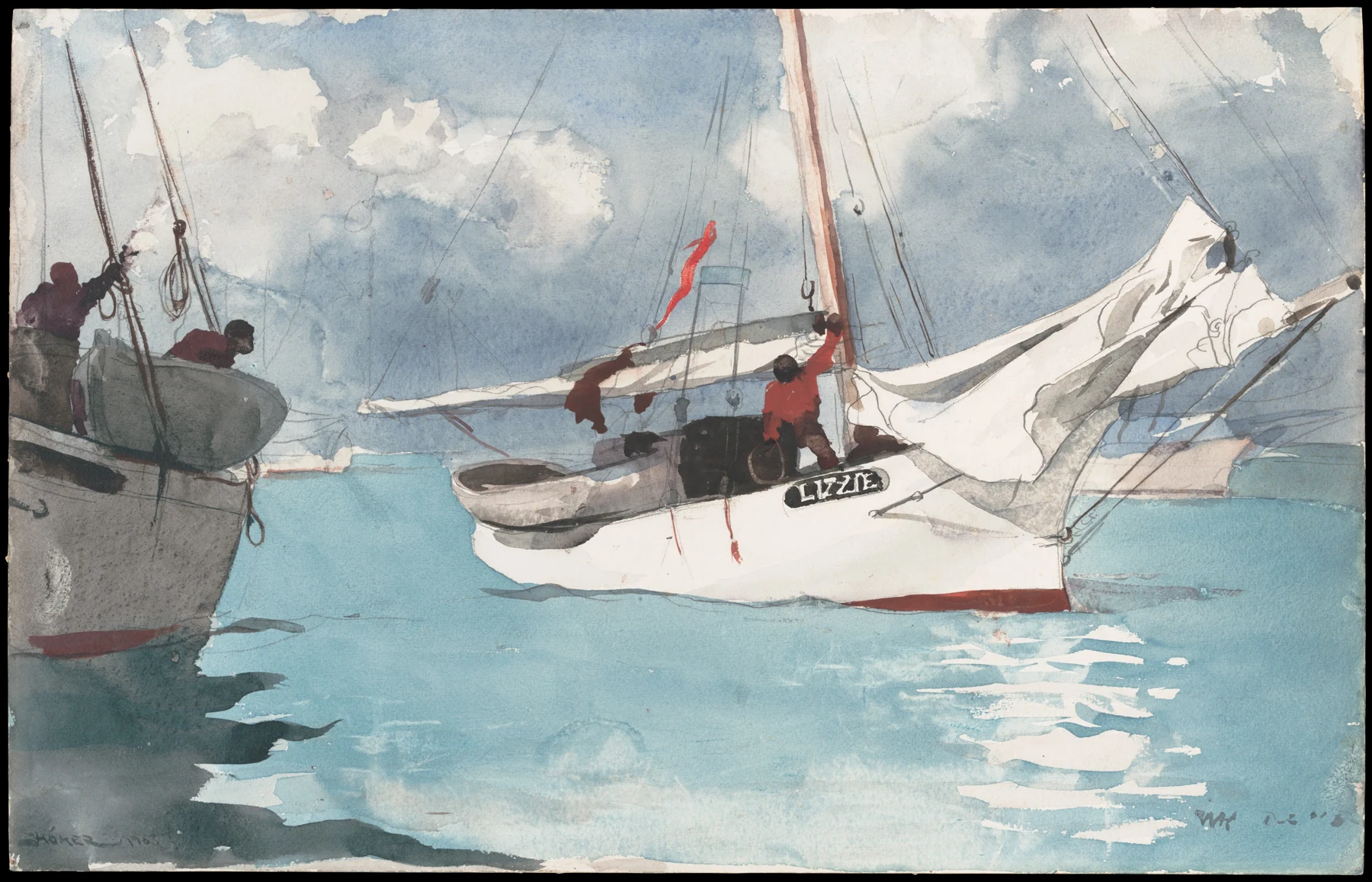
- Homer places a cropped boat against a larger vessel whose pale hull and sails stand out from the water and cloud.
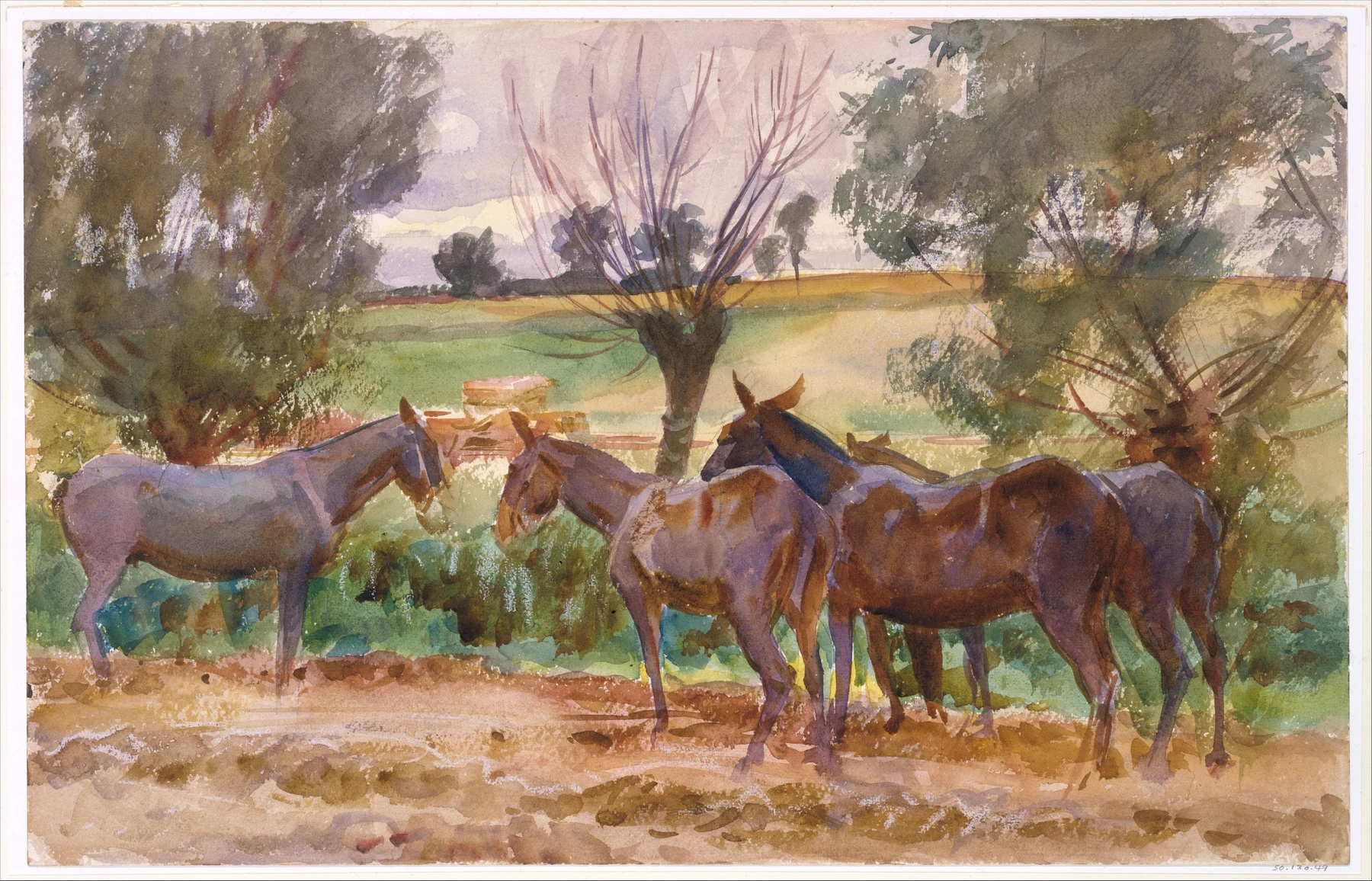
- Sargent groups overlapping animals in a sunlit setting; the low ground and feet reward a second look after reading the wartime context.
These observations describe what is visible, not how the artist made the painting.
A travelling medium, with people already there
Watercolour travels well: a small kit can record changing conditions without the equipment of a large studio. The Museum of Fine Arts Boston describes its importance during Winslow Homer’s journeys through places including England, Florida and the Caribbean. Portability helps explain the choice of medium; it does not explain everything happening in a picture. The place an artist visits is also somewhere people live and work.
That distinction gives travel painting a fuller history. Instead of treating a harbour as a supply of delightful boat shapes, ask who works there, how objects are used and which connections the view contains. Such questions do not require us to invent the identities of small figures. They ask us to read the available evidence before allowing beautiful colour to turn the world into scenery.
Homer’s boats cross more than a composition
Fishing Boats, Key West was painted in 1903. The Met notes that the craft appear characteristically Bahamian, despite the Florida title, and relates the scene to movements between the Bahamas and Key West, including Black Bahamian migration after the American Civil War. This context puts a busy stretch of water inside a regional history of travel and livelihood. A boat’s design can be historical evidence as well as a pleasing diagonal.
Look at the composition itself. A cropped boat enters from the left, while the larger vessel stretches across the right. Pale sail and hull shapes meet a turquoise foreground and grey cloud. The rigging draws a delicate network over those broad areas. Reserve your attention for the contrast between thin lines and substantial shapes: too many equally dark ropes in your own painting would pull the entire harbour into a knitting project.
Sargent’s quiet animals belong to a war
John Singer Sargent’s Mules, dated 1918, can initially seem pastoral. Animals cluster in front of trees, with sunlight, grass and patches of open ground. The museum record places the work in Sargent’s service as an official British war artist on the Western Front. Mules carried people, supplies and artillery over difficult terrain. The mud around their hooves matters in that context; the sheet does not need visible battle to belong to the history of war.
The listed materials include watercolour, graphite and wax crayon. That is another useful correction to a narrow idea of the medium. Look at the warm and violet passages across the animals, the overlapping backs and the repeated vertical legs. We can describe what is visible without claiming to identify the exact tool responsible for every light mark. Material records give a starting point for investigation, not a licence to guess.
Looking without turning the subject into a prop
The two works are paired here as an editorial comparison, not evidence of one artist borrowing from the other. Each rewards attention to bodies, equipment and work. The paintings also show how much context can remain outside the frame. Reading the museum record after an initial look changes what we notice on returning: the vessel becomes part of a network, the mule part of a vast logistical effort.
For a contemporary study, choose a working place you can observe respectfully: a repair bench, a café before opening, a boat being prepared or your own painting table. Notice repeated actions and the arrangement of tools. Draw only what you can actually see, and keep factual notes separate from assumptions. The artistic task is still colour, shape and attention. The historical habit is to remember that the visible arrangement has a life beyond being useful to your composition.
Paint the work behind the view
- Choose a familiar working space or an appropriate public view. Write three things you can directly observe and one question you would need to research.
- Make a thumbnail connecting the largest tool, object or figure shapes. Include one trace of use: a worn surface, tied rope, stacked material or muddy ground.
- Paint a small study with three principal values. Let the broad shapes explain the activity before adding narrow lines or texture.
- Caption it with place, date and a factual observation. Read the caption beside the painting and check that neither claims more than you know.
Make this a study of your own subject. These are our practice prompts, not a claim to reproduce an artist’s exact method.
Take a practice sheet →- How watercolour claimed a wall of its own
- Cézanne: when the paper joins the argument
- Sargent: a life in paint, a lesson in looking
Keep looking
- MFA Boston: Homer at Home and Abroad — travel and watercolour
- The Met: Fishing Boats, Key West — Bahamas connections and materials
- The Met: Mules — Sargent’s wartime context and mixed materials
Sources support the factual context; looking notes and exercises are Watercolourist editorial interpretation.
What happened on your paper?
One useful observation beats “lovely work”. Show a study, ask about a decision, or tell us where you disagree.
Join the studio discussion