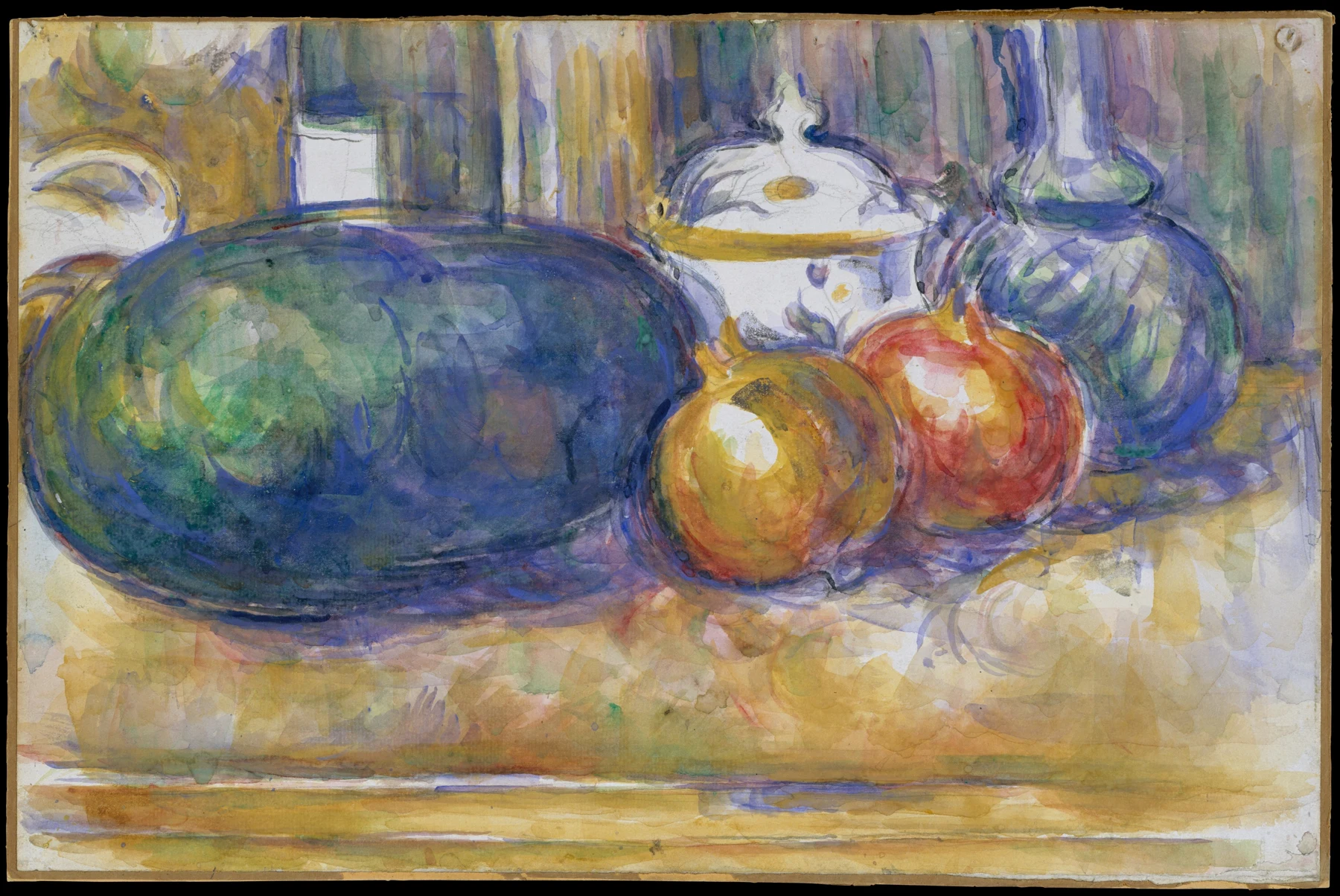
- The large cool melon balances two smaller warm fruits; blue and violet recur around more than one object.
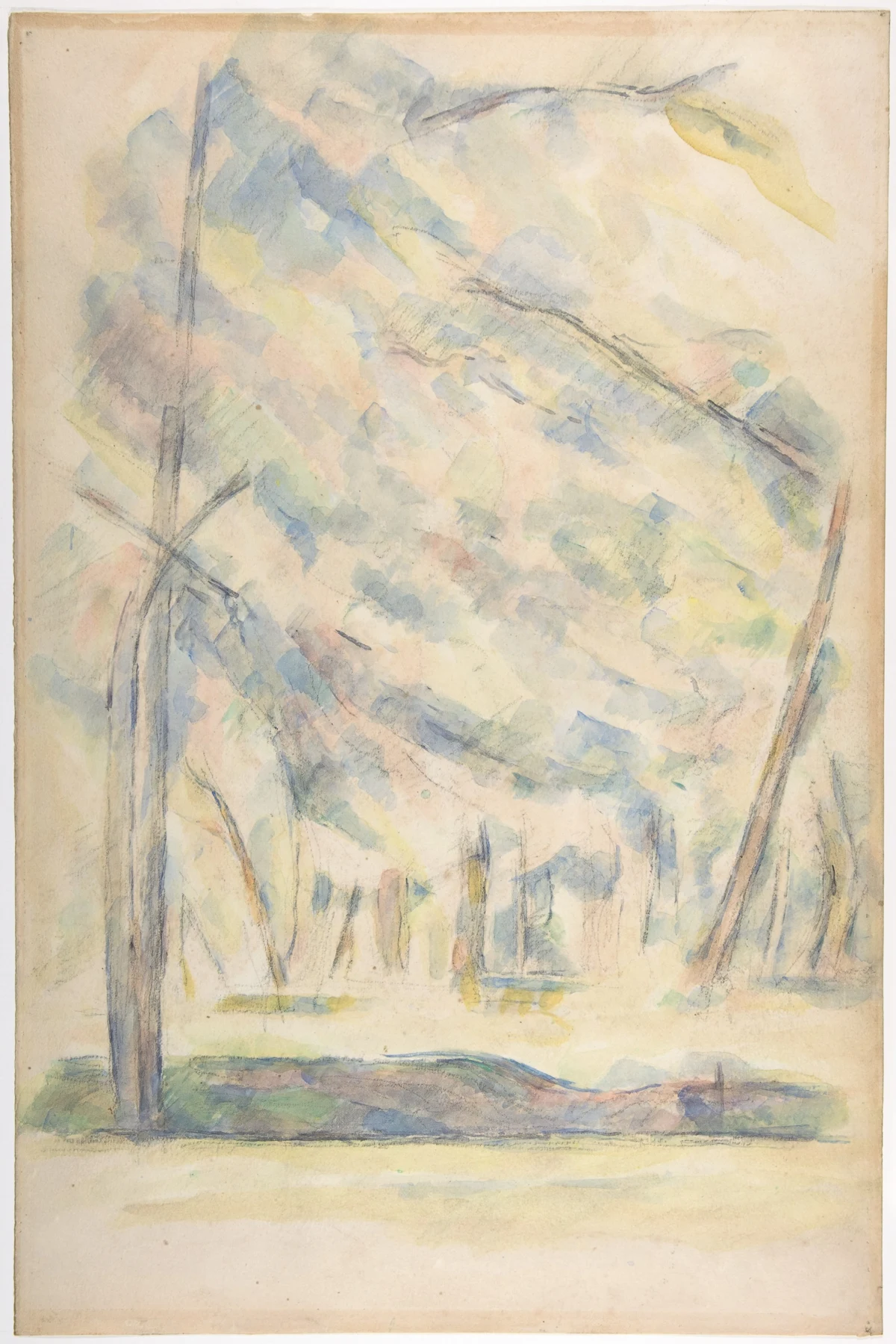
- The landscape holds broad intervals of pale paper between slanting trunks and dispersed coloured marks.
These observations describe what is visible, not how the artist made the painting.
Modern painting begins with another look
Cézanne is often introduced as a bridge to modern art. That is a helpful signpost, provided we stop on the bridge and look at something. Born in Aix-en-Provence in 1839, he exhibited with the Impressionists in 1874, and developed ways of organising colour and form that later painters studied closely. The Met’s historical essay traces his importance for Cubism and other early twentieth-century movements. Influence is part of the story; his pictures are also worth meeting without Picasso waiting at the exit.
Watercolour makes certain questions unusually visible. How much contour is needed to suggest a solid object? Where can the paper remain active? Can a small patch describe both a surface and a relationship to the neighbouring colour? These are questions we bring to the work as viewers. They help explain why a bowl of fruit can contain more pictorial adventure than a grand subject painted on autopilot.
A watermelon with considerable presence
Still-Life with a Watermelon and Pomegranates, dated 1900–1906, is among Cézanne’s more extensively worked late watercolour still lifes. Look at the weight of the green-blue melon on the left and the smaller warm fruits in front. Behind them, vessels rise into a dense field of vertical marks. Blue travels between objects rather than belonging neatly to one of them. The objects remain distinguishable, yet the same colours keep the surface connected.
The Met draws attention to the sugar bowl, whose light is formed from reserved paper. That is not a hole waiting for paint: its neighbours help us read it as an object. Follow the outline and notice how the surrounding marks carry some of the descriptive burden. This offers a better question than “How do I paint white?” Ask which adjacent shapes would let the white already present become convincing.
An open landscape is doing another job
The companion Landscape dates to 1890–95 and uses watercolour over black chalk on the front of the sheet. Compared with the still life, its marks are widely separated. Slanting trunks establish an enclosure, with pale coloured patches indicating foliage and intervals of open paper carrying light through the scene. A narrow dark band near the bottom gives the airy arrangement a firmer base.
Our comparison concerns how much information the eye needs; it is not a judgement that one sheet is more complete or successful. Cézanne could use both densely worked and open arrangements. Getty’s study of his watercolour still lifes describes varied degrees of finish and a practice in which drawing and painting could develop together. An exposed line can remain part of the finished visual experience rather than a construction mark that ought to have been erased.
From a coloured patch to a way of seeing
Why was this consequential? Cézanne gave later artists a powerful example of a picture whose internal relationships could be felt as strongly as its represented subject. His role in the history of modern painting does not mean that every irregular ellipse is an advance towards abstraction. It means that the arrangement of colour, contour and space can become a central subject of attention, even when the motif is a familiar piece of fruit.
At your own table, start with one vessel and two fruits. Draw lightly, place a few patches and leave the pencil visible. Compare the apparent weight of an object with the amount of paint used to describe it. A thinly painted form may feel substantial if its neighbours support it; a thoroughly filled-in one may still float. Before adding another layer, decide which relationship actually needs clarification. Sometimes the paper has already said enough. It rarely sends a formal complaint, so you have to notice.
Three objects, twelve patches
- Arrange a pale cup and two fruits against a simple background. Make a light drawing, including the gaps between objects.
- Choose twelve initial colour patches. Place them where they explain a turn, an overlap or a neighbour; do not fill each object to its outline.
- Let the first marks dry. Add only the lines or patches needed to make the arrangement legible. Leave one connected area of paper untouched.
- View the result from across the room. Identify which mark gives an object weight, and which patch could disappear without losing the idea.
Make this a study of your own subject. These are our practice prompts, not a claim to reproduce an artist’s exact method.
Take a practice sheet →- How watercolour claimed a wall of its own
- Beyond the souvenir: watercolour, work and witness
- Sargent: a life in paint, a lesson in looking
Keep looking
- The Met: Paul Cézanne — career and influence on modern painting
- Getty: Cézanne in the Studio — drawing, layers and exposed paper
- The Met: Still-Life with a Watermelon and Pomegranates
- The Met: Landscape — recto and verso materials
Sources support the factual context; looking notes and exercises are Watercolourist editorial interpretation.
What happened on your paper?
One useful observation beats “lovely work”. Show a study, ask about a decision, or tell us where you disagree.
Join the studio discussion