Start with the glow
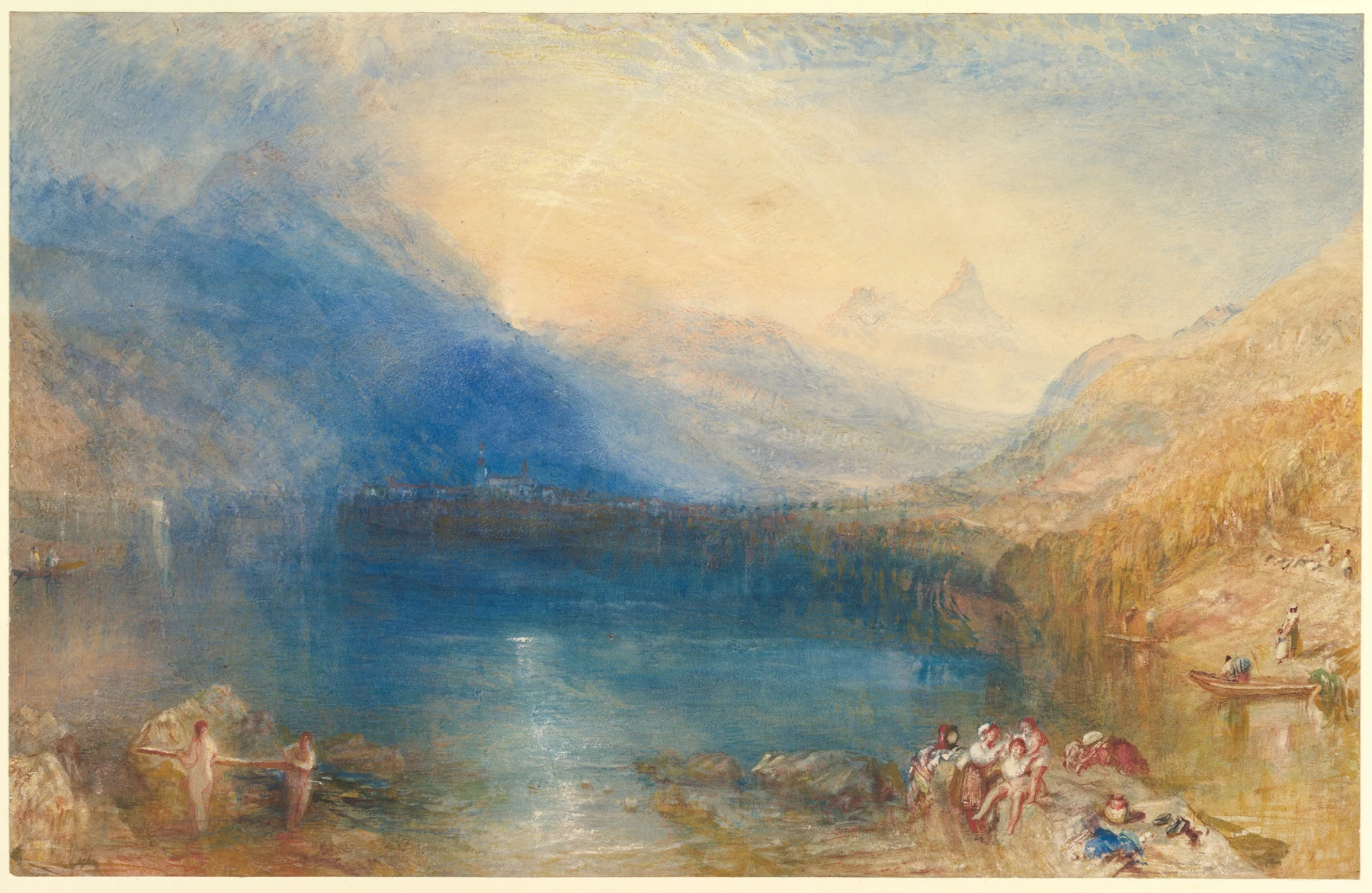
Turner is an excellent companion for anyone whose landscape has become a meeting of individually outlined objects. Mountain. Boat. Tree. Another tree, now with seventeen branches. Look at The Lake of Zug, made in 1843, and the invitation is different: notice the light before making an inventory. The bright opening above the lake gives the surrounding forms somewhere to belong.
The Met identifies this as watercolour and bodycolour over graphite, with techniques that remove paint. Its account describes layered washes and scraping back to paper. That matters because the finished work isn't evidence of a single miraculous splash. Turner could build, change and recover a passage. The watercolour purity police may take a short walk.
Look for unequal attention
Our reading of the painting starts with its unequal contrasts. The blue mass at the left has considerable weight; distant peaks almost disappear into the warm sky. Small foreground figures sharpen the near edge. These differences make the space feel expansive. If every mountain were equally crisp, the distance would flatten into a collection of cut-outs.
For your own landscape, decide which passage deserves the clearest statement. Perhaps a roof catches the last light. Perhaps a dark headland interrupts a pale sea. Give that area a few deliberate edges and let other boundaries remain quieter. Softness earns its place through comparison. A painting with no firm edge anywhere can feel as though it has misplaced its glasses.
Borrow a decision, then change the subject
Try a study of a local reservoir, a park or the view beyond a supermarket car park. The useful question is how a light area holds the picture together. Sketch three thumbnail arrangements before touching your good paper. In each, move the light opening to a different place. Choose the version that makes your eye travel most comfortably.
Use two colours you already know well, plus clean water. Keep the opening pale by painting around it or using a very dilute wash. While the surrounding paper is damp, place a broad cool mass beside that warmth. Allow it to settle. When dry, add a smaller, darker shape near the front. This sequence is an editorial exercise inspired by looking at Turner; it is not a reconstruction of his working process.
Stop before the weather becomes furniture
At the halfway point, step back far enough that the tiny marks disappear. Does the light still lead? If it does, extra details must earn their passage. A couple of dark interruptions may help. Filling every empty patch usually makes the atmosphere less convincing, however impressive your new rigger brush feels.
Compare the finished study with the first thumbnail. If the glow has shrunk, note which stage crowded it out. Repeat the same arrangement tomorrow with fewer marks around the opening. The point of studying Turner is to become more alert to your own choices: how much contrast to spend, where to soften a boundary, and when a quiet patch already says enough.
An opening in the weather — an editorial study
- Draw three tiny value plans with the light opening in different positions.
- Choose one and paint a pale warm opening beside a broad cool mass.
- Let the paper dry; add only three small dark accents near the foreground.
- Step back and check whether the opening still leads the picture.
Make this a study of your own subject. These are our practice prompts, not a claim to reproduce an artist’s exact method.
Take a practice sheet →Keep looking
Sources support the factual context; looking notes and exercises are Watercolourist editorial interpretation.
What happened on your paper?
One useful observation beats “lovely work”. Show a study, ask about a decision, or tell us where you disagree.
Join the studio discussion