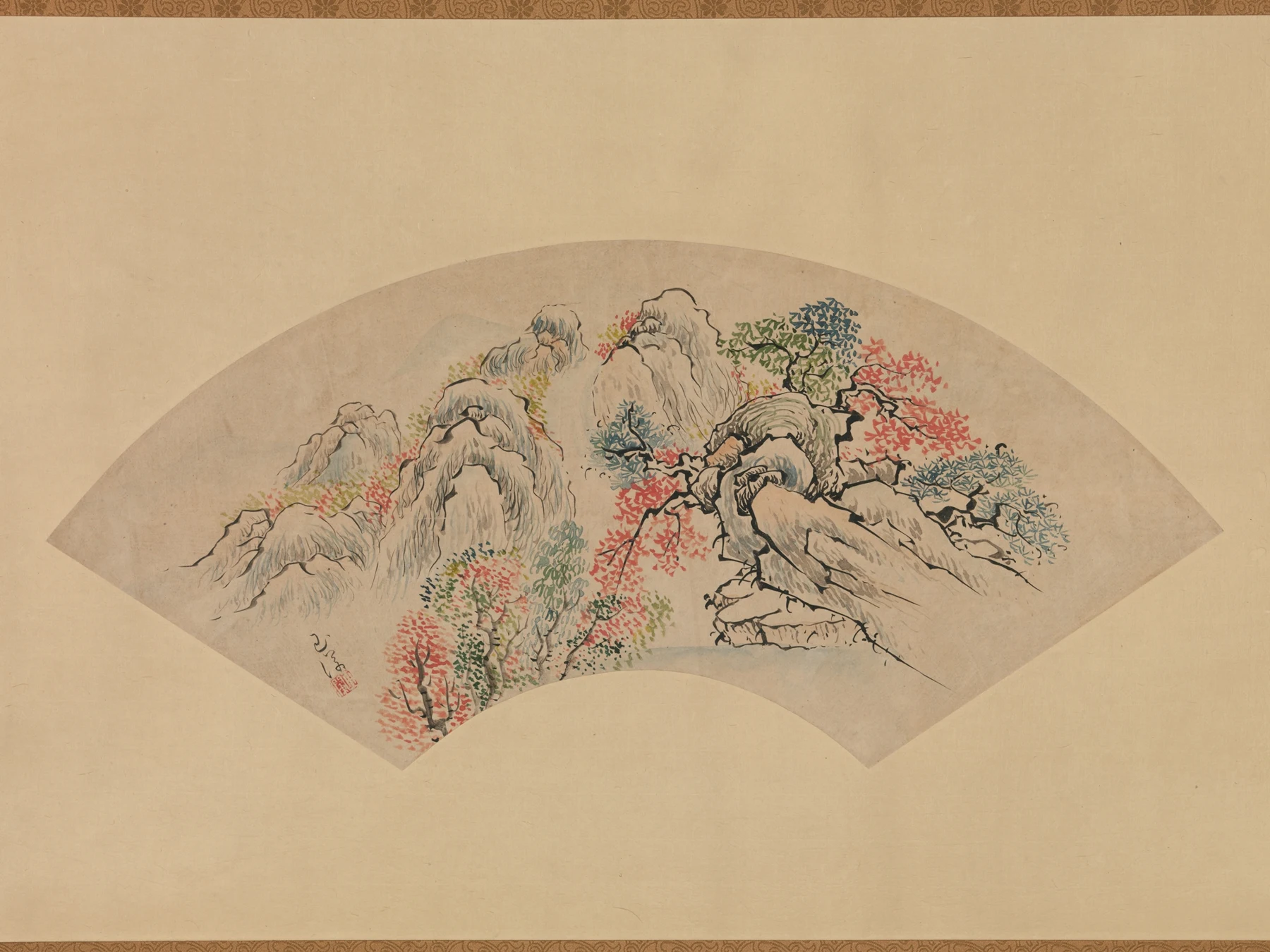
- Observe the fan’s upper and lower curves; the painted field is wider at its upper edge.
- Track the waterfall’s pale vertical movement against the landscape’s sideways spread.
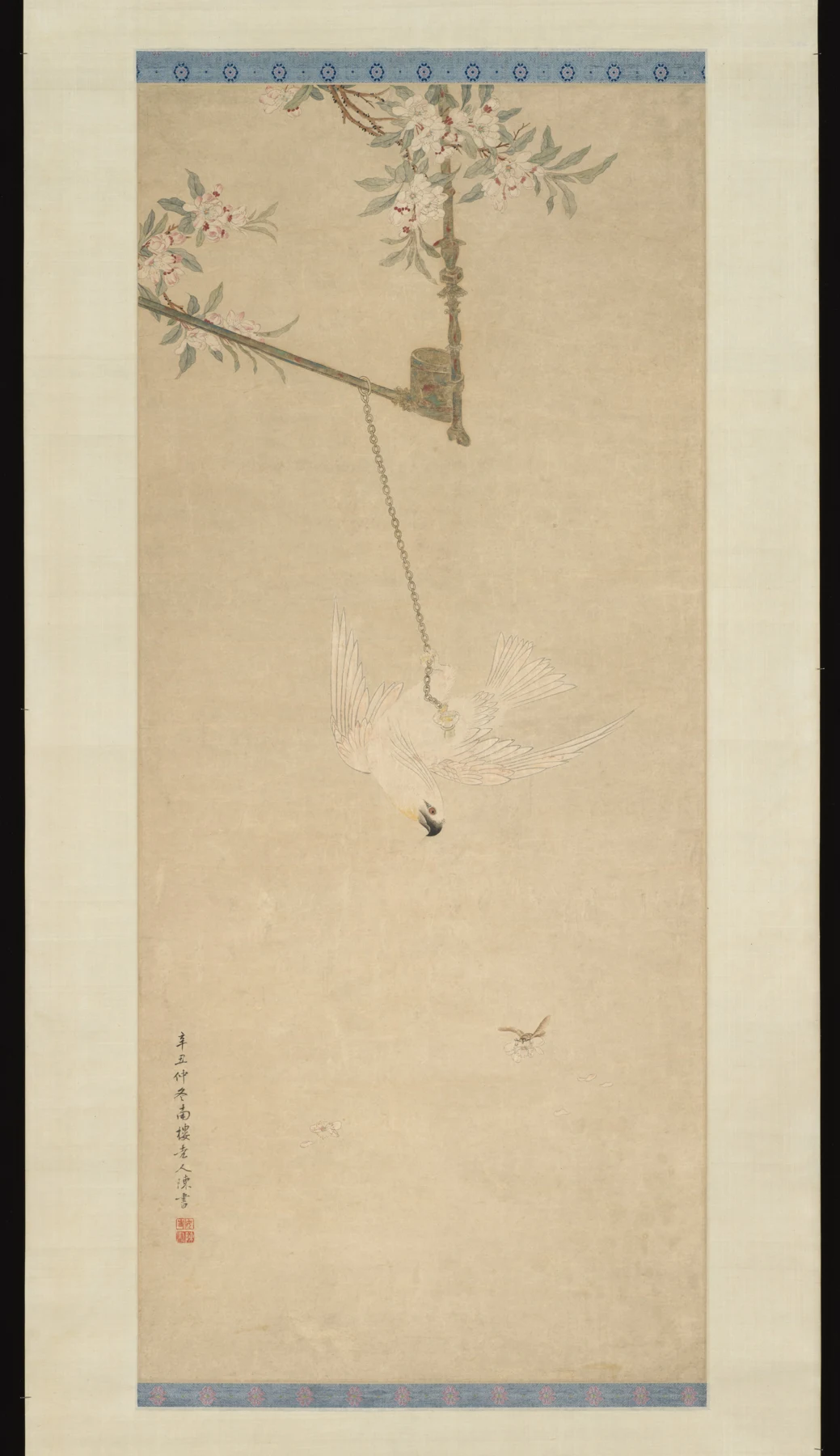
- Compare the fan with Chen Shu’s tall scroll as a format study, without assuming a direct historical connection.
These observations describe what is visible, not how the artist made the painting.
Ideas travelled; contexts changed
Nanga, usually translated as Southern painting, developed in Japan through engagement with Chinese literati art. That relationship was active interpretation, not a parcel of tradition arriving unchanged. Philadelphia’s account describes eighteenth-century interest in Chinese studies among Japan’s educated merchant elite, and artistic material arriving through merchants, immigrants and imported books. Chinese scholar-bureaucratic ideals became resources for painters working in another society. The words wenren in Chinese and bunjin in Japanese are related, but they do not make their users socially identical. Keeping that distinction in mind helps us appreciate what Japanese painters selected, adapted and made newly compelling.
Books opened imaginary landscapes
Imported Chinese printed books were important early sources for Ike Taiga, a leading Nanga painter and Gyokuran’s husband. Poems, titles and references to older pictures could give a landscape meanings beyond its visible trees and hills. A learned viewer might recognise an allusion where another viewer simply enjoyed the scenery. That layered experience is useful to remember when an old painting seems deceptively straightforward. Its subject may include another artwork or a line of writing that the picture itself cannot fully explain. Looking remains essential, but a catalogue note can open a door that excellent eyesight alone cannot find.
Gyokuran had a history before her marriage
Gyokuran grew up in a Kyoto tea-shop family in which her mother and adoptive grandmother published waka poetry. Kyoto National Museum describes her own poetic training and her study with the painter Yanagisawa Kien. Her marriage to Taiga belongs within this already substantial creative life. The museum also notes that her paintings were popular during and after her lifetime. Calling her simply a famous painter’s wife removes precisely the training and reputation we need to understand. Poetry was a working practice in this household, not an elegant accessory hung beside the real business of painting.
Cultivation could be sociable
Denver Art Museum describes literati circles as communities sharing poetry, calligraphy and painting, with appreciation of Chinese culture helping to connect their members. This social setting complicates the familiar image of the hermit alone in the mountains. An image of withdrawal could circulate among friends; solitude could itself be a shared artistic subject. For a modern painting group, the interesting parallel is that conversation changes what people notice. It is a parallel, not evidence that an evening sketch club reproduces Edo-period cultural life. Ask who made a picture, but also who could read its references and enjoy receiving or discussing it.
The fan gives the picture its conditions
Gyokuran’s Autumnal Landscape with a Waterfall survives as a fan mounted on a hanging scroll. Its ink and colour occupy a widening curved field, rather than a conventional rectangular window. Angular dark marks sit beside softer passages; little coloured clusters punctuate the landscape. The shape encourages the eye to move sideways while the waterfall provides a contrasting vertical direction. These are our observations of the image, not evidence of a particular sequence of painting. Nor does the poetic culture around Gyokuran authorise inventing a poem for this fan. The object’s surviving form and its historical associations are different kinds of evidence.
Compare without blending everything together
The accompanying Chen Shu scroll offers a deliberate editorial comparison: two women, distinct places and dates, different pictorial formats. It is not a claim that Gyokuran saw that picture or learned from Chen Shu. Try describing each work before searching for a common label. Which movements does the support encourage? Where does colour interrupt the ink? What knowledge does the historical account add? For your own study, let a short line of your writing and an unusual paper shape set a problem. The aim is a more attentive picture, not an instant certificate in Nanga.
One observation, two formats
- Write one plain sentence about a place you know: a season, sound or change of light. Use your own words rather than an imitation historical poem.
- Draw a rectangle and a fan-shaped field of similar area. Plan the same landscape in each with three large shapes.
- Paint both using one dark mixture and two colours. Let the sentence guide one choice, such as a repeated colour or an interval of empty space.
- Show the studies to another person or compare them after a pause. Record how the format changed the reading and which marks actually support your sentence.
Make this a study of your own subject. These are our practice prompts, not a claim to reproduce an artist’s exact method.
Take a practice sheet →- Chinese literati painting: Chen Shu and the learned brush
- When words grow leaves: William Blake’s painted poems
- Walking into a painting: Kurosawa, Van Gogh and the moving eye
Keep looking
- Philadelphia Museum of Art: Ike Taiga and Tokuyama Gyokuran, including the Nanga movement
- Kyoto National Museum: The Genius of Ike no Taiga, Gyokuran’s training and reputation
- Denver Art Museum: Her Brush, Literati Circles
- The Met: Gyokuran, Autumnal Landscape with a Waterfall
- The Met: Chen Shu, Cockatoo, shown for editorial comparison
Sources support the factual context; looking notes and exercises are Watercolourist editorial interpretation.
What happened on your paper?
One useful observation beats “lovely work”. Show a study, ask about a decision, or tell us where you disagree.
Join the studio discussion