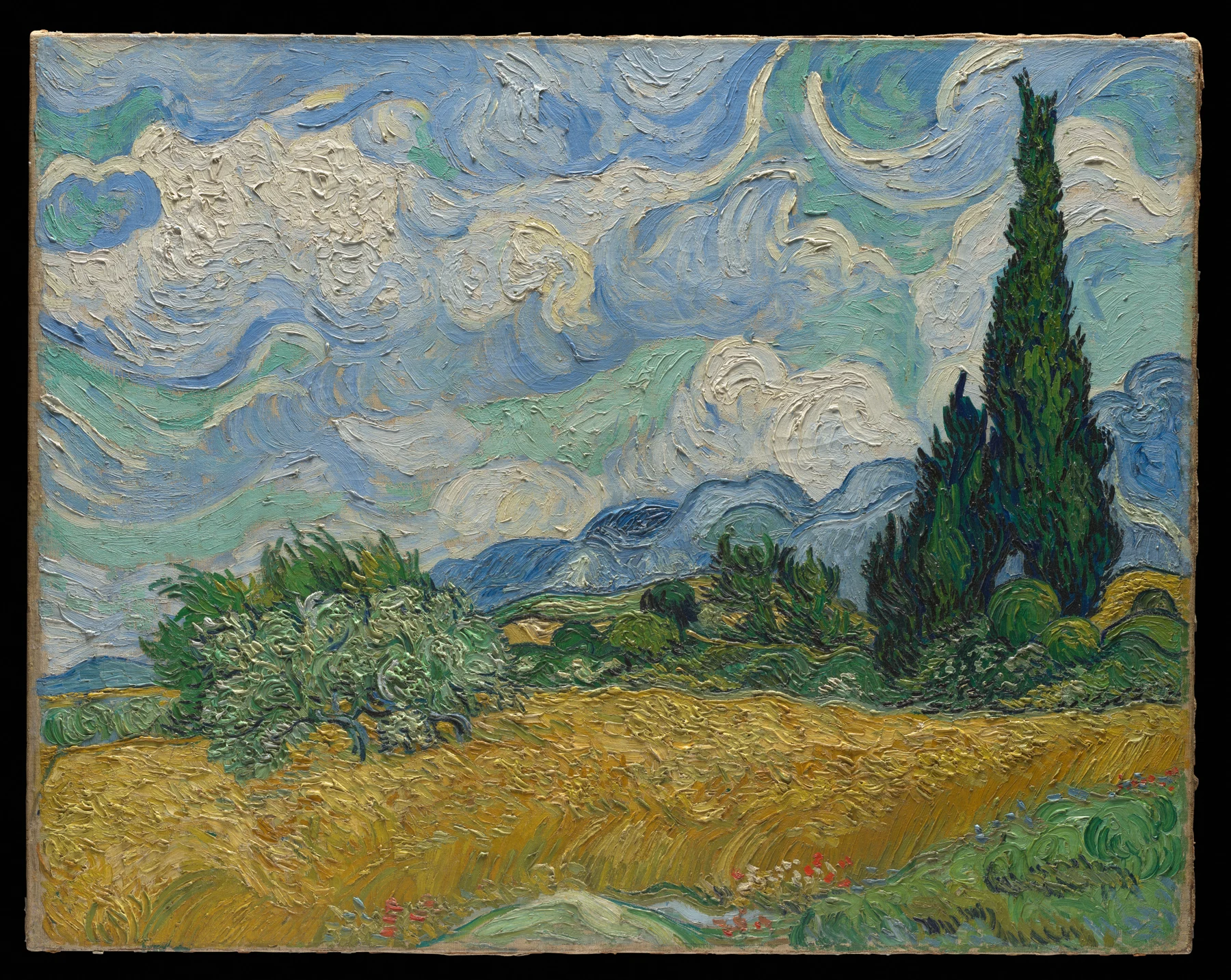
- In Wheat Field with Cypresses, the dark upright tree at the right cuts across the rolling bands of cloud, hills and field.
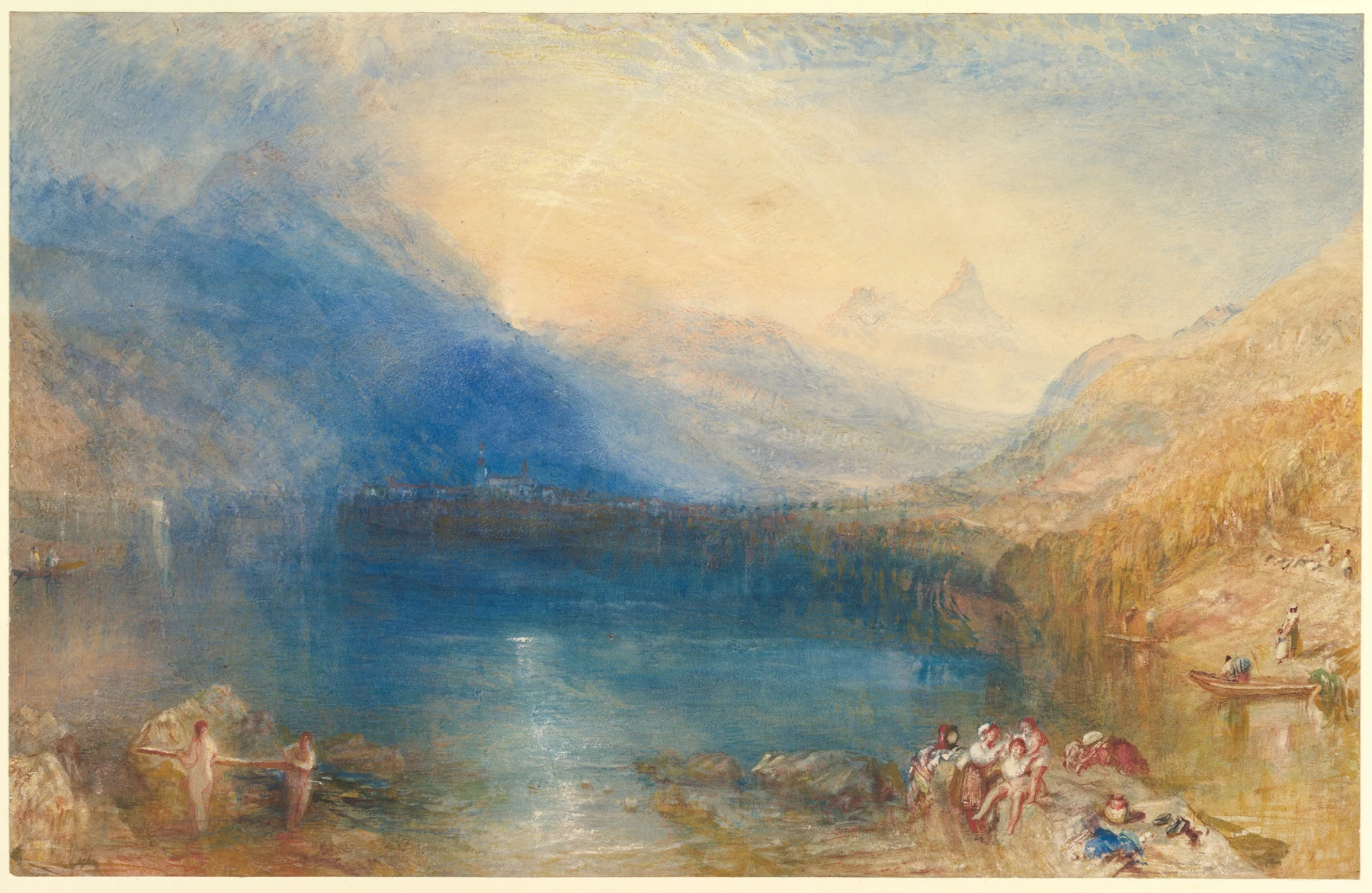
- In The Lake of Zug, the pale upper centre sits above a broad blue lake; small warm-coloured figures and boats gather along the lower edges.
These observations describe what is visible, not how the artist made the painting.
A real encounter between cinema and painting
In Akira Kurosawa’s Dreams, looking at a painting becomes a journey through it. The 1990 film consists of eight episodes, and Crows sends its protagonist into the world of Vincent van Gogh, played by Martin Scorsese. This is a documented, explicit encounter between the arts. We do not need to spot a vaguely yellow field and announce an influence with the confidence of a pub quiz contestant.
Criterion’s essay by Bilge Ebiri describes the episode’s progression from recreated landscapes into paintings and enlarged brushwork. The same essay discusses Kurosawa’s early ambition to become a painter and his recollection that looking at painters changed how he saw the world. Begin with Criterion’s official film page and trailer, then read the essay. If you watch the complete film through a lawful available edition, give Crows your attention as an unfolding sequence, not just a collection of attractive frames.
Look at the paint, then imagine the journey
Van Gogh’s Wheat Field with Cypresses, painted in 1889 and held by the Met, is our looking companion here. We are not identifying this particular canvas as a shot in Dreams. It offers a separate way to investigate the relation between painted movement and a viewer’s movement. The tall dark cypress at the right interrupts a landscape full of curving activity: pale clouds roll across the top, distant hills undulate, and the golden field carries closely packed directional strokes.
Try tracing three routes without touching the screen. One might climb the cypress; another follow the low hills; another circle through the cloud shapes. These routes do not have to agree. Their competing directions help the image feel active while the strong dark tree gives the eye somewhere to land. Copying the surface marks alone would miss that larger arrangement. Thousands of energetic dabs can still produce a remarkably sedentary painting.
A watercolour comparison, with the history kept straight
Turner’s The Lake of Zug, dated 1843, offers a different kind of journey. Its bright upper centre opens above a broad blue basin, while warmer slopes and small foreground figures hold the sides and lower edge. Buildings and distant mountains become less insistent than the near activity. Compared with Van Gogh’s visibly inscribed surface, this image invites a slower search through differences in clarity, colour and scale.
This pairing is our editorial comparison; it is not a claim that Turner influenced Dreams. It is also worth reading the Met’s materials line: the Turner includes watercolour, bodycolour and reductive techniques over graphite. Its luminosity cannot honestly be reduced to a rule about transparent washes alone. For your own painting, borrow a question rather than a recipe: where should the eye pause, and where should it pass through? Softness is useful when it has a job.
Make a sequence before a finished painting
Film makes time unavoidable: a shot lasts, a figure moves, and the next image arrives. A painting offers all its parts together, although we still take time to explore them. Use that difference. Draw three thumbnail views of one subject, each with a different entry point. A dark foreground shape might usher us towards a light opening; a quiet sky might delay the encounter with a busy harbour. Neither arrangement requires a famous painter’s palette.
When watching the official trailer or a licensed edition, note a change in scale or the placement of a small figure. Ask what the surrounding space does to that figure’s importance. Then make your own landscape from observation with one deliberate change of emphasis. Keep the comparison modest and useful. You are studying how attention can be directed across different media, not attempting to turn a watercolour into a two-hour film before the wash dries.
Storyboard a single landscape
- Choose a landscape photograph you took or a view from a window. Make three small rectangles and use pencil only.
- In the first, lead the eye with one dark shape. In the second, use a large pale opening. In the third, change the apparent scale by adding a tiny observed figure or familiar object.
- Choose the clearest route and paint a small study using three main values. Decide which edges need emphasis before adding detail.
- Ask someone to point to the first place they noticed. Compare it with your intention, without treating a different answer as a failure.
Make this a study of your own subject. These are our practice prompts, not a claim to reproduce an artist’s exact method.
Take a practice sheet →Keep looking
- Criterion: Akira Kurosawa’s Dreams — official film page, credits and trailer
- Criterion: Bilge Ebiri on Dreams — Crows and Kurosawa’s relationship with painting
- The Met: Van Gogh, Wheat Field with Cypresses — painting and collection record
- The Met: Turner, The Lake of Zug — painting and materials
Sources support the factual context; looking notes and exercises are Watercolourist editorial interpretation.
What happened on your paper?
One useful observation beats “lovely work”. Show a study, ask about a decision, or tell us where you disagree.
Join the studio discussion