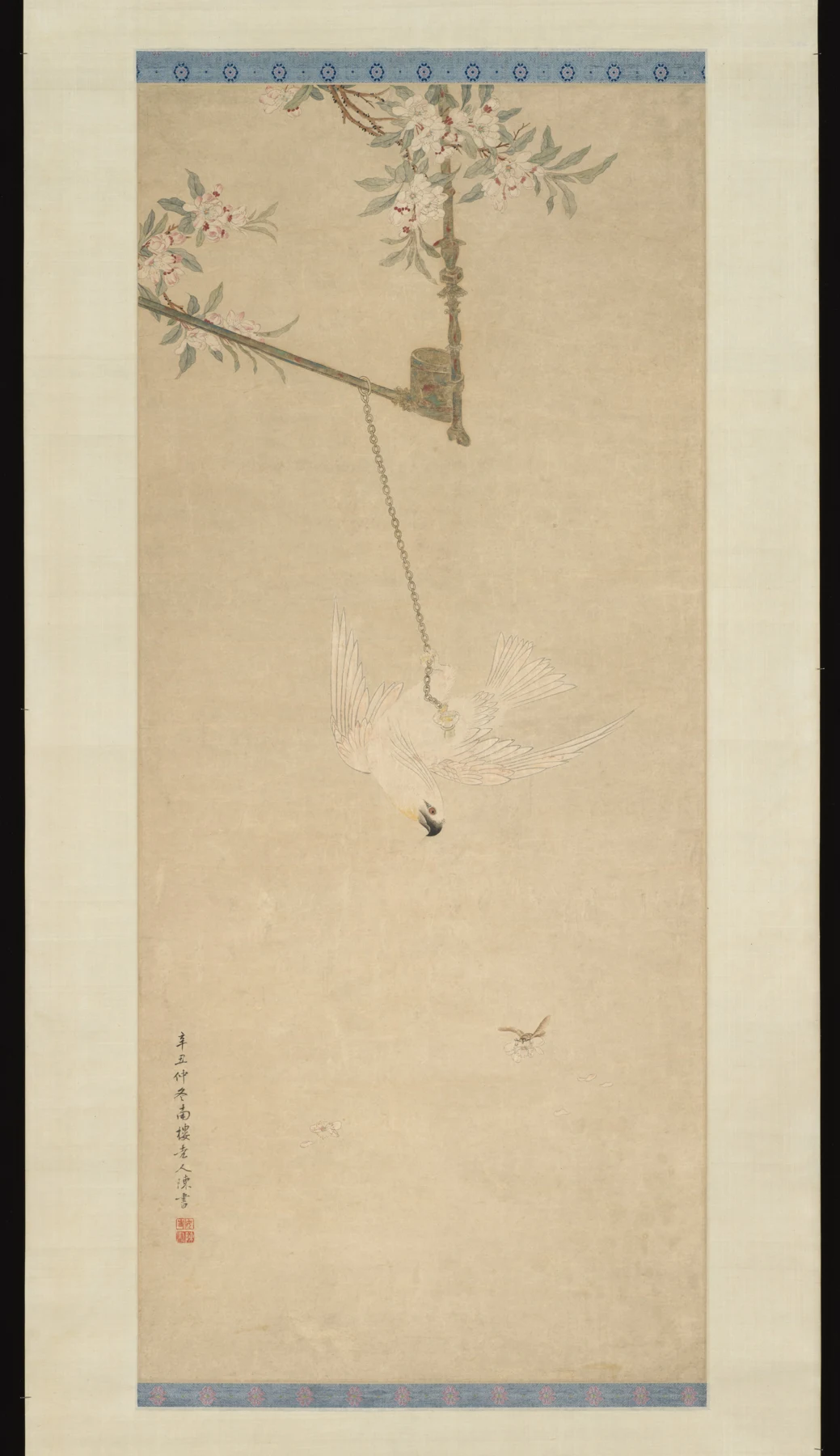
- Follow the long intervals between branch, bird and inscription before examining individual feathers.
- Compare the descriptive precision of the cockatoo with the lighter plant forms; one artist can use several kinds of mark.
- Keep the tall scroll format in view when making a thumbnail: a tight crop changes the painting’s pacing.
These observations describe what is visible, not how the artist made the painting.
A brushstroke could carry an education
Literati painting names a historical ideal of cultivated expression, not a recipe for making everything misty. In China, poetry, calligraphy and painting could belong to the same learned life. The Met traces an important development to early Song scholar-officials, who used painting for self-cultivation and brought calligraphic expressiveness to its brushwork. A tree or rock could offer more than scenery: it could suggest character, endurance or retreat. This changes our first question. Alongside asking whether a mountain looks convincing, we can ask what kind of cultivated person the painting presents, and which earlier paintings it asks an informed viewer to remember.
The past was an active teacher
During the Yuan period, when many educated Chinese were excluded from government service, the scholar’s retreat gained particular resonance. Later Ming painters such as Shen Zhou and Wen Zhengming reworked earlier styles rather than treating the past as finished business. Quotation could be a creative act. The Met’s exhibition on learning to paint identifies several overlapping routes into practice: relatives, friends, printed manuals and earlier paintings. Picture a culture of sustained study and exchange, rather than an inspired solitary figure inventing a personal style from nothing. Copying a model might start a conversation with it; resemblance alone did not exhaust the point.
Women belonged in that conversation
The National Palace Museum’s account of late Ming and early Qing women painters describes expanding education and print culture, alongside networks involving teachers, male scholarly intermediaries and exchanges between women. Elite women and celebrated courtesans participated through differing social circumstances. These were neither identical opportunities nor a single training system. The useful correction is to stop imagining that women appeared only as isolated exceptions. Access to books, teaching and supportive connections mattered. We should also resist assigning an attractive general history to a particular person without evidence: these networks provide context for Chen Shu, not proof of precisely who taught her.
Chen Shu refuses a tidy stylistic box
Chen Shu, born into a gentry family in Jiaxing in 1660, gained a reputation as a painter. The Met identifies most of her surviving works as literati landscapes, yet her Cockatoo of 1721 uses the meticulous descriptive manner associated with Song and Ming court painting. She made it in Beijing after her son’s scholarly appointment brought her there. One artist could command different pictorial languages. That is an excellent antidote to the modern urge to give every painter one signature trick. Her precise bird is not an awkward exception to a story about expressive painting; it demonstrates the inadequacy of our simplified categories.
Read the whole object, then the marks
In the reproduced scroll, a flowering branch, suspended bird and lower inscription occupy different stretches of a tall field. Look at how much travelling the eye does between them. The small descriptive touches matter because of their setting, not merely because they demonstrate fine brush control. The museum’s medium is ink and colour on paper. That wording deserves to remain visible: this belongs to a particular painting tradition, rather than being automatically recast as British transparent watercolour. Our comparison as painters concerns decisions about attention, line and colour; it does not make the materials or historical purposes interchangeable.
Study a choice, not a borrowed identity
A useful contemporary exercise separates observation from quotation. Draw a plant in front of you, then study how an older painting orders its marks. Change one organisational decision in your own drawing and record what you borrowed. This is our editorial exercise, not a reconstruction of Chen Shu’s teaching. Leave room for the difference between understanding a visual choice and claiming mastery of its culture. A sketchbook can hold both a practical discovery and an unanswered historical question. Neither requires turning your signature into pretend calligraphy.
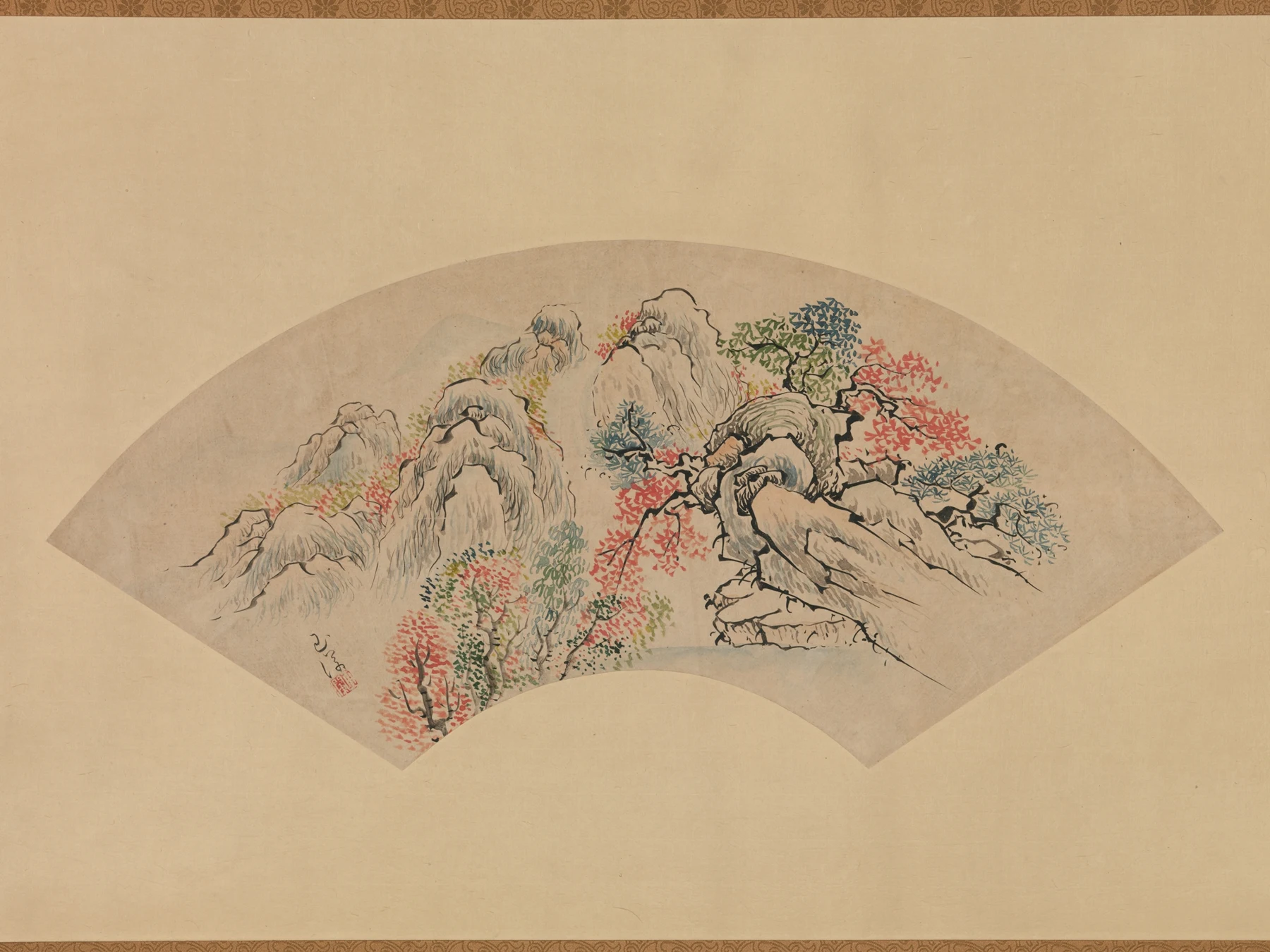
The companion Gyokuran fan belongs to eighteenth-century Japan, a different context explored in its own essay. Set its broad curved field beside Chen Shu’s tall scroll to compare formats. This pairing asks how a support guides looking; it does not establish a connection between these individual works.
Observation, quotation, transformation
- Draw a real twig or houseplant for ten minutes using your ordinary materials. Write the date and subject in your own handwriting.
- Make a small diagram of Chen Shu’s scroll showing only the positions of branch, bird and inscription. Label it as a study after Chen Shu.
- Paint your plant again in a tall format, borrowing only the idea of separated zones of attention. Choose your own colour and line decisions.
- Compare the two studies. Note one change caused by the format and one historical question to follow through the museum sources.
Make this a study of your own subject. These are our practice prompts, not a claim to reproduce an artist’s exact method.
Take a practice sheet →- Gyokuran and Japanese Nanga: poetry, company and a painted fan
- When words grow leaves: William Blake’s painted poems
- Walking into a painting: Kurosawa, Van Gogh and the moving eye
Keep looking
- The Met: Landscape Painting in Chinese Art
- The Met: Learning to Paint in Premodern China
- National Palace Museum: Women’s Painting in the Late Ming and Early Qing
- The Met: Chen Shu, Cockatoo, 1721
Sources support the factual context; looking notes and exercises are Watercolourist editorial interpretation.
What happened on your paper?
One useful observation beats “lovely work”. Show a study, ask about a decision, or tell us where you disagree.
Join the studio discussion