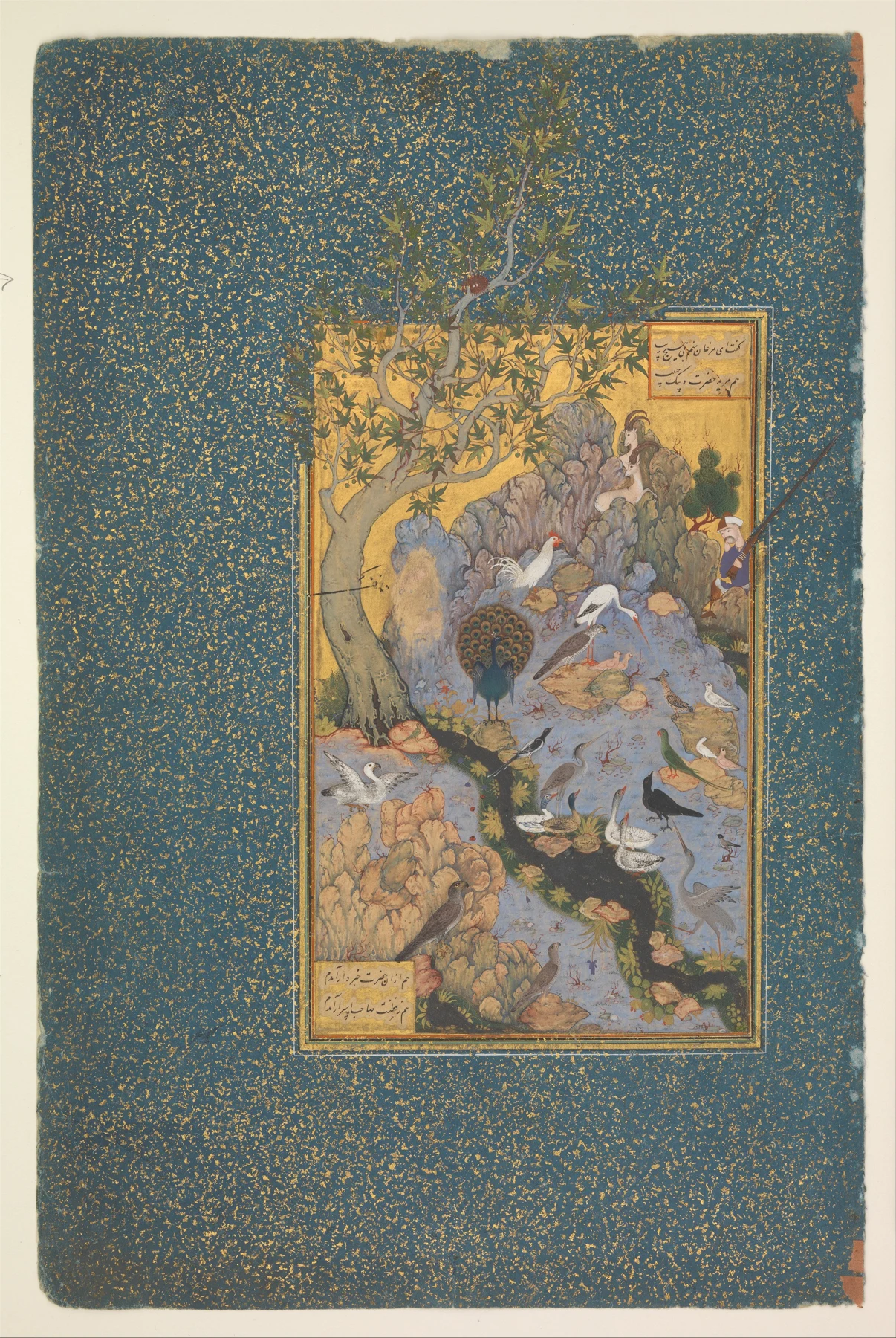
- Distinguish the decorative margin, the inner scene and the text compartments before following individual birds.
- Find the hunter at the right edge and remember that the museum distinguishes him from the poem’s narrative.
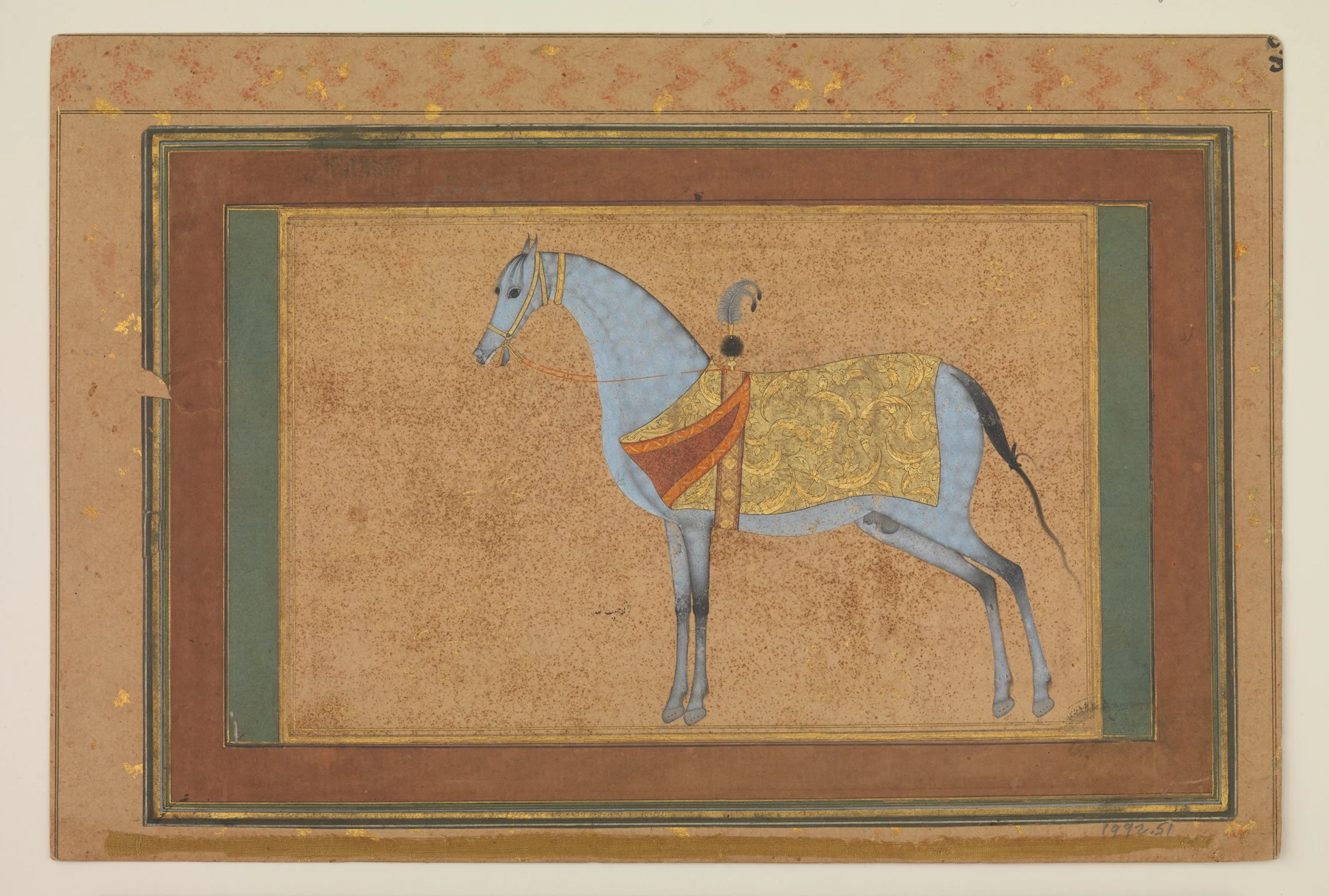
- Compare the distributed attention of the birds’ gathering with the concentrated animal form in the separate Stallion.
These observations describe what is visible, not how the artist made the painting.
Start with the book, not the isolated rectangle
A museum reproduction can make a manuscript page look like an independent easel painting. Return the book to your imagination and the questions change. Where does this page sit in the text? Who commissioned the volume, wrote its words, painted its figures and prepared its binding? Smithsonian’s account of Islamic book arts describes collaboration among calligraphers, painters, illuminators and binders, often within a royal or princely library-workshop. A librarian could coordinate the work to a patron’s requirements. The finished object combined different kinds of expertise. The painter’s name matters, but it does not mean the whole book sprang from one pair of hands.
Materials made reading a rich experience
Book painters worked with pigments from several sources and binding media such as gum arabic; luxury production could include gold, silver and costly blue materials. Habiballah’s Concourse of the Birds is specifically catalogued as ink, opaque watercolour, gold and silver on paper. That precision matters. Water-based painting has histories of dense colour and metallic brilliance as well as transparent washes. On this page the broad ornamented margin, inner picture and text compartments establish distinct zones of attention. We can notice how differently each zone asks to be read without pretending that a screen reproduces the physical behaviour of metal or the intimacy of turning a page.
A poem about spiritual seeking
The illustration accompanies Farid al-Din ‘Attar’s Mantiq al-Tayr, often called The Conference of the Birds. In this Sufi poem, the hoopoe urges the birds towards a difficult spiritual quest. Thousands begin; thirty finally reach the Simorgh, and a play on the Persian words for thirty birds helps express their discovery of themselves in what they sought. The Met’s discussion by Maryam Ekhtiar and Leili Anvar places this ending within the poem’s search for divine unity. It is more than a charming animal gathering. Understanding that purpose gives the birds’ assembly a gravity which an account concerned only with decorative colour would miss.
One manuscript can contain several moments
The Met’s manuscript contains sixty-six folios and illustrations from both the fifteenth and seventeenth centuries. Habiballah’s painting, dated about 1600 and attributed to Isfahan, was added roughly a century after the earlier manuscript work. A book’s history can therefore involve later additions, not just one original commission. The museum notes a hunter with a firearm who is outside the poem’s narrative, helping distinguish this image from an earlier date. We should not turn every visible figure into a character from the text. Sometimes the painting records its own moment of making as well as the older story it accompanies.
Different purposes under one artist’s name
The accompanying Stallion, dated about 1601–6 and attributed to Herat, is a separate work by Habiballah, not another page from this poem. Its concentrated animal form makes a useful comparison with the densely populated Concourse. In the horse picture, much of our attention collects around one body and its elaborate equipment; in the birds’ scene it circulates among many creatures and landscape passages. That contrast is our editorial reading, not a proposed influence or a recovered instruction from the artist. It shows why a painter’s name alone cannot tell us what a particular picture was designed to do.
Borrow the question of sequence
For contemporary practice, the book offers a different challenge from filling one sheet impressively. How does an image behave beside words, and what changes when a second page follows? A small folded booklet makes those decisions tangible. Use an ordinary event of your own rather than borrowing sacred language as decoration. Let one page establish a place, another develop an action and a final page alter the mood. This exercise investigates pacing and collaboration between text and image. It does not reproduce Persian manuscript materials, workshop labour or the spiritual experience of reading ‘Attar.
A three-scene painted booklet
- Fold a sheet into a small booklet and choose an ordinary event you can describe accurately, such as a walk before rain. Write three short original sentences.
- Assign one sentence to each of three pages and plan different balances of text, image and margin. Make miniature layouts before painting.
- Paint with your usual watercolours, adding opaque passages only if useful. Repeat one colour to connect the sequence while varying the density of each scene.
- Read the booklet in order, then reverse it. Note how sequence changes the meaning and credit the historical manuscript that prompted this modern exercise.
Make this a study of your own subject. These are our practice prompts, not a claim to reproduce an artist’s exact method.
Take a practice sheet →- A painting you turn: Ethiopian books, reading and prayer
- Nauny's scroll: a picture intended to do something
Keep looking
- Smithsonian National Museum of Asian Art: The Arts of the Book
- The Met: Spotlight — Seeking Unity with the Divine
- The Met: Habiballah, The Concourse of the Birds
- The Met: Habiballah, A Stallion
Sources support the factual context; looking notes and exercises are Watercolourist editorial interpretation.
What happened on your paper?
One useful observation beats “lovely work”. Show a study, ask about a decision, or tell us where you disagree.
Join the studio discussion