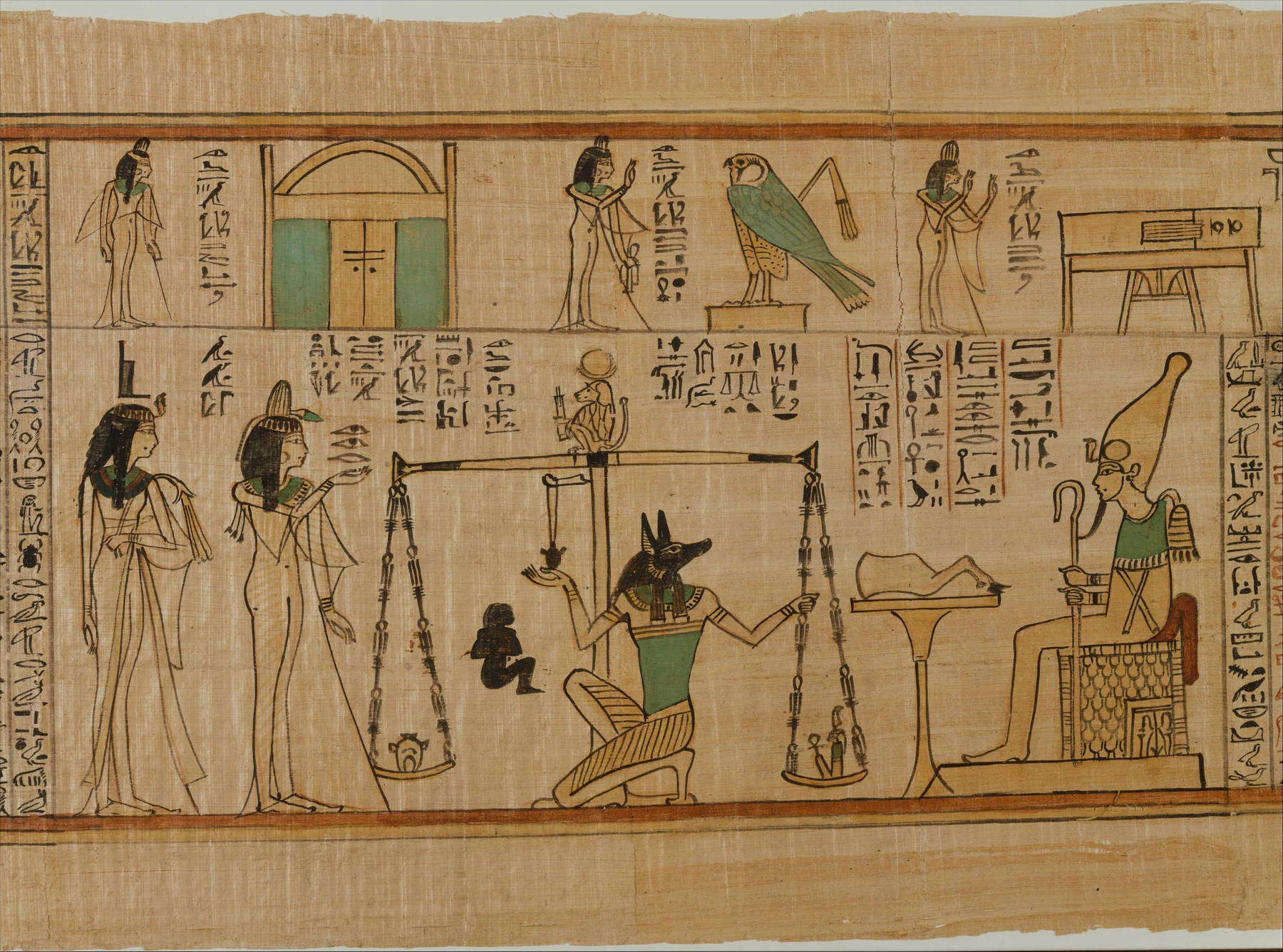
- The long beam of the scales spans the central portion of the judgment detail.
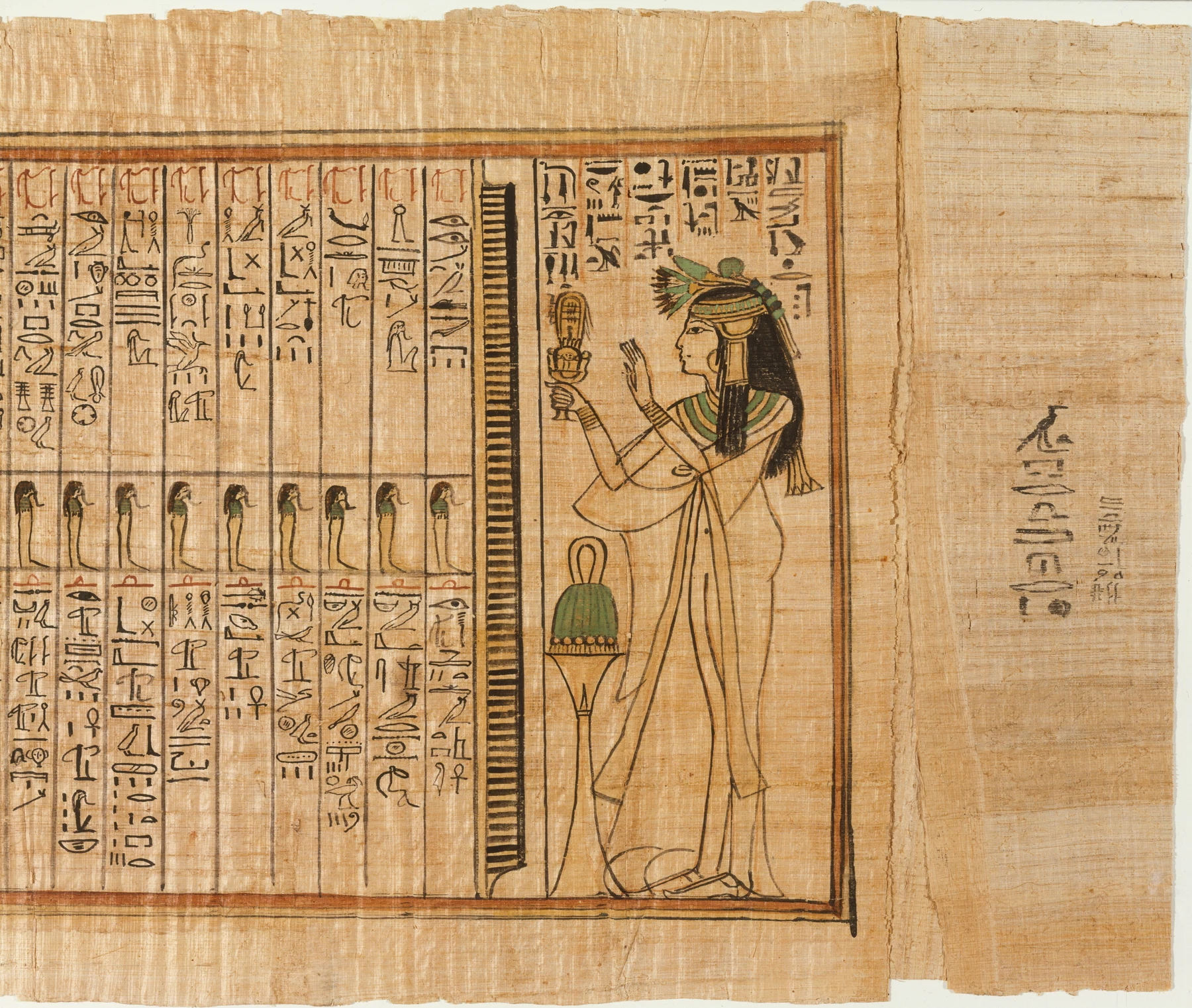
- The second detail places a tall figure beside closely spaced columns of writing.
- Warm fibres, joins and surface variation remain visible around the black lines and selected green areas.
These observations describe what is visible, not how the artist made the painting.
A named woman, an unnamed maker
Nauny's painted papyrus, made around 1050 BCE, belonged to her burial equipment at Thebes. She was a chantress of Amun-Re: a woman with a named religious role. That makes her an identifiable owner and participant in the represented world. It does not identify her as the person who drew or painted the scroll. Keeping owner, subject and maker separate is a small but essential discipline in art history.
The Met records that the scroll was contained inside a hollow wooden figure of Osiris. Unrolled, it extends beyond seventeen feet. The two reproductions here are details of that larger object, not two separate paintings. Think of the difference between examining one illustrated page and understanding a whole book. Our convenient crops provide access while also concealing the scale and physical sequence of the original.
The Book of the Dead was not one fixed book
Getty describes the Book of the Dead as an evolving collection of ritual spells, selected and combined in individual manuscripts. Its familiar modern name can suggest a single standard volume, but the material history is more varied. These writings and images were intended to assist the deceased in the afterlife. Reading them as mere illustrations to a strange story misses the work they were understood to perform.
This distinction changes a useful question. Instead of asking only whether the image convincingly resembles a visible event, ask how figures, names and actions establish an effective relationship. Repetition can identify the same person in different episodes. A clear gesture can matter more than a plausible shadow. We need not share the ancient beliefs to take their importance seriously, just as we need not treat every painted surface as an audition for modern realism.
A surface made from a plant
Papyrus is materially different from a modern cotton watercolour sheet. The Met's conservation account explains that strips of the plant's inner pith were laid in crossing layers to form sheets. Sheets could then be joined into a roll. The precise ancient pressing and drying procedure is not fully established, so a confident modern reconstruction should not be mistaken for complete historical knowledge.
The object's catalogue medium is papyrus and paint. That description does not identify a present-day watercolour formulation or prove a particular pigment recipe. Look at the visible fibrous structure and joins in these photographs: the support is active in our encounter with the marks. The line has a different visual company from the clean white sketchbook page. Understanding the surface is a better first step than trying to match the green in a modern colour chart.
Judgment, sequence and the rhythm of looking
The main detail shows Nauny's heart weighed against Maat before Osiris. In the Met's explanation, the balanced scales affirm an ethical life and her fitness for the afterlife. It is a represented successful judgment, not a suspense scene whose outcome we must invent. The composition gives the balance a long horizontal reach, with figures distributed around it.
Compare the second detail, where a tall standing figure occupies a narrow compartment beside densely arranged writing. The difference in pace is striking: repeated text columns lead into a much larger figure. In the judgment scene, the larger lower band and smaller upper episodes offer another division of attention. These are our observations of arrangement, rather than translations of the inscriptions.
A useful modern experiment is to make image and words responsible for different information. Let a drawing explain a physical relationship while a short note supplies a name or sequence. If both merely repeat the same thing, reconsider the page. There is room for cooperation here; the caption need not arrive late and squeeze itself beneath the furniture.
Words and pictures with different responsibilities
- Choose an ordinary process you understand, such as repotting a plant. List three stages in your own words.
- Plan a horizontal strip with one large drawing and two smaller episodes, leaving deliberate spaces for writing.
- Use ink and one watercolour. Let drawings show positions and gestures; let the notes give information that is difficult to see, such as timing.
- Cover the text, then cover the drawings. Identify what each contributes and remove one unnecessary repetition. Use your own lettering and subject throughout.
Make this a study of your own subject. These are our practice prompts, not a claim to reproduce an artist’s exact method.
Take a practice sheet →- A painting you turn: Ethiopian books, reading and prayer
- Persian manuscript painting: a whole world inside a book
Keep looking
- The Met: Nauny's Book of the Dead, burial context and judgment scene
- Getty: What Is the Egyptian Book of the Dead?
- Getty: The Egyptian Book of the Dead, exhibition introduction
- The Met: Papyrus-Making in Egypt, materials and reconstruction limits
Sources support the factual context; looking notes and exercises are Watercolourist editorial interpretation.
What happened on your paper?
One useful observation beats “lovely work”. Show a study, ask about a decision, or tell us where you disagree.
Join the studio discussion