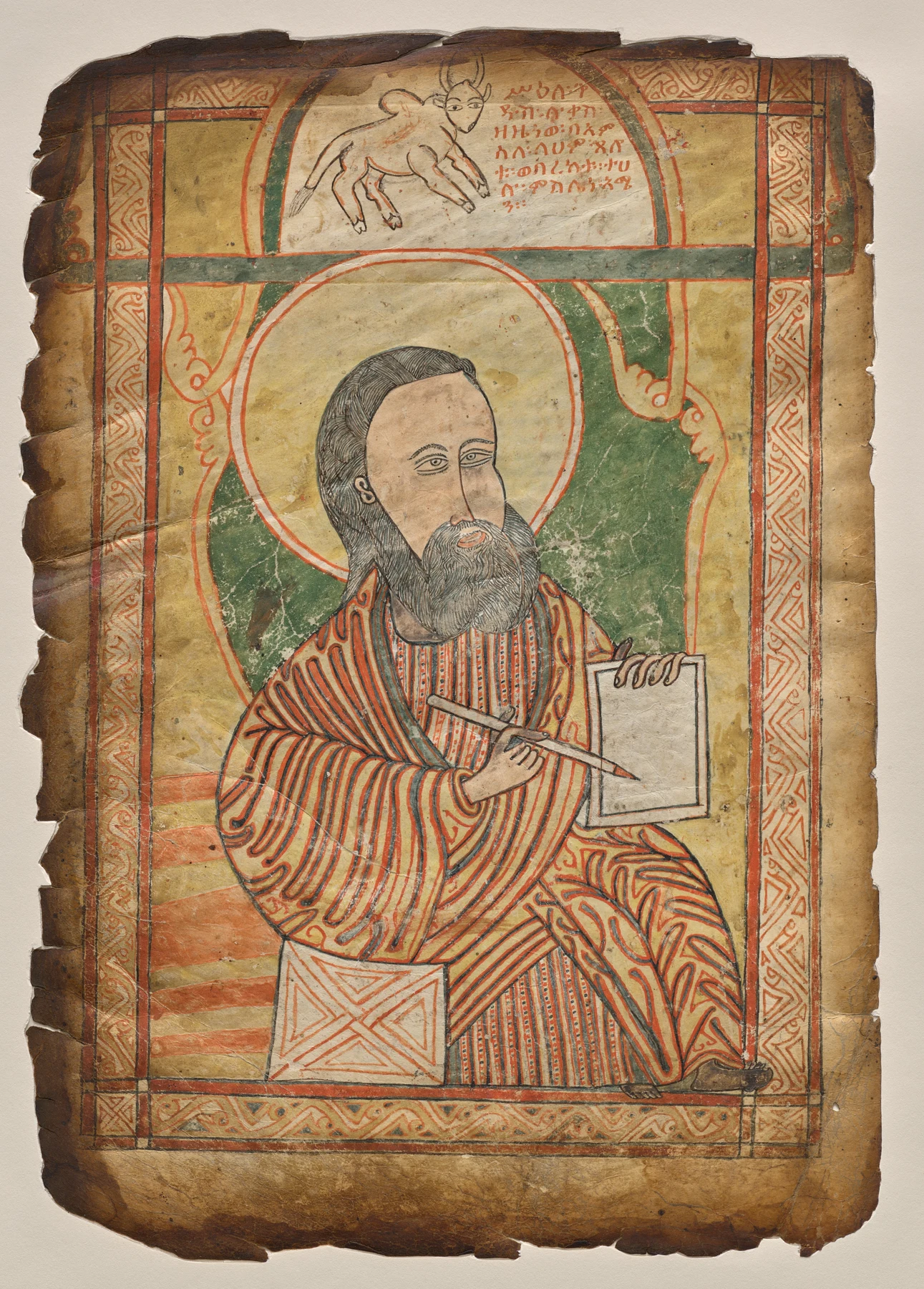
- Luke's pale writing surface contrasts with the closely striped garment beside it.
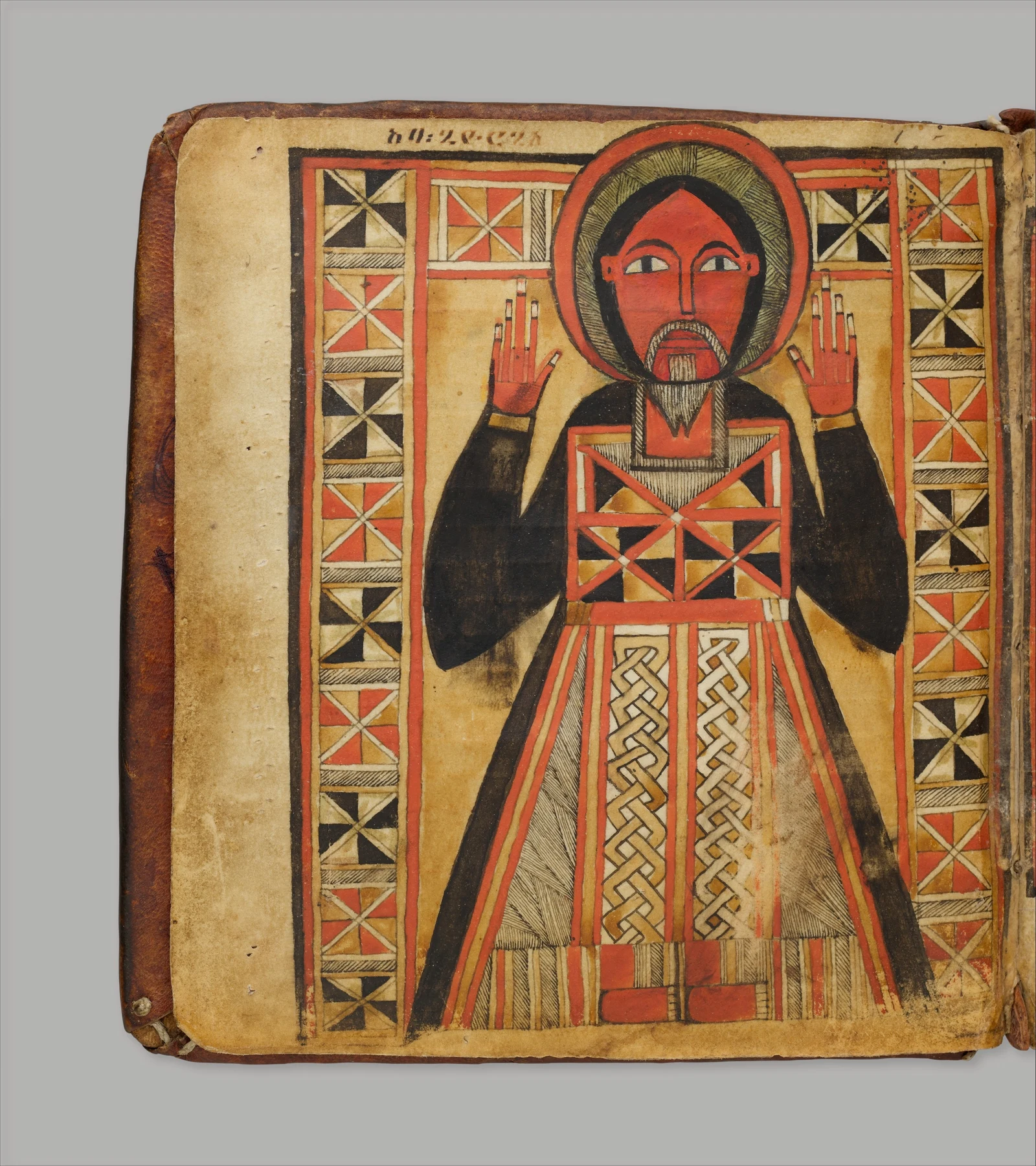
- Giyorgis's raised hands balance each other around a strong central axis.
- The later illumination repeats triangular divisions in both its border and central garment.
These observations describe what is visible, not how the artist made the painting.
Begin with a book, rather than a framed rectangle
A screen makes a manuscript page look conveniently independent: one image, neatly displayed, ready for our opinion. A book asks for another kind of attention. Pages arrive in sequence; words and pictures share a physical object; handling, reading and returning are part of the encounter. These Ethiopian examples invite us to put that larger object back into the picture. Their borders organise an act of attention as well as an attractive surface.
Christianity has a history in Ethiopia extending to the fourth century. The Met's account of an Ethiopian Gospel leaf places that tradition in contact with Christian communities in Egypt and Syria and with the Byzantine world. This is an African Christian history with its own institutions and visual traditions. Treating the manuscripts as peripheral copies of European art would give us the wrong starting point before we had even opened the book.
Luke: an image of writing inside a written work
Cleveland dates the Saint Luke leaf to about 1440–80 and locates it in the Tigray region of the Ethiopian Empire. Ink and tempera sit on vellum. The evangelist's ox appears above him; the inscription uses Ge‘ez, the church's liturgical language. The museum does not identify the maker. These are specific facts about a Gospel-book leaf, not a licence to label every Ethiopian manuscript alike.
Notice the doubled act of writing: we look at marks on a page while Luke holds a writing implement beside a pale rectangular surface. His hand directs attention towards that small clear area. Around it, the curving garment is densely striped. To my eye, the relatively quiet writing surface becomes a focus precisely because the robe has so much movement. The image makes authorship visible without requiring naturalistic depth to carry the argument.
A later prayer book has a different task
The late-seventeenth-century Arganonä Maryam, or Organ of Mary, is a book of Marian prayers. Its pictured holy man is Abba Giyorgis of Sägla, traditionally credited with the text. The Met explains that this volume divides prayers by days of the week: labelled ornamental borders help its owner find the appropriate prayer. Decoration therefore participates in navigation. A beautiful border can also tell someone where they are.
The attribution needs care. Baselyos names himself as scribe, but the relationship between that scribe and the illuminator called the Ground Hornbill Master remains debated; a workshop is another scholarly possibility. We retain the museum's 'attributed to' rather than tidying away uncertainty. The binding includes wood and leather around parchment leaves. Its bodily presence differs from both the detached Luke leaf and our flat digital view.
Read continuity without erasing change
Put the images together and compare the hands. Luke's gesture turns towards a task; Giyorgis raises both palms within a broadly frontal arrangement. His sleeves form large dark areas beside a patterned central garment. The pages offer different relationships between figure, writing and enclosure. Their shared religious setting does not make them interchangeable, and the later page need not be graded as a step towards more convincing perspective.
For a painter, the productive question is how an image serves the object carrying it. A journal, a prayer book and a gallery picture invite different behaviour. Try designing a small sequence before worrying about an isolated masterpiece. Let one page introduce, another explain and another slow the reader down. This exercise borrows a design question, not sacred imagery or a historical recipe. The paintbox can contribute without appointing itself an expert in several centuries of Ethiopian devotion.
Three pages with three jobs
- Fold a sheet into a small booklet and choose a secular subject you know: making tea, a local walk or caring for a plant.
- Give three pages distinct purposes: introduction, sequence and reflection. Reserve text areas before drawing.
- Use two watercolours and ink, repeating one invented border element while changing its size or placement to signal each page's purpose.
- Ask a reader to turn the pages in order. Note where they pause or lose their place, then revise one visual cue.
Make this a study of your own subject. These are our practice prompts, not a claim to reproduce an artist’s exact method.
Take a practice sheet →- Nauny's scroll: a picture intended to do something
- Persian manuscript painting: a whole world inside a book
Keep looking
- Cleveland Museum of Art: Saint Luke leaf, date, materials and Ge‘ez
- The Met: Arganonä Maryam, devotional organisation and attribution debate
- The Met: Double-Sided Gospel Leaf, Ethiopian Christianity and international connections
Sources support the factual context; looking notes and exercises are Watercolourist editorial interpretation.
What happened on your paper?
One useful observation beats “lovely work”. Show a study, ask about a decision, or tell us where you disagree.
Join the studio discussion