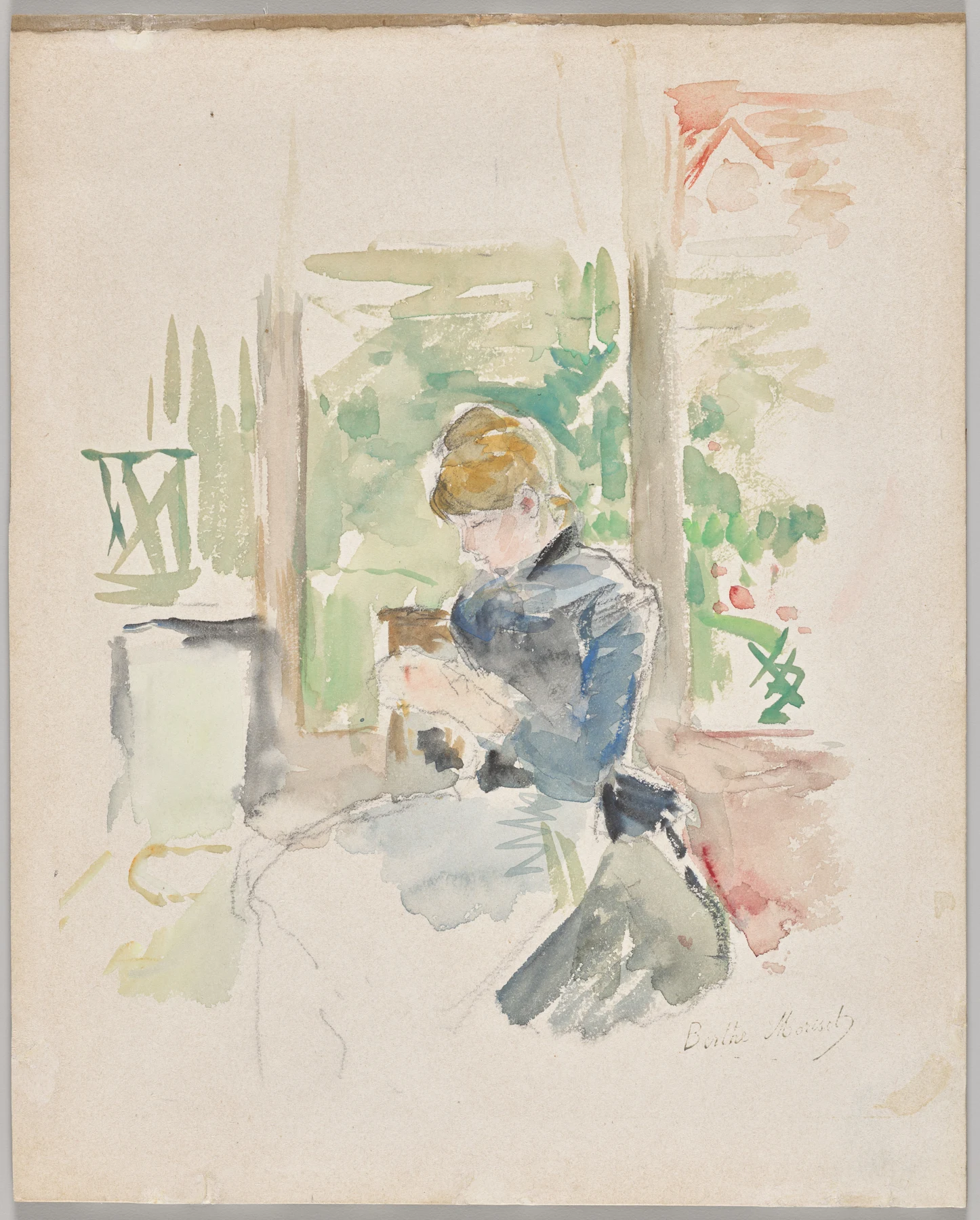
- Morisot gives the blouse and head stronger definition than the lower skirt.
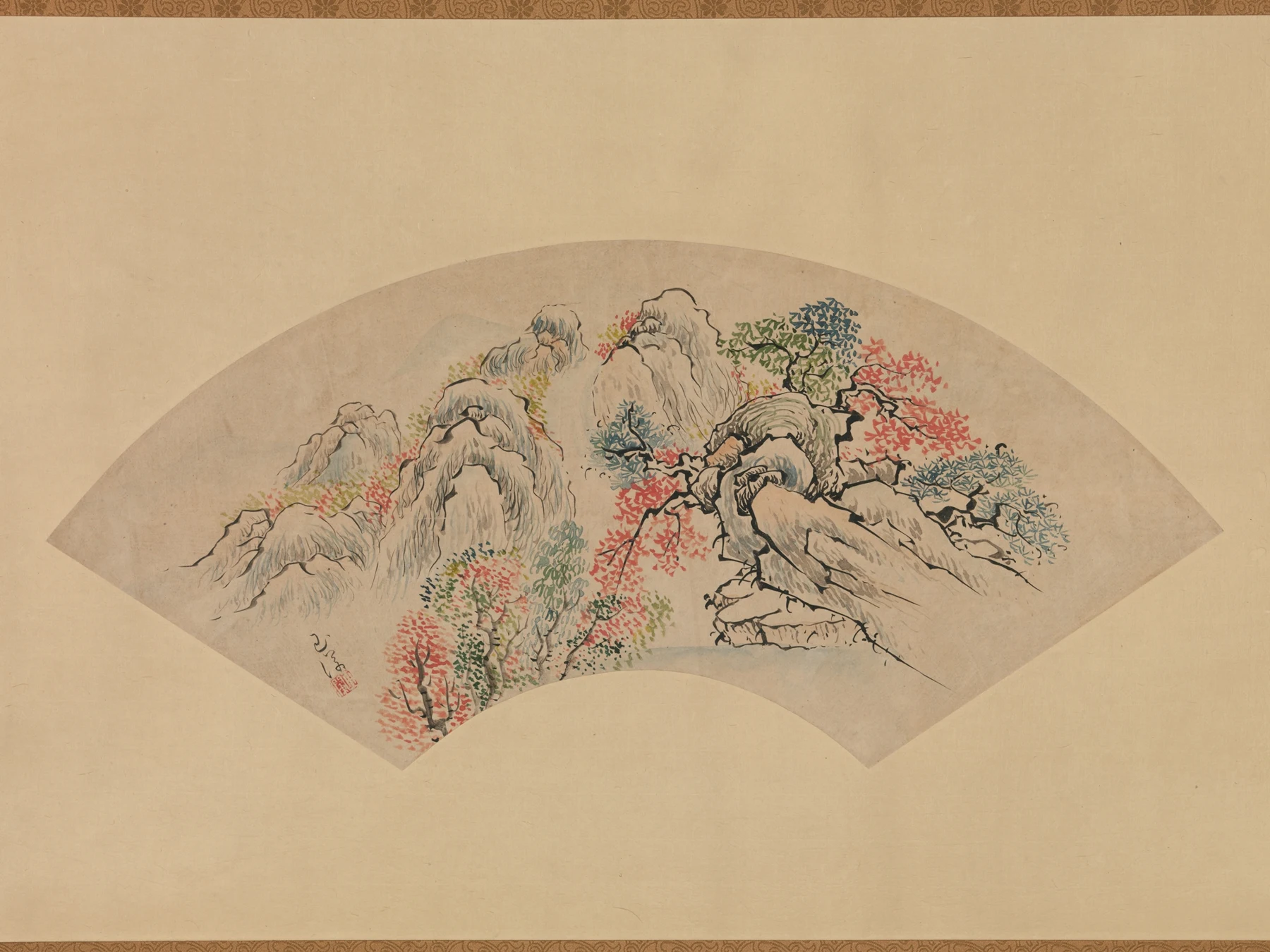
- Gyokuran places the darkest angular branches towards the right of the fan.
- Compare how the rectangular window structure and the fan's curved edges guide attention in different ways.
These observations describe what is visible, not how the artist made the painting.
Talent needs somewhere to work
An artist's career involves more than the dramatic moment when brush meets paper. Training, materials, time, working space and people who take the work seriously all matter. Berthe Morisot in nineteenth-century France and Ike Gyokuran in eighteenth-century Japan offer two specific routes through that problem. Their lives belong to different societies. Putting them together is an editorial comparison of access, not a claim of influence or a single shared experience of being a woman artist.
It also widens what we mean by an institution. A state art school is one kind; a regular exhibition is another. A family business, a poetry circle or a teaching relationship can also sustain artistic life. Asking which doors existed, and who could pass through them, gives us more than a roll call of exceptional individuals. The paint did not arrange its own lessons.
Morisot: privilege and exclusion in the same career
The Musée d'Orsay explains that Morisot's wealthy family could provide private tuition and a garden studio while women remained excluded from the entrance examination of the École des Beaux-Arts. The school opened admission to women in 1897, after her death. She and her sister Edma nevertheless exhibited at the Salon from 1864. Access was therefore uneven rather than simply present or absent: economic advantages supported a route around a formal barrier.
Morisot then helped make another public setting for art. The Met describes her central contribution to the Impressionist group and the organisation of its exhibitions. This places her among the people creating the movement's opportunities, rather than merely receiving an invitation into someone else's achievement. Institutions are made by people, and participation can include changing where work is seen.
Gyokuran: poetry, teaching and a working household
Gyokuran's route cannot be explained by importing the rules of a Parisian academy. The Met describes her upbringing in Kyoto, where her family ran a tea shop and her mother and adoptive grandmother published waka poetry. Kyoto National Museum identifies her training in poetry within that family and her painting studies with Yanagisawa Kien. It also records the popularity of her paintings during her life and afterwards.
Her marriage to the painter Ike Taiga formed part of this creative world, but it did not create all of it. Naming the earlier women poets and her teacher makes the network more visible. The Met places the couple's home and studio near Gion Shrine. Our comparison concerns the cultural support around a practice; it does not claim that this setting offered every woman the same opportunities or that a family connection automatically guaranteed success.
Return to the work before writing the verdict
Morisot's Sewing near the Window, about 1885, depicts Pasie, her daughter Julie's nanny. Cleveland identifies it as a preparatory watercolour for a later composition. The blue blouse and bowed head receive firmer attention than the broad pale skirt. The nearby window bars remain legible while much of the surrounding space is lightly stated. To my eye, these decisions make the act of sewing more insistent than a detailed inventory of the room.
Gyokuran's Autumnal Landscape with a Waterfall, from the second half of the eighteenth century, is ink and colour on a fan mounted as a scroll. Here we can follow small colour clusters through the mountains, then meet the much darker angular branches at the right. A curved format and a rectangular domestic study produce different movements of attention. Neither image is evidence of an inherently feminine brushstroke.
Historical context should sharpen looking without swallowing the work. Ask both how these artists gained the means to practise and what they did with those means. Then apply the question locally: which people, spaces and routines help your own work develop? A dependable meeting for looking at paintings can be a more useful investment than another heroic promise to become disciplined on Monday.
A study, a conversation and a second attempt
- Choose a familiar interior or landscape and make a ten-minute study, concentrating detail in just one area.
- Write two questions about the picture: one about where the eye goes, one about what remains unclear.
- Discuss it with a willing fellow painter or friend, recording what they actually notice rather than asking whether it is good.
- Make a second study changing one decision. Note which part of the exchange helped, and choose one realistic way to repeat that kind of support.
Make this a study of your own subject. These are our practice prompts, not a claim to reproduce an artist’s exact method.
Take a practice sheet →- A valley and a streetcar: two ways to picture Mexico
- Indian natural-history painting: artists, animals and the patron’s eye
Keep looking
- Musée d'Orsay: Morisot's private education, family resources and Salon participation
- The Met: Women Artists in Nineteenth-Century France
- Cleveland Museum of Art: Sewing near the Window, sitter and preparatory function
- The Met: Gyokuran's Autumnal Landscape, family background and object format
- Kyoto National Museum: Gyokuran's poetry, painting training and reception
Sources support the factual context; looking notes and exercises are Watercolourist editorial interpretation.
What happened on your paper?
One useful observation beats “lovely work”. Show a study, ask about a decision, or tell us where you disagree.
Join the studio discussion