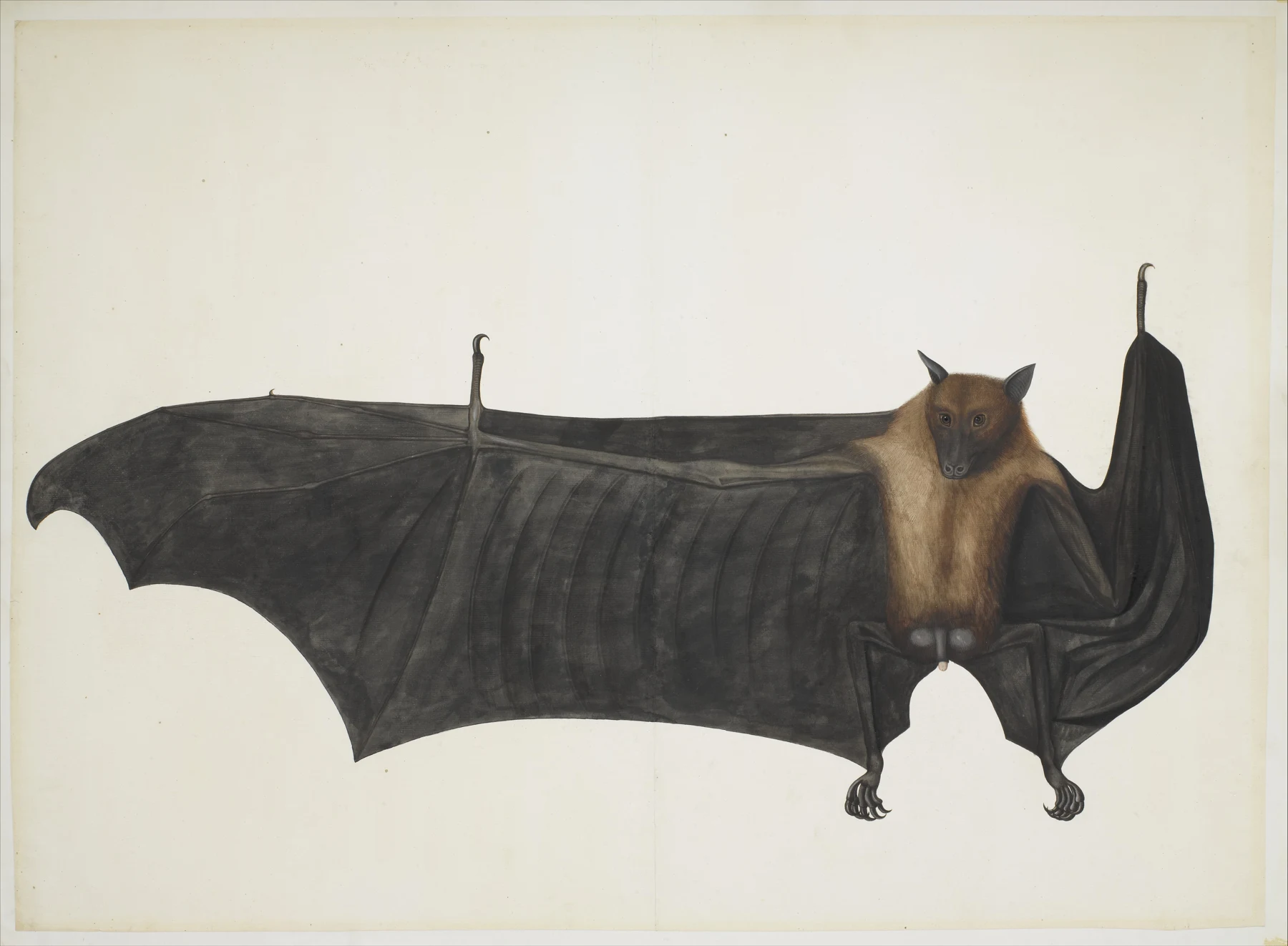
- Distinguish the spread wing’s fine structural lines from the short marks that describe the bat’s fur.
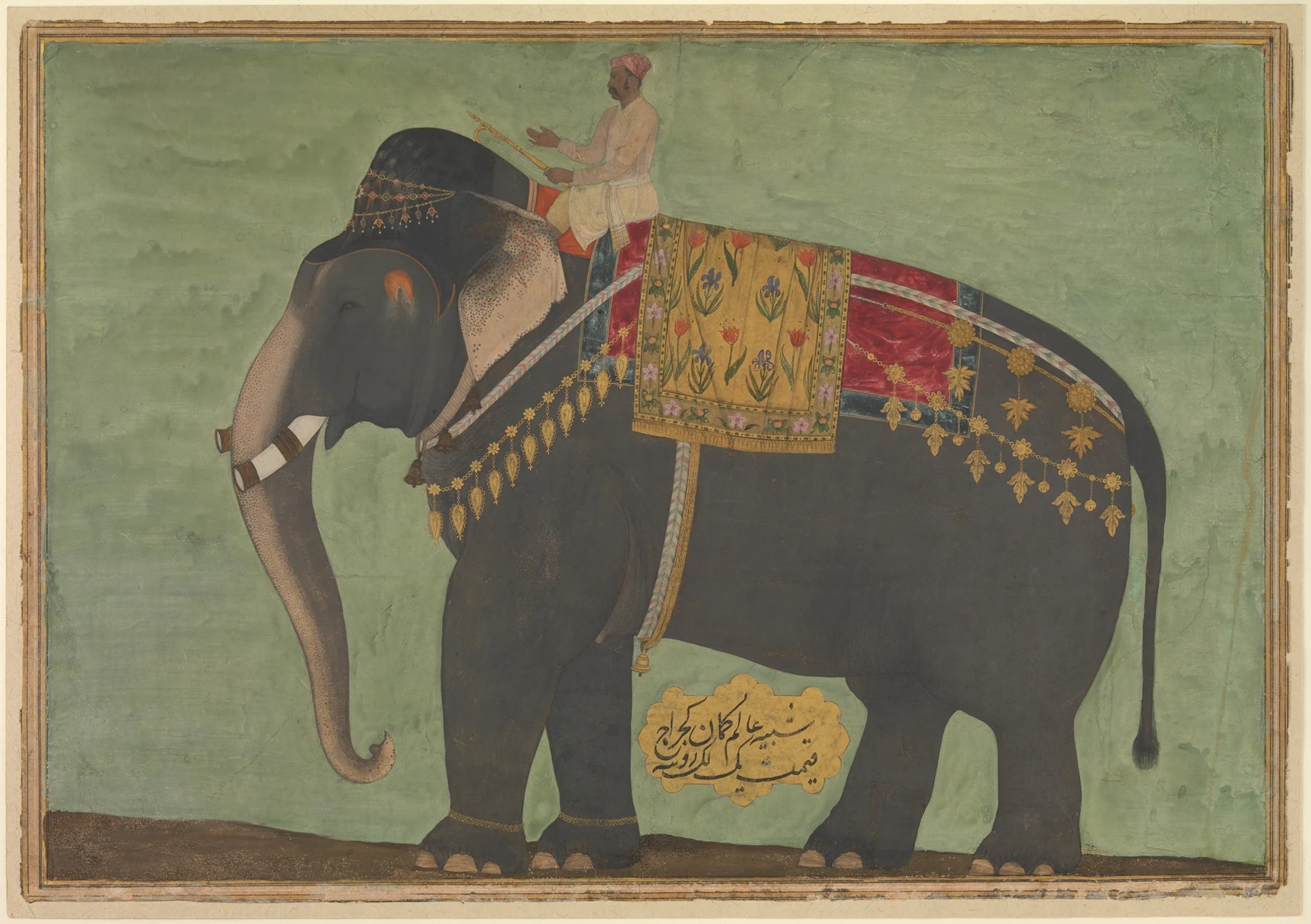
- Compare what the pale grounds omit and what the elephant’s rider and equipment actively tell us.
- Read the attribution and medium alongside the image; neither is safely inferred from appearance alone.
These observations describe what is visible, not how the artist made the painting.
Animal painting already had a distinguished history
Indian artists did not begin observing animals when British collectors arrived. Portrait of the Elephant ‘Alam Guman, attributed to Bichitr and dated about 1640, belongs to Mughal court painting. The Met identifies its subject as one of eighteen elephants from Mewar presented to Jahangir in 1614. An inscription records the animal’s considerable value. This is a particular elephant within a history of royal possession and exchange. Its careful portrayal can therefore be read alongside the court’s interest in rank, wealth and memorable individuals. Observation and power already share the page before we reach colonial natural-history albums.
New patrons commissioned existing expertise
In Calcutta, now Kolkata, Mary, Lady Impey commissioned natural-history studies between 1777 and 1782. The Ashmolean identifies three Mughal-trained artists involved: Shaikh Zain ud-Din, Bhawani Das and Ram Das. The Impeys kept an aviary and menagerie; by their departure in 1783 the artists had made more than two hundred studies, largely of birds, on imported English paper. These names and skills belong at the centre of the story. The patron supplied an important setting and demand, but the paintings required artists capable of turning prolonged attention into extraordinarily articulate images. An album named after its owner can obscure that distinction.
Company painting is a broad label
The term Company painting groups work made by Indian artists for people associated with the British East India Company. The Met’s historical survey describes varied regional practices, not one uniform style: subjects included buildings, occupations, possessions and natural history. Later, some artists also produced sets for a wider market. This was a changing field of employment within expanding colonial rule. Appreciating its paintings need not mean treating that setting as neutral. At the same time, a general label cannot tell us every artist’s circumstances or every commission’s terms. Start with the evidence for the particular work rather than supplying a complete story from the category alone.
Keep the question mark beside Bhawani Das
The Met dates Great Indian Fruit Bat to about 1777–82 and attributes it to Bhawani Das or a follower. Its relationship to a known painting supports the attribution, but does not settle authorship. Nor should the wider Impey history be used to certify this specific sheet as one of their commissions. Its medium is pencil, ink and opaque watercolour on paper: an immediate reminder that the category includes more than transparent washes. Keeping those qualifications visible does not diminish the painting. It distinguishes a compelling visual encounter from claims about authorship and ownership that the surviving evidence cannot fully resolve.
Two animals, two kinds of attention
In the bat image, a largely empty ground exposes the asymmetry of spread and folded wings. Membrane, supporting structures and fur demand different marks. The elephant, by comparison, carries richly patterned equipment and a rider, setting its body within a visible relationship of service and display. Our comparison is interpretive: it does not establish that the bat’s painter studied Bichitr’s sheet. It asks what each presentation makes readily available to the viewer. One encourages sustained inspection of bodily structure; the other combines an individual animal with signs of status. Neither picture is simply an unedited window onto nature.
Let the caption share the work
A modern observational study can make its own circumstances legible. Record what you actually observed, whether you used a photograph, and what remains uncertain. Then change the presentation and see how the implied purpose shifts. A pear isolated against pale paper reads differently from the same pear beside a price label, plate or hand. This small exercise cannot recreate the politics of a historical commission, but it reveals how framing directs attention. Careful looking includes the painted subject, the person making the image and the information supplied around it. A beautifully controlled wash is only part of that responsibility.
One subject, two purposes, honest labels
- Choose a fruit, seedpod or fallen leaf you can inspect directly. Paint it on a plain ground, prioritising three observable structural features.
- Write a caption naming your subject where known, the date, materials and any uncertainty. Separate direct observation from information checked elsewhere.
- Make a second study with a contextual object, such as a plate, packaging or price label. Keep the subject similar in size so the framing can be compared.
- Place the studies together and write two sentences about their different implied purposes. Retain the full museum attribution when recording the historical bat that prompted the exercise.
Make this a study of your own subject. These are our practice prompts, not a claim to reproduce an artist’s exact method.
Take a practice sheet →- A valley and a streetcar: two ways to picture Mexico
- Who gets to become an artist? Morisot and Gyokuran
Keep looking
- The Met: Portrait of the Elephant ‘Alam Guman, attributed to Bichitr
- Ashmolean Museum: Lady Impey’s Indian Bird Paintings
- The Met: Company Painting in Nineteenth-Century India
- The Met: Great Indian Fruit Bat, Bhawani Das or a follower
Sources support the factual context; looking notes and exercises are Watercolourist editorial interpretation.
What happened on your paper?
One useful observation beats “lovely work”. Show a study, ask about a decision, or tell us where you disagree.
Join the studio discussion