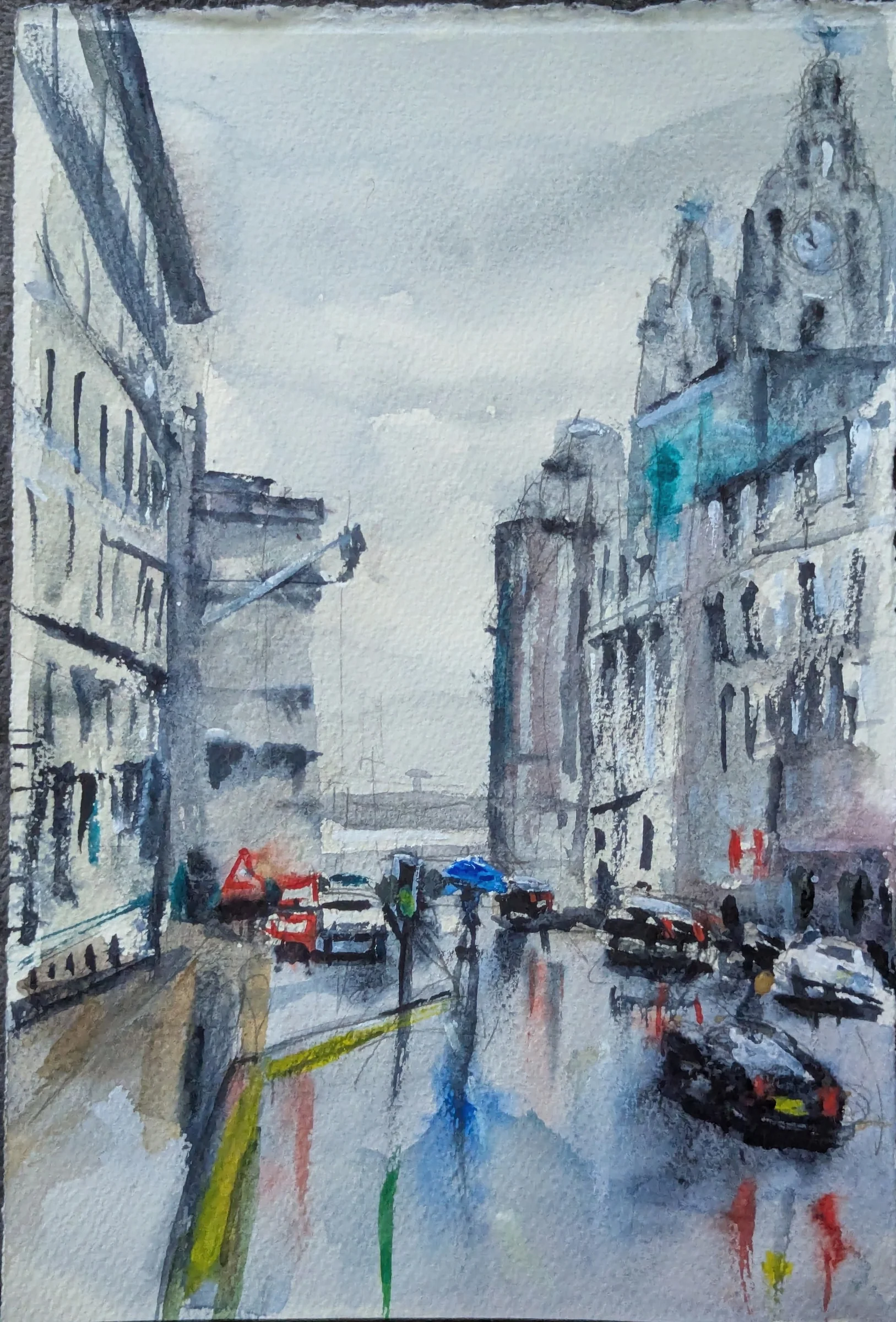
Start with the mark, then choose the brush
A brush is a small reservoir with a shape attached. Before deciding whether you need another one, ask what is failing: does a wash run out halfway across the roof, does the tip split, or does a long line end in a nervous succession of joins? Those are different problems. Buying a smaller brush for all three is how a five-minute tree becomes an administrative career.
Think in four qualities: capacity, release, point and spring. Capacity is how much liquid the head carries; release is how that liquid reaches the paper. A good point helps place an edge or finish a stroke. Spring is the resistance and recovery you feel when the head bends. A soft brush can be excellent at broad washes and less comfortable for someone who wants a firm push back. The useful combination depends on your hand and the scale of the picture.
The brushes Mark actually carries
Mark’s current bag contains the green Escoda travel set of three, plus a Rosemary & Co travel rigger and flat. The green Escoda set is a mixed synthetic selection, combining Último, Prado and Barroco fibres. Its variety matters more than a promise that one expensive hair will solve everything: it gives different shapes and responses to work with in a compact kit.
The rigger and flat add two distinct ways of drawing. A long, loaded rigger can carry a wire, branch or narrow accent through a passage. A flat can put down a broad plane, turn a corner, then use its edge for a thinner mark. Try that change of angle before reaching for another brush. The ferrule is allowed to turn; it has not signed a contract to face north.

One round can make several kinds of mark
With a pointed round, begin lightly, press to open the belly, then lift gradually. The resulting change from thin to broad and back is useful for leaves, figures and broken architectural shapes. Keep the hand moving while you change pressure. Stopping to negotiate each contour usually leaves a different mark from one continuous gesture.
Now make a roof or shadow with the side of the brush. A larger head can make a surprisingly precise boundary if its point holds and you have enough room to approach the edge. Conversely, a small head may require repeated reloading and encourage you to stitch a wash together. Brush numbers are not a dependable cross-brand measurement: compare the actual width and length of the head.
Synthetic and natural are choices, not ranks
Modern synthetic ranges include fibres designed for quite different purposes. Escoda’s mixed green set is a useful reminder that synthetic does not mean one stiff, uniform material. Natural-hair brushes also vary. Judge the particular head for carrying capacity, shape retention and feel, rather than assuming the word sable is a certificate of compatibility with your hand.
For a fair comparison, use the same mixture, paper and stroke length. Fully wet each brush, load it consistently and observe the result. Record how often you refill, whether the tip returns, and whether the line gets narrower as the head empties. Those observations tell you more about a working upgrade than the attractiveness of the case.
Look after the point you paid for
Rinse the head thoroughly after painting, working gently near the ferrule where colour collects. Do not leave the brush standing on its tip in the water jar. Reshape it lightly and let it dry with air around it. Travel caps protect the head in a bag; a damp brush still needs to come out and dry when you get home. Give masking fluid its own expendable tool.
The aim is a small set of familiar responses. Keep the brush that does the job, whether it was inexpensive or a considered purchase. If an upgrade lets you make a longer wash or a more assured edge, use that freedom in the painting. There is no obligation to celebrate by painting twice as many windows.
A brush audition, without buying a brush
- Choose two or three brushes you already own. Use one mixture and one sheet of your usual paper.
- For each brush make a broad rectangle, a thin-to-thick stroke and a long fine line. Reload consistently between tests.
- Note capacity, release, point and spring in your own words. Try the flat both face-on and edge-on.
- Paint a small roof, tree or doorway using only the brush that gave the most useful range. Keep the test beside the picture.
Make this a study of your own subject. These are our practice prompts, not a claim to reproduce an artist’s exact method.
Take a practice sheet →Keep looking
- Escoda: the mixed synthetic Green travel set
- Rosemary & Co: travel brush shapes and ranges
- Winsor & Newton: The best paintbrush hair for watercolour
- Winsor & Newton: How to clean watercolour brushes
Sources support the factual context; looking notes and exercises are Watercolourist editorial interpretation.
What happened on your paper?
One useful observation beats “lovely work”. Show a study, ask about a decision, or tell us where you disagree.
Join the studio discussion