A building with a clear argument
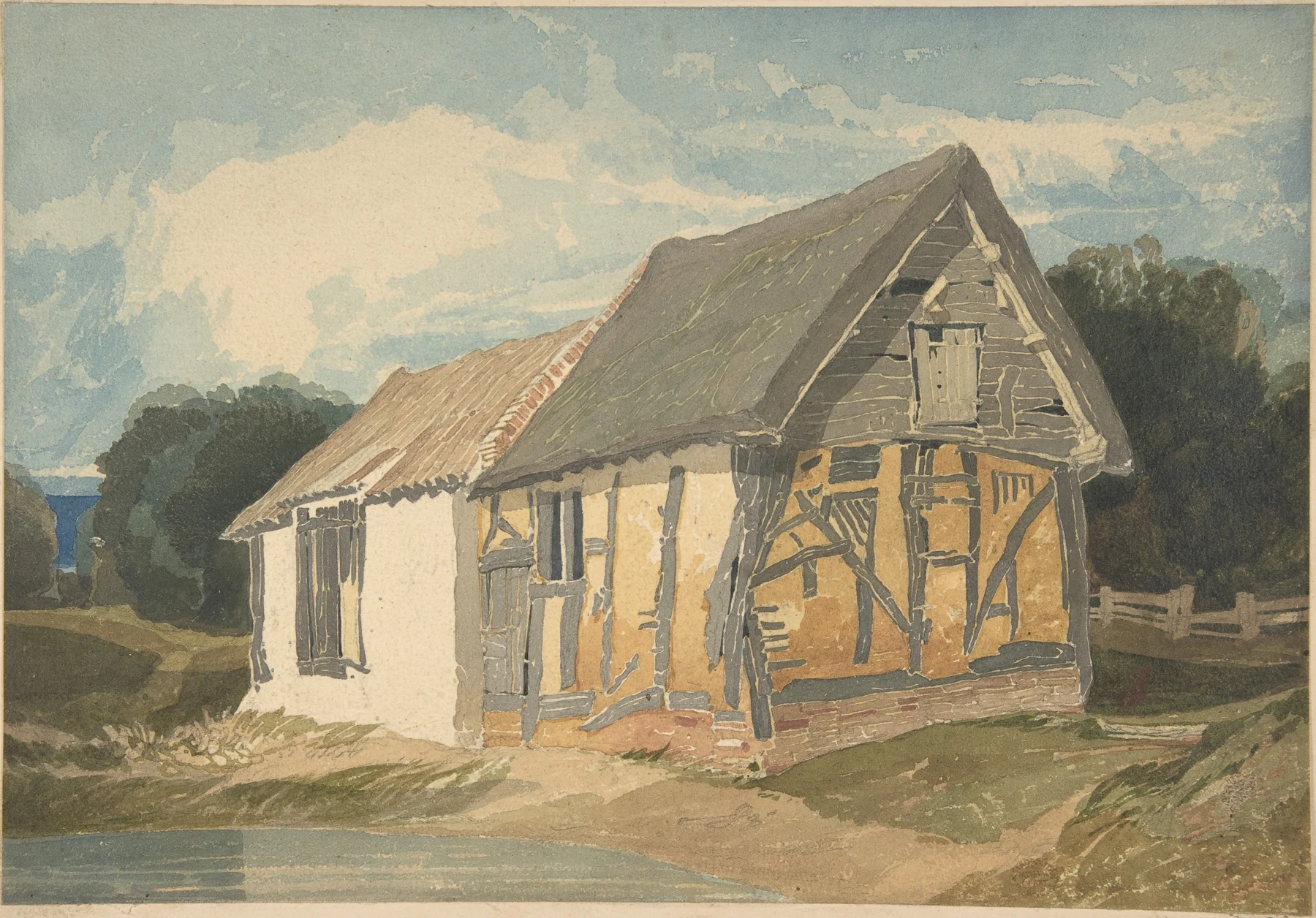
John Sell Cotman's Farm Building by a Pond has an immediately readable arrangement: a large roof, pale walls and dark foliage gathered behind. The Met dates it to around 1808–11, with some uncertainty. Its account connects small works of this kind with Cotman's teaching after his return to Norwich. Simplified forms were part of the work's usefulness to students, which makes it a particularly good picture to study with a sketchbook open.
Our eye goes first to the broad differences between roof, wall and trees. The timber details are enjoyable, but the building would still have weight without all of them. That is a useful standard for your own drawing. A convincing roof should not depend on the reader counting its tiles. Nobody has come round to inspect the planning application.
Reduce before you refine
Choose a shed, house or small group of buildings you can observe directly or from your own photograph. In a thumbnail, give yourself five shapes: sky, roof, lit wall, shadow and ground. Fit the subject into those groups before adding doors or windows. If the arrangement feels awkward at that size, adjust your crop or viewpoint while changing it is still easy.
Paint the thumbnail with one colour in three strengths. Let adjacent shapes dry when you need a clear boundary; connect them while damp when a softer joining makes sense. This is our exercise in organising value, not an attempt to prescribe Cotman's exact method. Once the small plan reads, carry its relationships into a larger colour study.
Keep the texture on a short lead
Texture can quickly break a clear wall into a swarm of marks. Begin with the wall's overall value and only add the structural lines that explain its plane or character. Put one cluster of detail near the area you want noticed, then leave a quieter stretch alongside it. Those less insistent areas make the detailed passage easier to enjoy.
Use the point of the brush only after you have checked the silhouette from a distance. If the roof angle is wrong, twenty exquisite bricks will be unable to help. Correct the drawing in the next thumbnail and try again. Repetition is cheaper than asking a single painting to contain your entire education.
Then change the scale of the drama
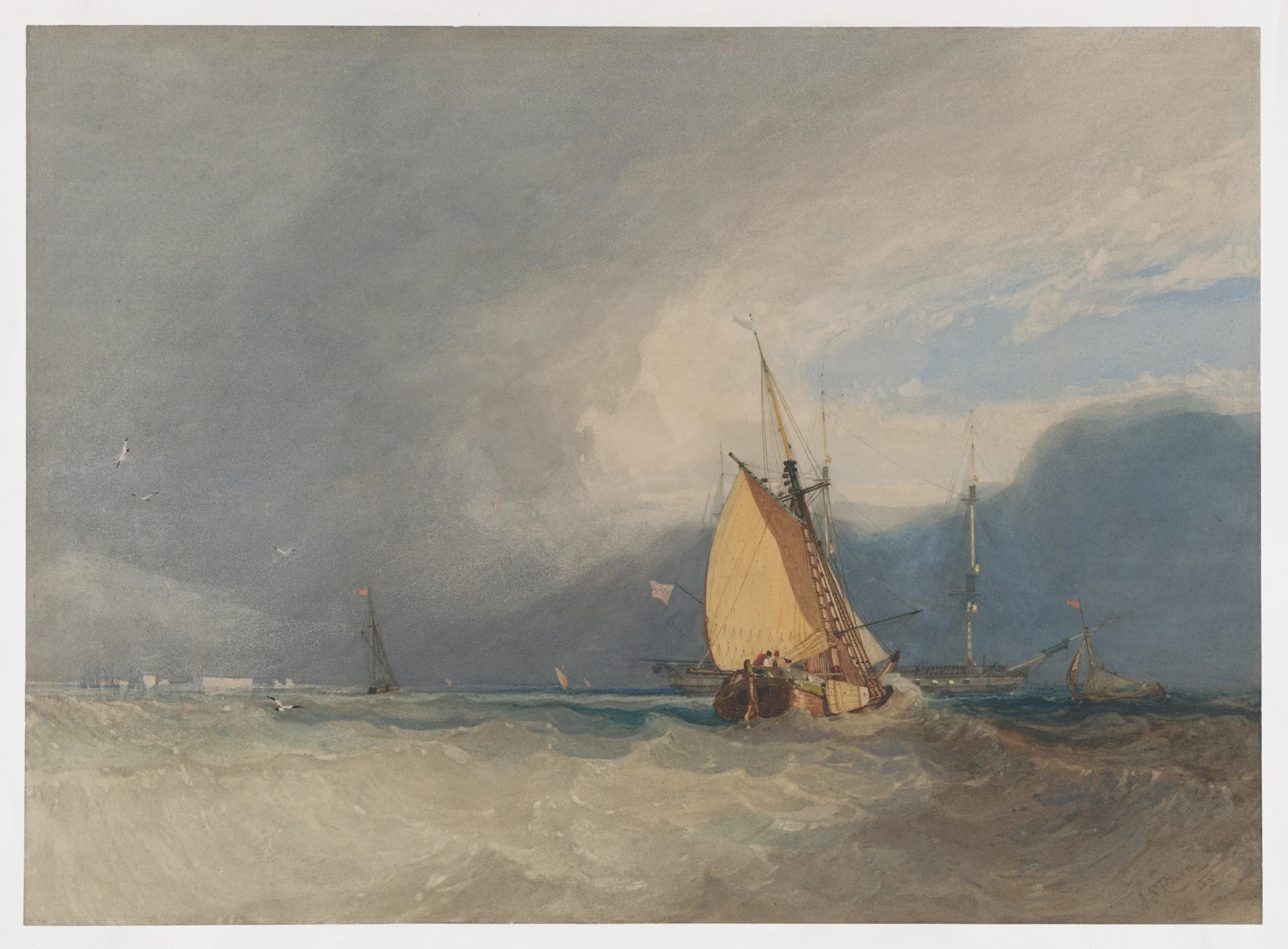
Boats off the coast, storm approaching, dated 1830, shows another aspect of Cotman's range. A warm sail stands against a much larger mass of weather. The museum records a complex combination of watercolour, bodycolour and surface techniques. Its discussion also notes experiments with flour paste. That is historical context rather than a recipe for today's paint box.
Compare the two works by squinting at them. Which large shape dominates each? Where does a small light or dark interruption make the surrounding area more powerful? Make a second five-shape plan for your own coastal reference, or invent a simple sky study from observed clouds. Aim for a clear relationship between the broad masses. Cotman offers plenty of detail to admire, but the structure gives that detail somewhere useful to live.
A building in five shapes — an editorial study
- Draw a small view using only sky, roof, lit wall, shadow and ground.
- Paint the plan with one colour mixed to three strengths.
- Translate the plan into colour, preserving the major value relationships.
- Add one small area of structural detail, then compare the painting with the original plan.
Make this a study of your own subject. These are our practice prompts, not a claim to reproduce an artist’s exact method.
Take a practice sheet →Keep looking
Sources support the factual context; looking notes and exercises are Watercolourist editorial interpretation.
What happened on your paper?
A study, a discovery, or a wash with a mind of its own. Share your painting, ask a question or show what happened when you tried an exercise. Tell us if you would like critique.
Sign in or join to post under your username. Your contribution appears in the studio discussion with a link back here. See what other painters are discussing →