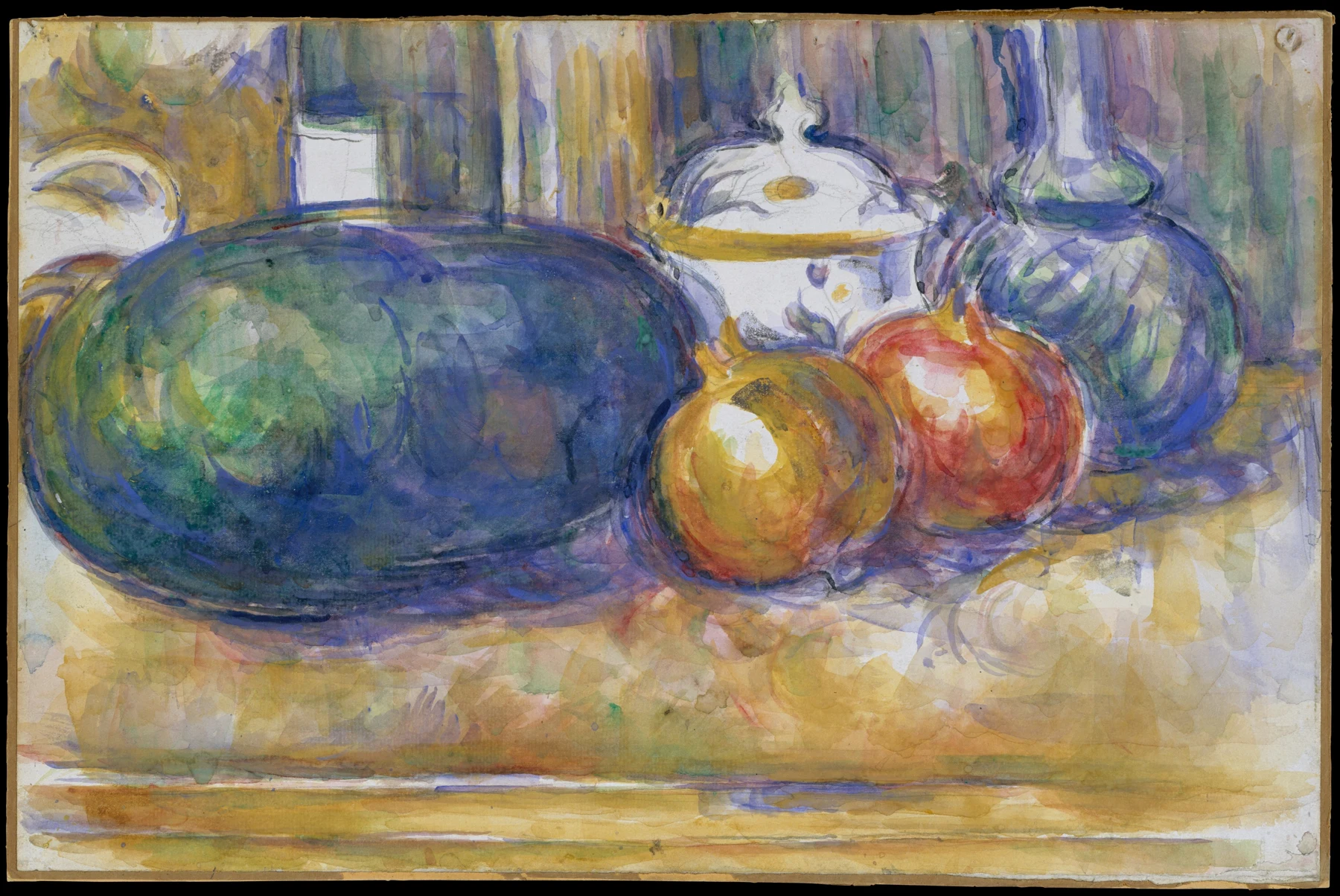
A watermelon with serious presence
Paul Cézanne's Still-Life with a Watermelon and Pomegranates, dated 1900–1906 by The Met, gives its fruit considerable authority. The watermelon occupies much of the left side, while smaller rounded objects gather on the right. Blue and violet passages recur across fruit, glass and background. Our reading is that these repeated notes help the separate objects feel part of one arrangement. It is a useful reminder that a still life is a painting of relationships, even when lunch is involved.
MoMA's account of Cézanne's materials describes a shift from dense early applications towards thinner layers and exposed paper. It also draws attention to broken contours and distinct strokes. Those are observations about his practice, not instructions to leave every study unfinished. A visible gap or pencil line still needs to contribute to the whole.
Look between the objects
Before drawing your fruit, inspect the gaps around it. Compare the space between a jug and an apple with the width of the apple itself. Notice whether the cast shadow connects the objects or leaves them floating separately. These relationships give you something more useful to check than whether the apple looks sufficiently apple-like.
Choose three ordinary objects with different sizes. Place them against a plain cloth and use one clear light source. Make a thumbnail showing their relative sizes and the spaces between them. Move an object if the arrangement feels evenly spaced or stiff. You are allowed to rearrange a still life. It is one of the few subjects unlikely to complain about its working conditions.
Build colour in small comparisons
Start with a light drawing and a few pale patches. Compare each new colour with a neighbouring patch: warmer or cooler, lighter or darker, stronger or quieter? Avoid deciding that every shadow must be blue or that every apple must be red. Your particular light and objects supply the evidence. If a colour surprises you, check it against its neighbour before correcting it out of existence.
Let a layer dry before adding another where you want the underlying mark to remain distinct. Leave some small spaces between patches and assess them from a distance. Our exercise borrows the question of how colour can build form; it does not reproduce a documented Cézanne painting sequence. You are testing a way of seeing with materials already on your desk.
Take the same question outside
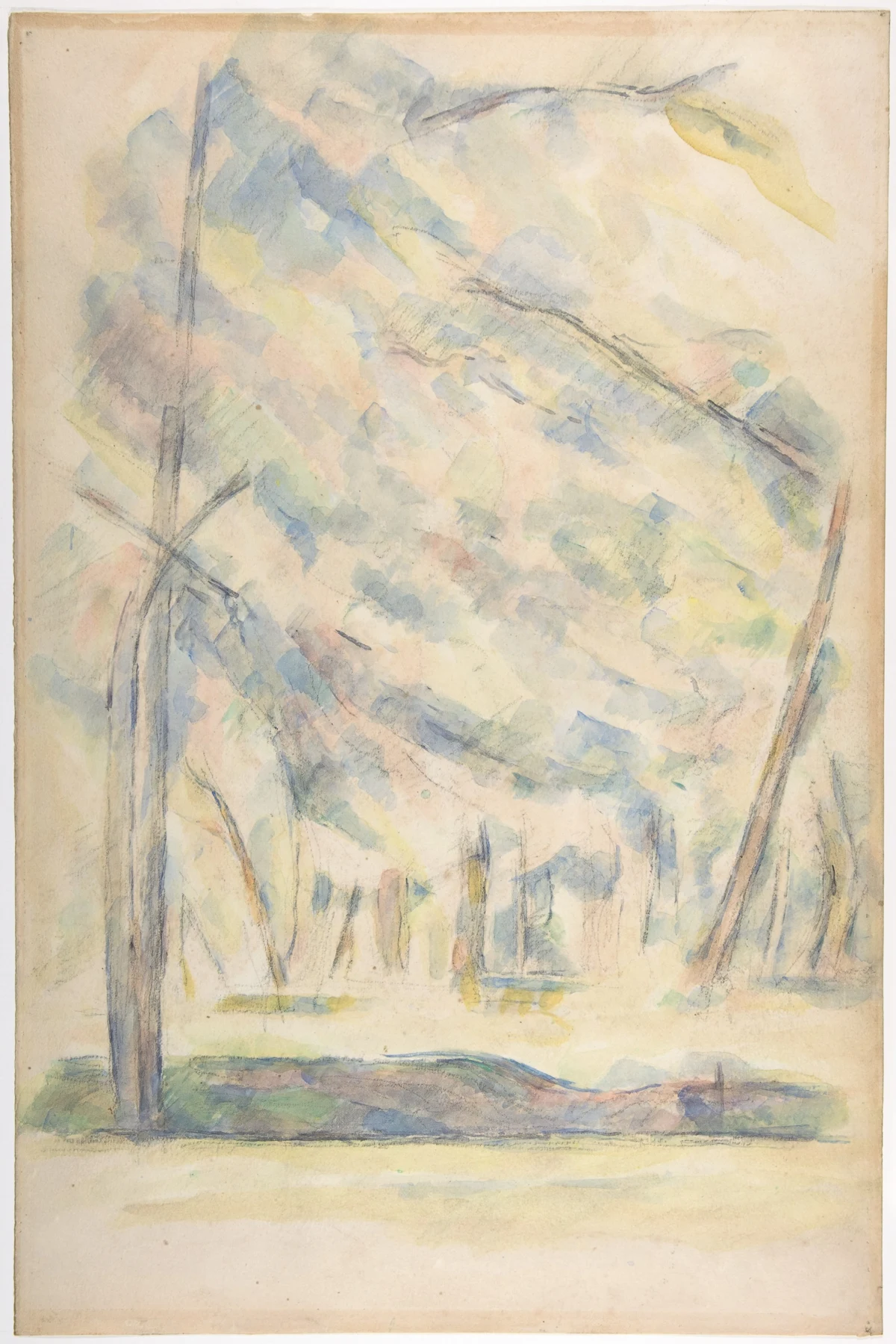
The companion Landscape, dated 1890–95, offers a much airier arrangement. Dark linear trunks and branches sit among pale touches of colour, with plenty of the sheet visible. Looking at it beside the still life is a useful exercise in range: a colour patch can help describe rounded fruit or suggest the light passing through a canopy.
Try a second study of one tree with the same palette. Keep the trunk placement simple and build the canopy through a few colour relationships. Stop to compare both studies before adding detail. Which marks carry the form? Which merely fill an uncomfortable empty patch? Keep those questions beside you. They will improve the next painting more reliably than purchasing the precise green you imagine Cézanne might have approved.
Three objects, neighbouring colours — an editorial study
- Arrange three differently sized objects and draw a thumbnail of the spaces between them.
- Place pale colour patches, comparing each with its neighbour before adding another.
- Let selected areas dry and add a second layer without filling every gap.
- Step back; note which patches describe form and which merely fill space.
Make this a study of your own subject. These are our practice prompts, not a claim to reproduce an artist’s exact method.
Take a practice sheet →Keep looking
- The Met: Still-Life with a Watermelon and Pomegranates
- The Met: Landscape, 1890–95
- MoMA: A Guide to Cézanne's Mark-Making and Materials
Sources support the factual context; looking notes and exercises are Watercolourist editorial interpretation.
What happened on your paper?
A study, a discovery, or a wash with a mind of its own. Share your painting, ask a question or show what happened when you tried an exercise. Tell us if you would like critique.
Sign in or join to post under your username. Your contribution appears in the studio discussion with a link back here. See what other painters are discussing →