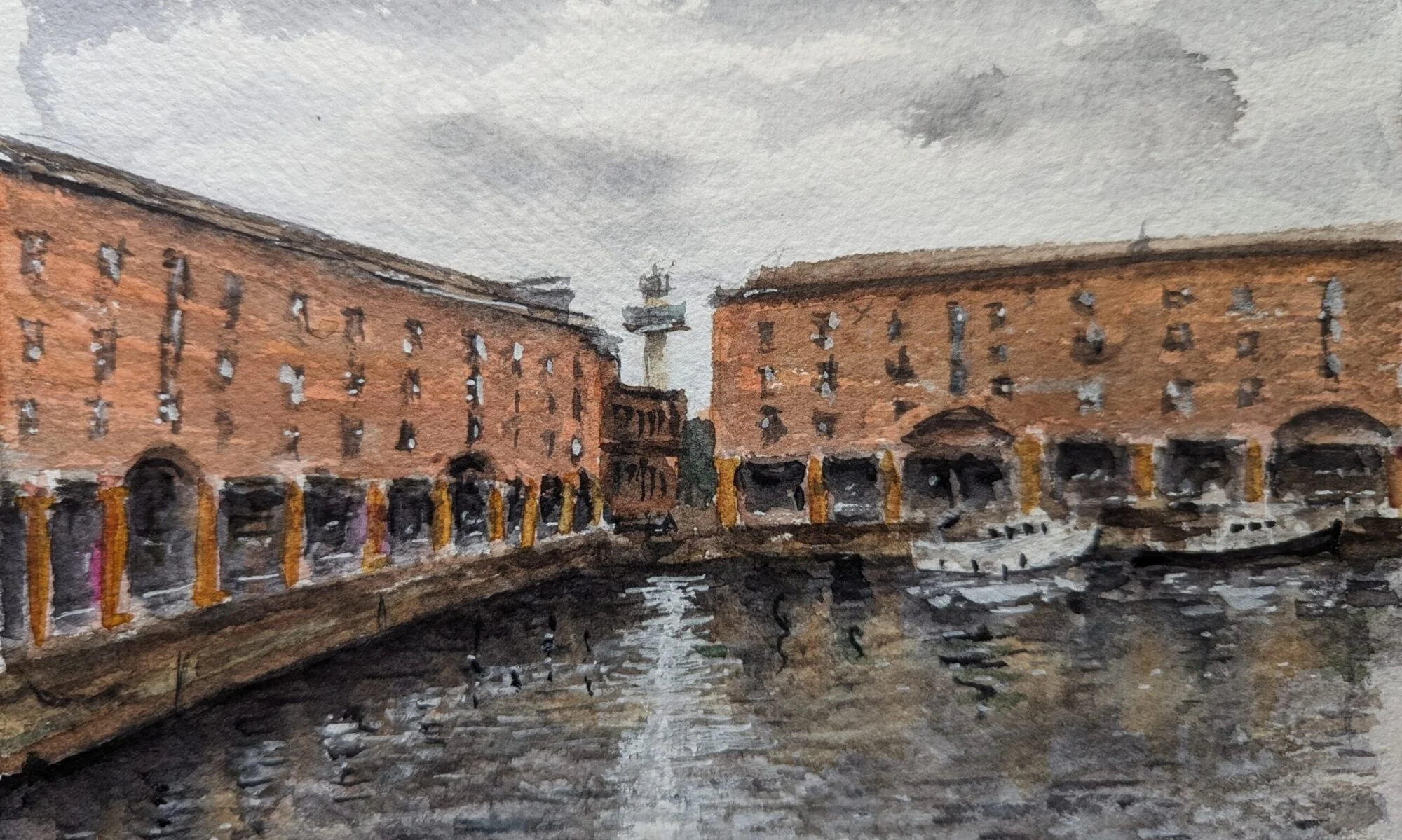
- In Royal Albert Dock, warm warehouse colours reappear in the water among darker, broken vertical shapes.
- Short pale marks interrupt the darker water, while a broad light passage leads towards the central gap between the buildings.
These observations describe what is visible, not how the artist made the painting.
First identify what you can see
Water is not automatically blue, and a reflection is not simply a second building flipped underneath the first. Look at the actual surface: what belongs to the reflected scene, what appears to be sky, and where does movement interrupt those shapes? The Watercolor Learning Center's guide distinguishes surrounding reflected colour, the water's own appearance and the effect of looking across or down into it.
For this exercise, use a reference with a clear bank or quay and one or two recognisable reflected objects. A photograph you made yourself is helpful because it freezes the changing pattern. Begin with a calm or lightly disturbed surface. White water and breaking waves deserve a separate study rather than being added as an unexpected advanced examination.
Find the large colour areas
Look at Royal Albert Dock. The water contains warm passages related to the buildings, darker broken forms and a central light area. These relationships establish the setting before any single ripple becomes important. Squint at the painting and follow the largest areas. Then look again at normal distance to see how the smaller marks sit within them.
Make a thumbnail of your reference showing the bank, one reflected mass and the most important light passage. Check their positions against the objects above the water. Observe the reflection's actual width, length and interruptions rather than imposing perfect symmetry. A distorted surface has no obligation to resemble your neat diagram.
Separate the mass from the surface marks
On a small sheet, establish the broad water colour while protecting the light passage you chose. Test a reflection mixture on spare paper. Place the main reflected mass with as few strokes as comfortably describe it, choosing a soft or firm boundary from your observation. Leave it alone long enough to see what the wash actually does.
After drying, add a few shorter marks across selected areas where your reference shows surface movement. Vary their spacing and length. They should interrupt or connect existing shapes, not cover the entire sheet with evenly spaced stripes. Stop and view the study from a distance after each small group. If the surface already reads, the remaining ripples may take the afternoon off.
Reserve light deliberately
Robert Cook's Daniel Smith waterscape demonstration uses masking to protect selected light marks before painting. That is one practical option, but our small study can simply leave a few gaps with the brush. If you choose masking fluid, test it on the same paper and follow the product's handling instructions; do not introduce it halfway through a precious painting as an act of faith.
Judge the finished study by the relationship between the object, its reflection and the quieter surrounding water. Are the strongest marks clustered where you want attention? Does the large light passage remain visible? Make a second version with half as many small marks and compare. Keep whichever is clearer. Counting fewer ripples is not the goal; learning which ones earn their place is.
The reflection, then the ripples
- Choose a reference with a clear bank and one dominant reflection.
- Map the reflected mass and one important light passage in a thumbnail.
- Paint the broad water and reflection shapes, then allow them to dry.
- Add a few observed surface marks; repeat with fewer marks and compare.
Make this a study of your own subject. These are our practice prompts, not a claim to reproduce an artist’s exact method.
Take a practice sheet →Keep looking
- Watercolor Learning Center: Painting Water in Watercolor
- Robert Cook for Daniel Smith: masking lights in a waterscape
Sources support the factual context; looking notes and exercises are Watercolourist editorial interpretation.
What happened on your paper?
A study, a discovery, or a wash with a mind of its own. Share your painting, ask a question or show what happened when you tried an exercise. Tell us if you would like critique.
Sign in or join to post under your username. Your contribution appears in the studio discussion with a link back here. See what other painters are discussing →