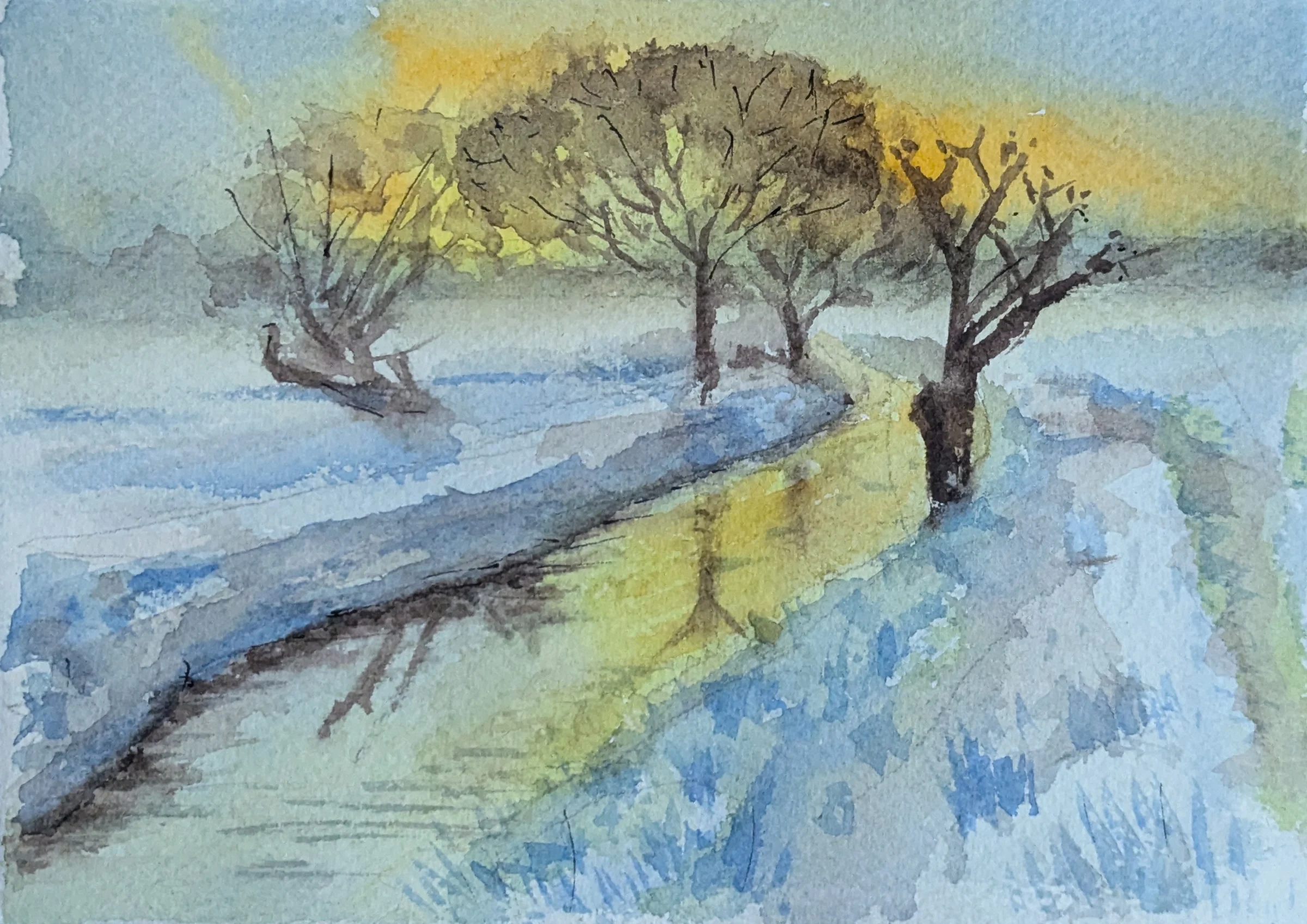
- In Winter Stream, pale blue areas of snow sit beside much darker banks and tree trunks; the contrast helps the light shapes read.
- The yellow-green stream makes a continuous curve through the cooler surrounding snow, linking the foreground to the trees.
These observations describe what is visible, not how the artist made the painting.
Look at the shape between things
Negative painting means defining a shape by painting around it. Brenda Swenson's demonstration for Daniel Smith uses this approach to preserve lighter passages, then develops depth through transparent layers. The idea is straightforward; the difficulty is remembering that the background has a shape of its own. It deserves more attention than whatever paint is left after the interesting bits.
Start by looking at Winter Stream. The snow reads partly through its relationship with the dark bank and trunks. That observation does not tell us how Mark made the painting. It gives us a useful question for our own work: which surrounding dark would make this particular light more convincing?
Choose three lights worth keeping
For our exercise, arrange three pale leaves or pieces of torn paper on a darker surface. Overlap two and leave a visible gap between the others. Draw their outer boundaries on a small sheet, but also inspect the gaps. Is one a narrow triangle? Does another widen at the bottom? Check those spaces as carefully as the objects.
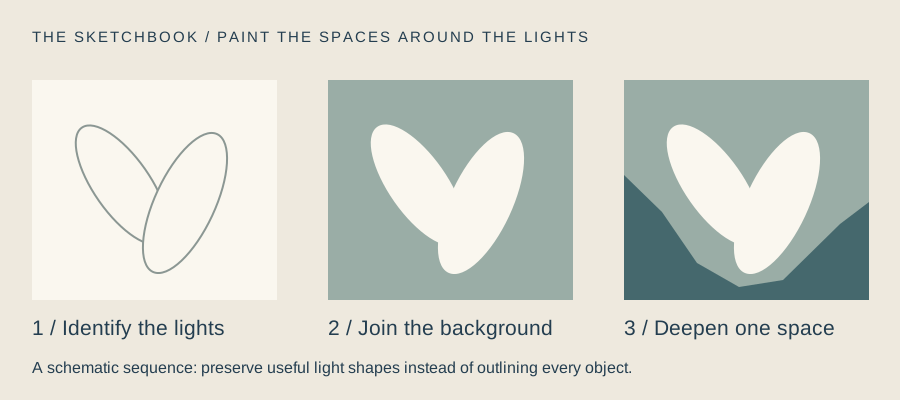
Choose three light areas to protect. They need not all remain white. A pale first wash can establish a coloured light, provided you allow it to dry before working around it. Make a thumbnail of the whole arrangement and shade only the background. If the objects are already readable, you have enough information to start painting.
Carry the wash beyond the outline
Mix a generous puddle of a middle value. Begin beside one of the chosen lights and paint outward into the background, joining that passage to the next wherever possible. Avoid tracing a thin dark moat around every object. A moat describes the edge but leaves you with another edge to explain a centimetre further out.
Work in manageable areas, keeping a test strip beside the sheet. If a passage starts drying before you can join it comfortably, stop at a sensible boundary. Let it dry before continuing. Speed is not the goal; a deliberate relationship between adjacent shapes is. Change the size of the exercise if the brushwork has become a miniature plumbing emergency.
Add depth selectively
Once the first background is dry, choose one smaller space for a deeper wash. Keep some of the original middle value visible, so the darker addition creates another level rather than replacing the entire background. In a group of leaves, this might be a gap behind the main overlap. Test your colour on spare paper before committing.
Step back and compare the light shapes. If every edge is equally emphatic, choose which boundary really needs attention and allow quieter areas to stay quiet. Do not keep shrinking the lights to make the drawing perfect. Finish while their shapes still feel deliberate. The result should make the objects clearer, not demonstrate how patiently you can paint a complicated fence around them.
Three lights, two background values
- Arrange three pale objects with one overlap and one open gap.
- Draw the objects and check the shapes of the surrounding spaces.
- Paint one connected middle-value background, protecting three lights.
- After drying, deepen one smaller background area and compare the result from a distance.
Make this a study of your own subject. These are our practice prompts, not a claim to reproduce an artist’s exact method.
Take a practice sheet →Keep looking
Sources support the factual context; looking notes and exercises are Watercolourist editorial interpretation.
What happened on your paper?
A study, a discovery, or a wash with a mind of its own. Share your painting, ask a question or show what happened when you tried an exercise. Tell us if you would like critique.
Sign in or join to post under your username. Your contribution appears in the studio discussion with a link back here. See what other painters are discussing →