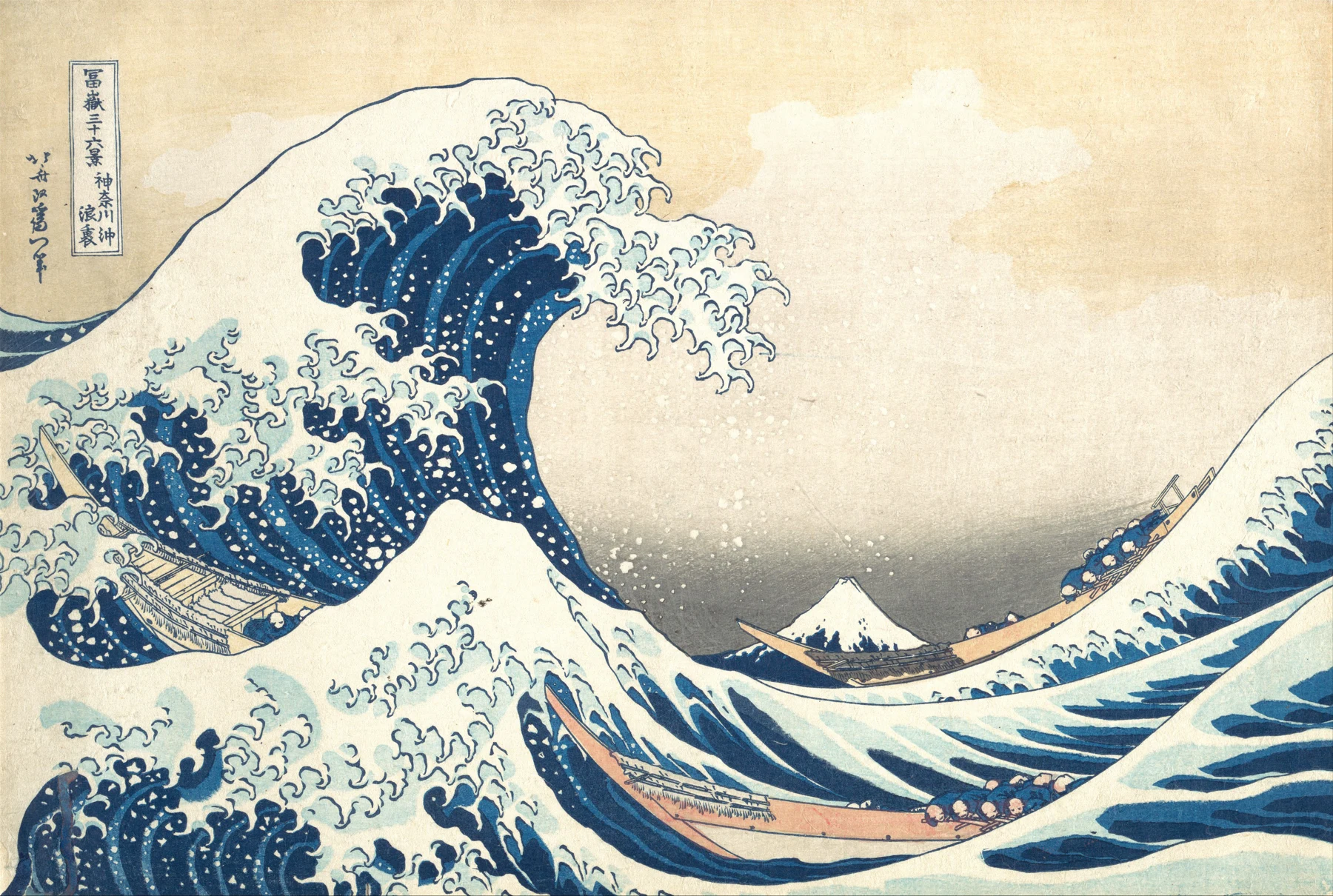
- In The Great Wave, a broad pale sky separates the branching foam from the small distant triangle of Mount Fuji; long boats repeat the surrounding curves.
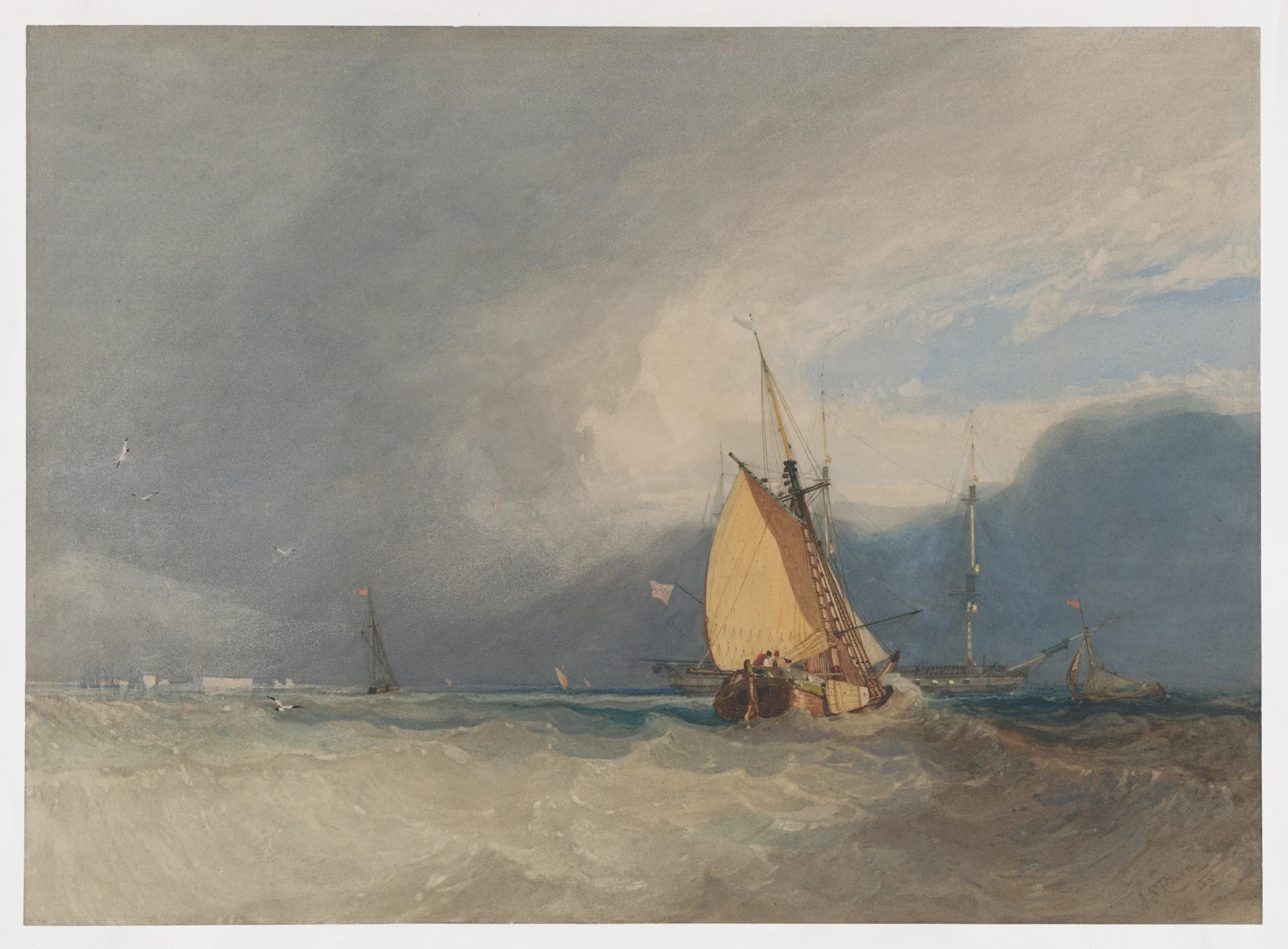
- In Cotman’s Boats off the coast, storm approaching, a warm central sail stands against an expansive grey sky, above uneven horizontal bands of water.
These observations describe what is visible, not how the artist made the painting.
Start with the actual connection
Hokusai’s Great Wave appears on countless objects, but one particular appearance matters to music history. A cropped version of its wave was used on the cover of the first edition of Claude Debussy’s La mer, published by A. Durand & Fils in 1905. The Metropolitan Museum’s illustrated article reproduces that cover and explains Debussy’s choice. It also shows a 1910 photograph of the composer’s studio with a Great Wave print on the wall.
That establishes a real connection. It does not establish that a specific curl of foam becomes a particular bar of music. The Met discusses Debussy’s interest in evoking remembered sensations of the sea, rather than supplying a literal catalogue of nautical sound effects. Keep those distinctions in mind when listening: the relationship is more interesting than a game of matching every orchestral splash to a painted one. Even the sea deserves an afternoon off from illustration duties.
A woodblock print with lessons for a wet brush
The Met’s impression of Under the Wave off Kanagawa dates from around 1830–32. It is a woodblock print in ink and colour on paper, not a watercolour. Look at the huge curling wave, the boats lying along slanting curves, and Mount Fuji’s small triangular peak in the distance. The pale sky occupies a surprisingly generous area. That open region gives the foam’s branching tips something clear to bite into.
Here is our studio reading: the print balances different sizes of repetition. The major wave establishes an enormous gesture; smaller curls answer it, while flecks of spray make a finer pattern. If every shape were equally intricate, the eye would have trouble finding the larger movement. In watercolour, try organising a shore study into one broad wash, a few middle-sized breaks and a restrained scattering of small accents. This is an exercise inspired by looking, not Hokusai’s documented painting method.
Music as a way of naming relationships
Whistler gives us another, differently documented connection. His musical titles encouraged viewers to consider arrangements of colour and form. The University of Glasgow’s Whistler Writings project reproduces and discusses his explanations, including his 1878 defence of titles such as symphonies and harmonies. Music offered him a way to explain pictorial relationships without requiring a story to justify the painting.
Explore Symphony in White, No. 1: The White Girl on the National Gallery of Art’s website. Its pale dress and curtain invite attention to differences within an apparently restricted range. For a watercolourist, that is a good prompt to study five versions of a pale mixture before reaching for another colour. It does not mean white has an agreed musical note, or that a picture can be decoded by assigning instruments to pigments. The useful connection concerns organisation, not a secret translation chart.
Listen, look, then make your own comparison
For a further visual comparison, study Cotman’s Boats off the coast, storm approaching. The broad grey sky surrounds a much smaller warm sail, and the foreground water breaks into uneven bands. We place it here to explore contrast and intervals; we are not claiming any connection between Cotman and Debussy. Compare its dispersed weather and low horizon with Hokusai’s concentrated wave. Both reward attention to what occupies most of the rectangle.
The London Symphony Orchestra’s official La mer recording page lists the three movements and offers purchase and streaming options. Choose a lawful listening option available to you. Listen first without painting, noting changes in density, energy and pause in ordinary words. Then set the recording aside and design a small sea study with similar contrasts of activity and rest. Avoid chasing the orchestra with your brush: wet paper already has enough opinions about timing. Your result can be an independent painting, with a listening experience helping you ask better compositional questions.
A quiet area and a loud area
- Listen to a short passage of La mer through a lawful recording. Write three words describing its changes in density or energy; do not try to identify literal waves.
- Draw two sea compositions with different proportions of quiet sky and active water. Use Hokusai and Cotman as contrasting looking references.
- Paint one small study with a limited palette. Establish a broad shape, a few medium shapes and only then a small number of sharp accents.
- Let it dry and cover the most detailed area. Decide whether the remaining broad shapes still hold the painting together.
Make this a study of your own subject. These are our practice prompts, not a claim to reproduce an artist’s exact method.
Take a practice sheet →Keep looking
- The Met: Hokusai and Debussy’s Evocations of the Sea — first-edition score cover and studio photograph
- The Met: Hokusai, Under the Wave off Kanagawa — print and collection record
- University of Glasgow, The Whistler Writings: The Painter’s Music
- National Gallery of Art: Whistler, Symphony in White, No. 1
- The Met: Cotman, Boats off the coast, storm approaching
- LSO Live: Debussy recording — official track list and listening options
Sources support the factual context; looking notes and exercises are Watercolourist editorial interpretation.
What happened on your paper?
One useful observation beats “lovely work”. Show a study, ask about a decision, or tell us where you disagree.
Join the studio discussion