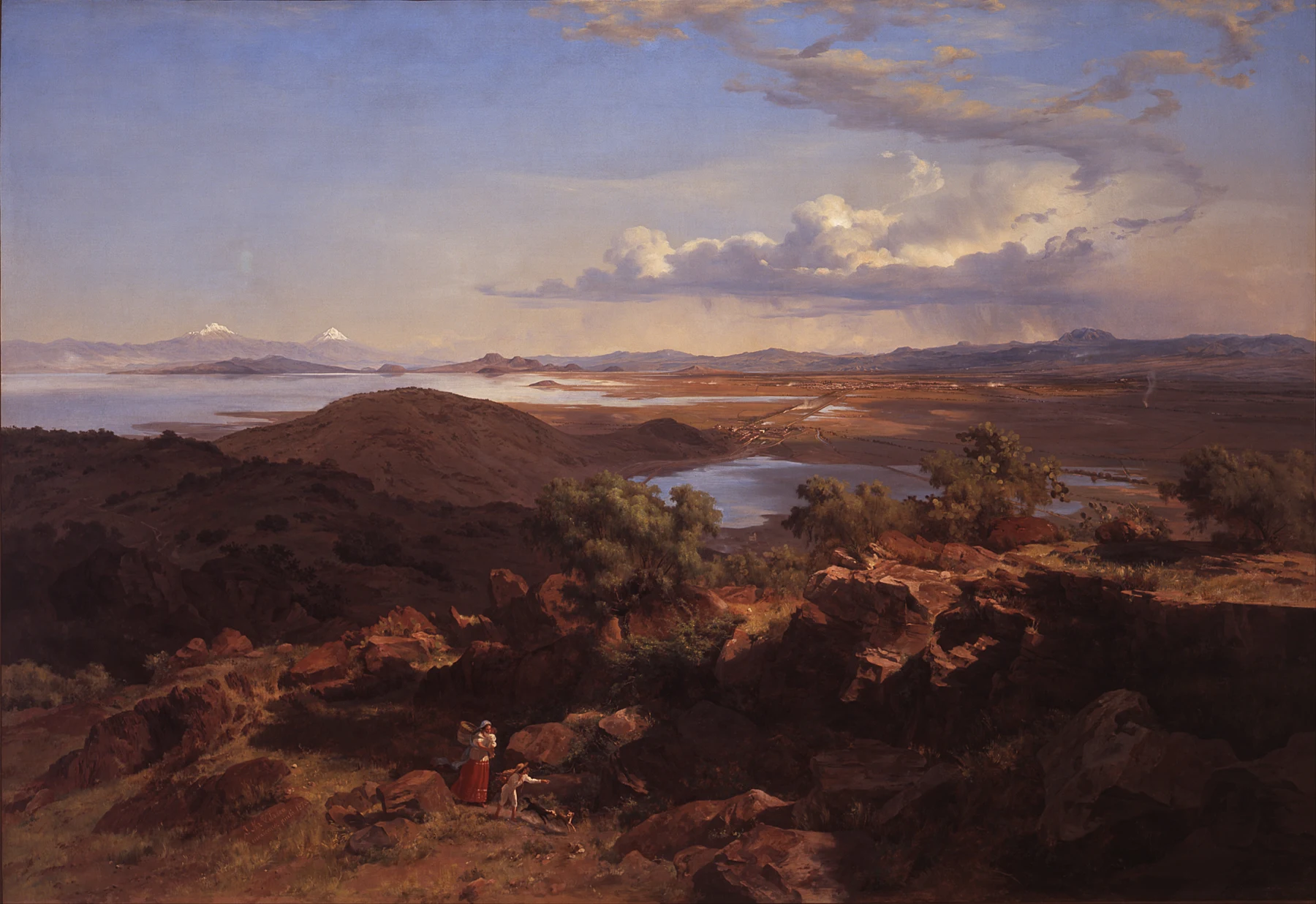
- Small figures stand among dark reddish rocks near the lower edge.
- Pale water and distant snowy peaks sit beyond the darker foreground hills.
- The cloud mass gathers towards the right, while the left sky remains comparatively open.
These observations describe what is visible, not how the artist made the painting.
What are we looking at?
This 1875 panorama by Mexican painter José María Velasco belongs to the Museo Nacional de Arte in Mexico City. The museum lists it separately from his 1877 Valley of Mexico; keeping those dates straight matters because he returned to the subject. This is an oil painting, included here for its compositional possibilities. A watercolour study can learn from its organisation without pretending that oils and wet washes behave identically.
Start with the small figures near the bottom. Behind them, dark rocky ground opens towards water, settlements and distant mountains. The sky takes up a substantial area, with the most concentrated cloud activity to the right. Before studying any individual cactus, register those large divisions. The painting has a considerable amount to say, but it does not deliver everything at the same volume.
Why this landscape matters
MUNAL places Velasco’s landscapes at the intersection of national territory and scientific naturalism. The Minneapolis Institute of Art’s exhibition guide also explains his sustained interest in Mexico’s history and his use of both observation and constructed compositions. Those larger concerns help us approach the picture as a Mexican artist’s considered representation of his country. They do not give us permission to transfer every symbol identified in a different version into this one.
Look at how cultivated or inhabited land sits within the same view as rocks, vegetation and weather. The human world is small, yet visible. That is a productive question for your own landscape work: which details make the location specific? A footpath, reservoir or line of roofs may carry more meaning than another attractively vague mountain.
Let distance change the level of attention
Our reading of this image is that its dark foreground gives the pale water and distant peaks their spaciousness. Warm rocks create a nearby foothold; cooler, less emphatic forms draw attention outwards. The tiny figures are effective because their scale contrasts with everything around them. Enlarging them would change the picture’s argument.
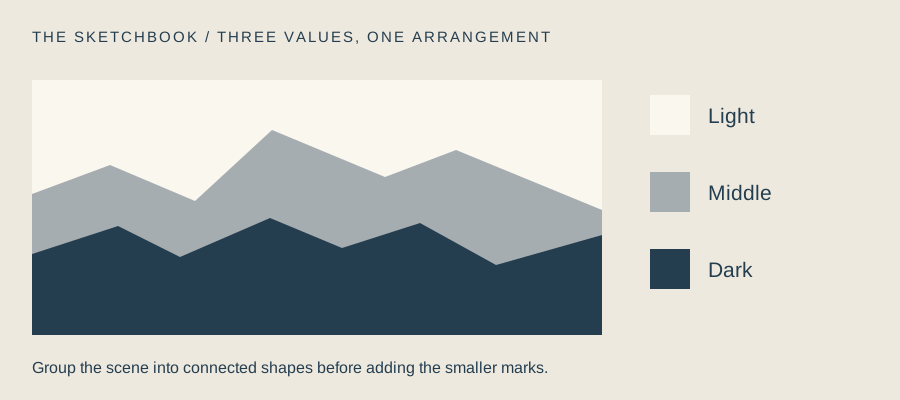
Try a monochrome thumbnail first, reserving separate bands for foreground, basin and sky. Then choose just two local details to preserve in a small colour study. Keep a written note of why you chose them. You are constructing a view with a point of attention, not attempting to complete an entire geological survey before lunch.
A place, not a generic view
- Choose a photograph you took of a place you know. Write down two details that make it recognisable to you.
- Make a three-value thumbnail with a connected foreground shape, a middle-distance band and a quieter distance.
- Paint a small watercolour study retaining those two details. Leave other small features subordinate.
- Compare the study with your written description: does it still feel like the particular place?
Make this a study of your own subject. These are our practice prompts, not a claim to reproduce an artist’s exact method.
Take a practice sheet →Keep looking
- MUNAL: Territorio Ideal — collection context and the distinct 1875 and 1877 paintings
- Minneapolis Institute of Art: José María Velasco exhibition guide — observation, history and composition
Sources support the factual context; looking notes and exercises are Watercolourist editorial interpretation.
What happened on your paper?
One useful observation beats “lovely work”. Show a study, ask about a decision, or tell us where you disagree.
Join the studio discussion