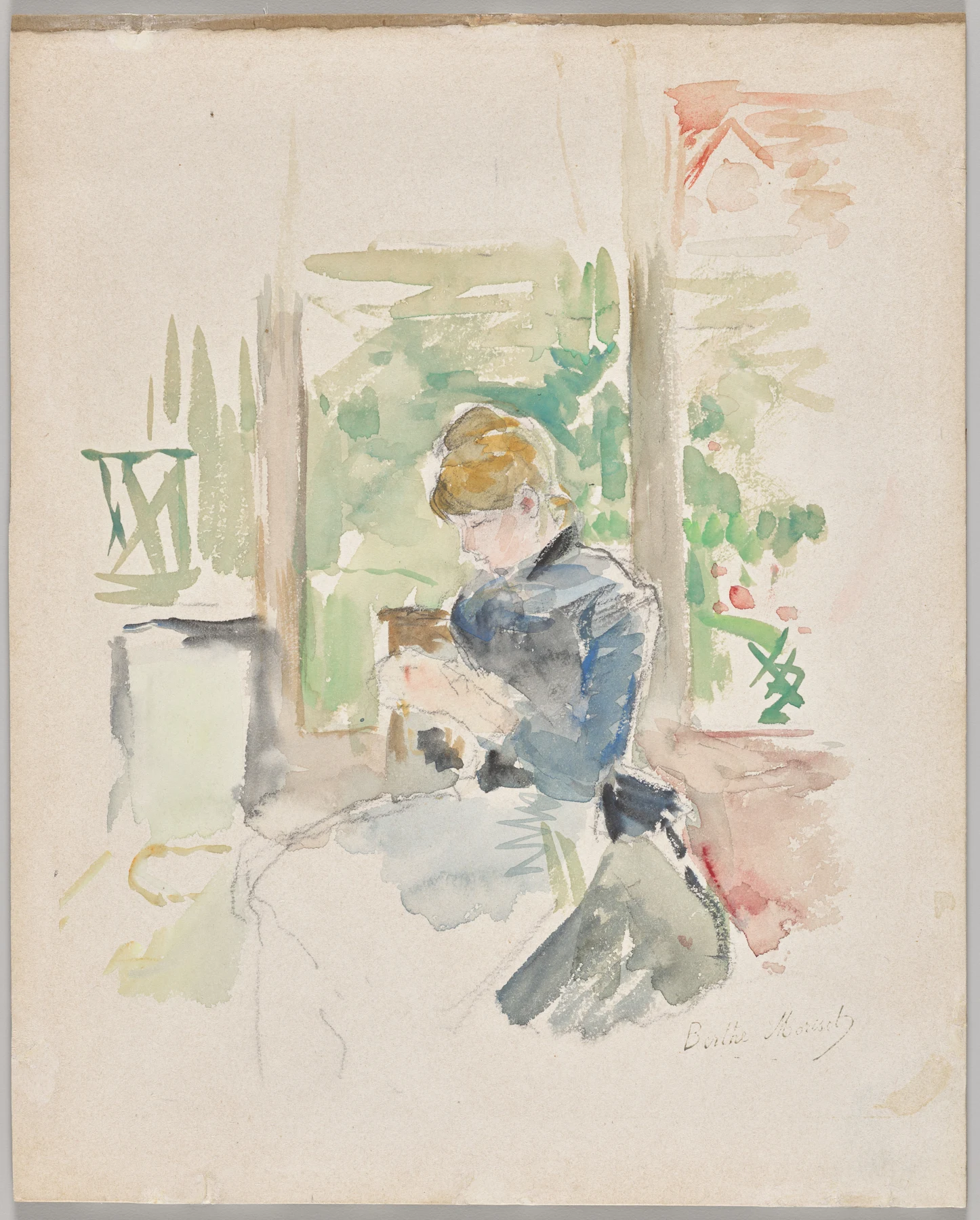
- The sitter’s blue blouse has more contrast than the pale skirt below it.
- Vertical window bars give structure to loosely placed green washes.
- Visible graphite and unpainted spaces remain part of the image rather than disappearing under colour.
These observations describe what is visible, not how the artist made the painting.
A person, not a domestic prop
The Cleveland Museum of Art identifies the sitter as Euphrasie, known as Pasie, the nanny of Morisot’s daughter Julie. She is sewing in the artist’s apartment. Naming her matters: the picture records a particular person at work, rather than supplying an anonymous woman to make a room look pleasant. The museum dates the watercolour to about 1885 and connects it to a later painted composition in which Morisot added Julie and brought the view closer.
The material also matters. Morisot worked in watercolour repeatedly from around 1870, making both preparatory and finished works. This sheet lets us consider a study as an active stage of thought. It need not be treated as a small, apologetic version of an oil painting.
Why this belongs in the story
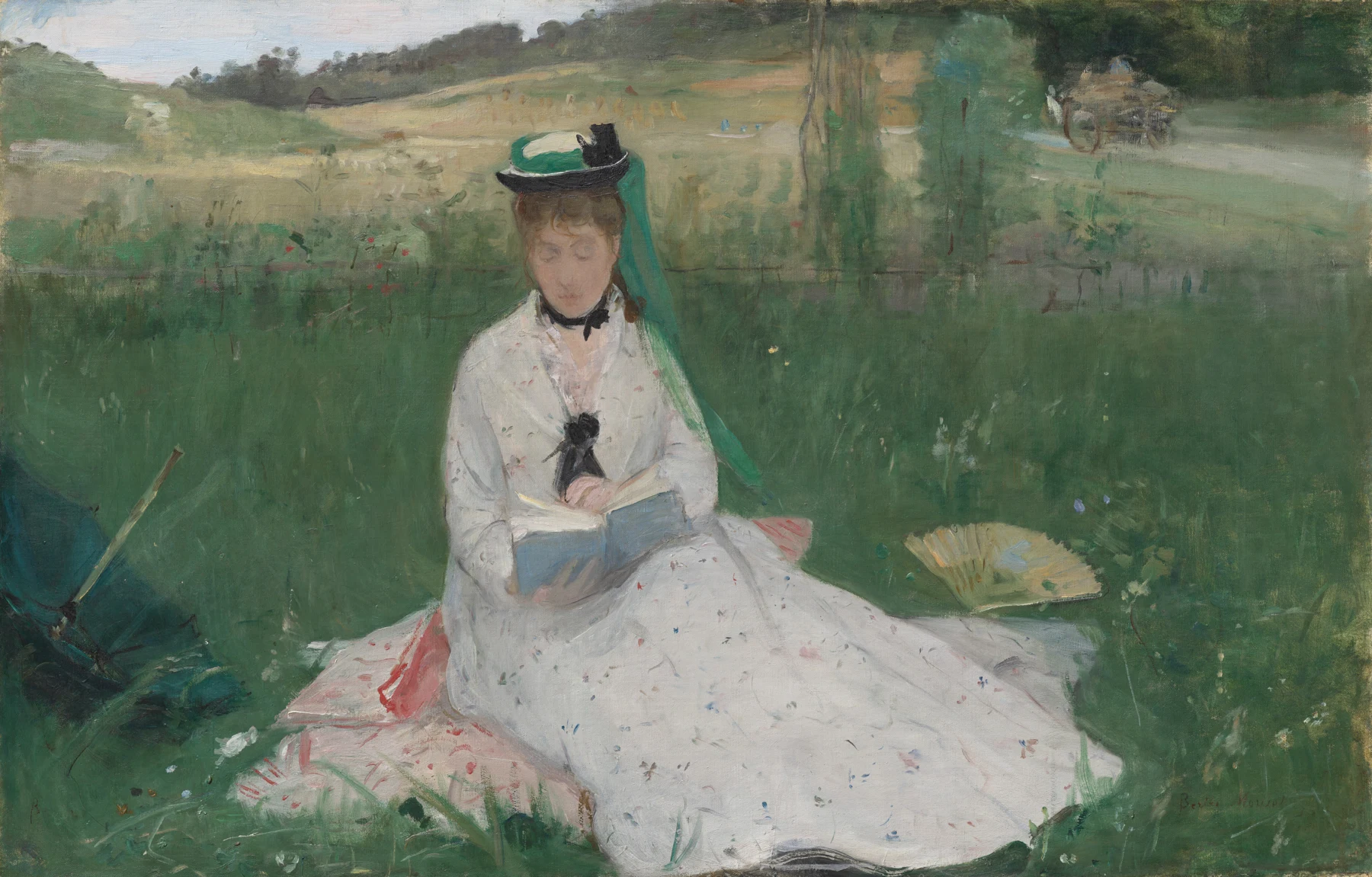
Morisot participated in the first Impressionist exhibition in 1874. Her work makes the people and spaces of her own social world central to the history of modern painting. Cleveland’s account of Reading, the companion oil painting shown below, also draws attention to the social constraints surrounding women’s lives. An intimate subject can be historically consequential without becoming a grand public spectacle.
In Reading, her sister Edma sits outdoors with a book. Keep the medium difference in view: that work is oil on canvas, not watercolour. Compare the two women’s absorbed attention, then ask how each setting gives that attention a different visual shape. This is our comparison between the works, rather than a claim that they were conceived as a pair.
Look at what she leaves open
In the watercolour, the blue upper body is more insistent than the pale skirt. The window’s upright bars hold the loosely described greens behind the sitter. A few warm touches suggest the wall and furniture, while broad areas of paper remain quiet. The graphite contour is visible in places where colour barely arrives. Look at how little is needed before the posture becomes legible.
For discussion: does that open skirt feel unfinished, or does it help you stay with the lowered head and hands? Try the same decision in your own study. You do not have to promote every chair leg to a starring role. One well-chosen relationship can say more than an afternoon spent inventorying the furniture.
One task, three levels of attention
- Ask someone to sit reading or doing a simple task, or use a photograph you took with their permission. Make a light drawing of the main posture.
- Choose one area to describe clearly, a second to suggest with a few washes and a third to leave mostly open.
- Use two colours and keep the background quieter than the main gesture. Let the paper dry before deciding whether a missing detail actually needs adding.
- View the study at arm’s length. Write down where your attention lands first and whether it matches the decision you made.
Make this a study of your own subject. These are our practice prompts, not a claim to reproduce an artist’s exact method.
Take a practice sheet →Keep looking
- Cleveland Museum of Art: Sewing near the Window, sitter and working context
- Cleveland Museum of Art: Reading, 1873, Edma and social context
- National Gallery of Art: Berthe Morisot, career and Impressionist exhibitions
Sources support the factual context; looking notes and exercises are Watercolourist editorial interpretation.
What happened on your paper?
One useful observation beats “lovely work”. Show a study, ask about a decision, or tell us where you disagree.
Join the studio discussion