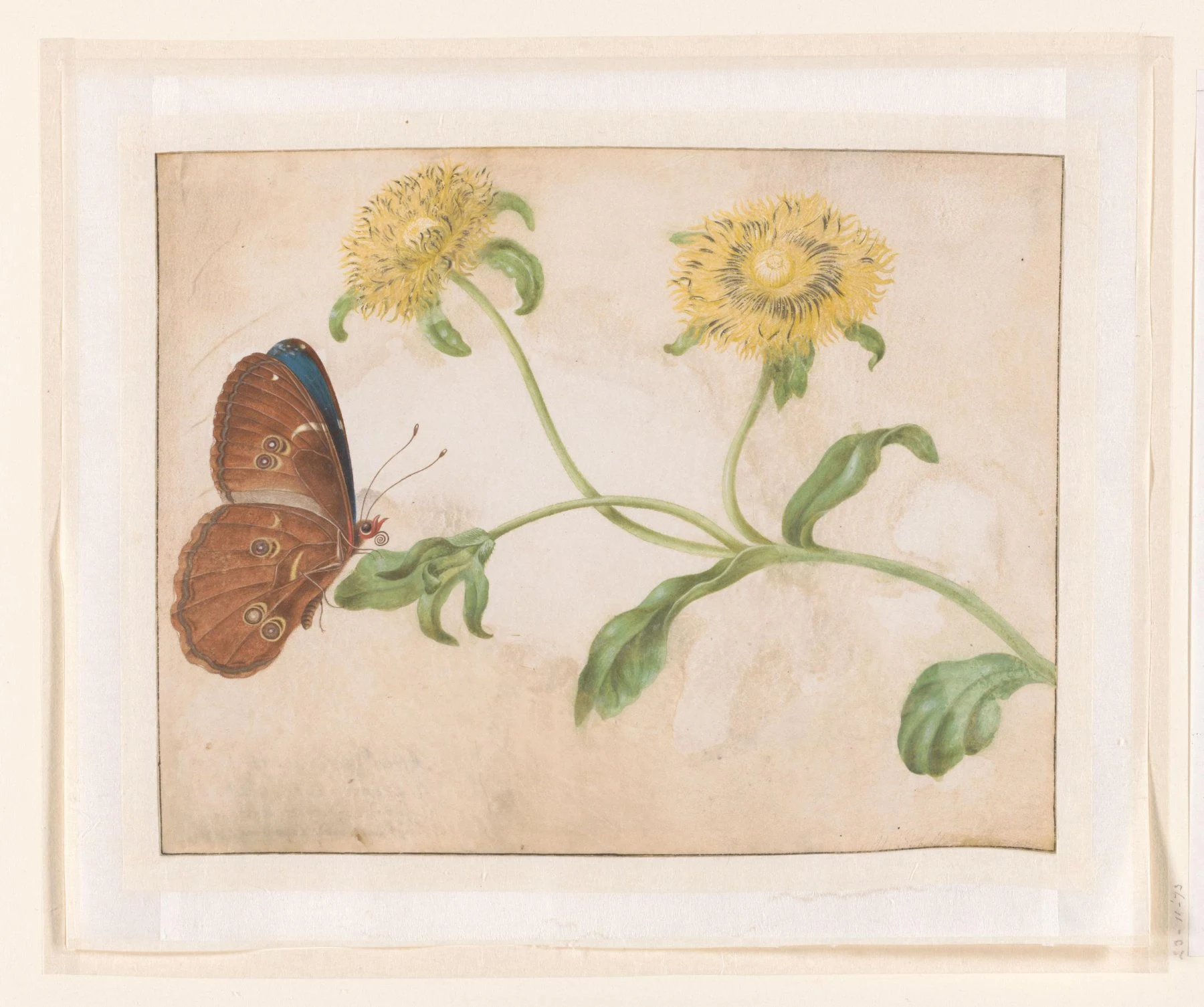
- The butterfly occupies the left side, with brown wing surfaces, circular markings and a narrow blue area above.
- Curved green stems lead towards two yellow flower heads across a mostly pale background.
- Fine insect details contrast with larger, simpler leaf shapes.
These observations describe what is visible, not how the artist made the painting.
Read the label as carefully as the wings
The Rijksmuseum attributes this 1696 drawing to Maria Sibylla Merian. That qualification belongs beside her name: the museum has not presented the authorship as certain. Its materials are opaque and transparent watercolour over graphite on vellum. The subject includes a Blue Morpho butterfly, a group associated with South American forests. Although the title says blue, much of the visible wing surface is brown, with a narrow blue area above.
The date predates Merian’s 1699 departure for Suriname with her daughter Dorothea Maria. This is therefore not an on-location record of that journey. Merian was a German-born artist working in Europe, later a visitor to a Dutch colony. We include the sheet as a connection between regions and natural-history practices, not as the work of a Latin American artist.
Why the wider story matters
Merian’s later Suriname studies contributed to her 1705 book of insects and their transformations. The Rijksmuseum explains that Indigenous people and enslaved people helped collect, identify and name the plants and insects on which that research depended. Their knowledge belongs in the account alongside the celebrated European author. The history becomes clearer when it includes the people whose contributions were not given equal visibility.
The earlier sheet also reminds us that careful-looking art is still open to questions. Attribution, date and the identity of a plant are research matters, not inconveniences to be smoothed away with a confident caption. An attractive natural-history image should invite further observation, including observations that complicate its label.
A few precise edges can carry a whole page
Look at the butterfly’s wing outline and small circular markings, then follow the long green stems towards the two yellow flower heads. Large areas of pale support separate these elements. My visual reading is that the concentrated detail in the insect holds attention while the curved stems connect the scattered forms. The page feels populated without becoming crowded.
For a modern study, choose a fallen leaf or a plant you can observe without disturbing wildlife. Reserve room around it and give your sharpest detail to one small area. Use a light wash elsewhere. Keep notes on anything you cannot identify: a question mark in a sketchbook is considerably more useful than an invented Latin name.
An observation and an honest question
- Choose a fallen leaf, fruit or plant visible from where you sit. Draw its main outline and leave a generous margin.
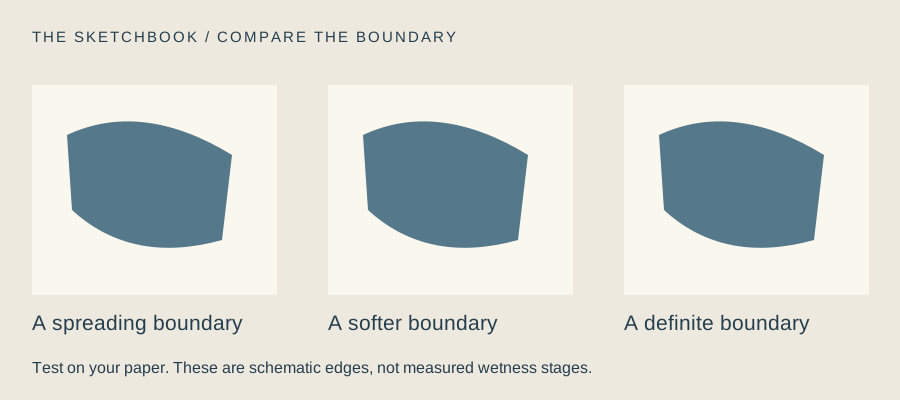
- Use two light washes to establish the largest shapes, letting each dry if you want a clean boundary.
- Add fine detail to one small area. Write one observation about shape or colour and one question you cannot yet answer.
- Identify the subject later using a reliable source, keeping the original uncertainty visible in your notes.
Make this a study of your own subject. These are our practice prompts, not a claim to reproduce an artist’s exact method.
Take a practice sheet →Keep looking
- Rijksmuseum: Blue Morpho Butterfly on a Yellow Flower — attribution, date, material and public-domain image
- Rijksmuseum: Merian’s insects of Suriname — journey, publication and local knowledge
Sources support the factual context; looking notes and exercises are Watercolourist editorial interpretation.
What happened on your paper?
One useful observation beats “lovely work”. Show a study, ask about a decision, or tell us where you disagree.
Join the studio discussion