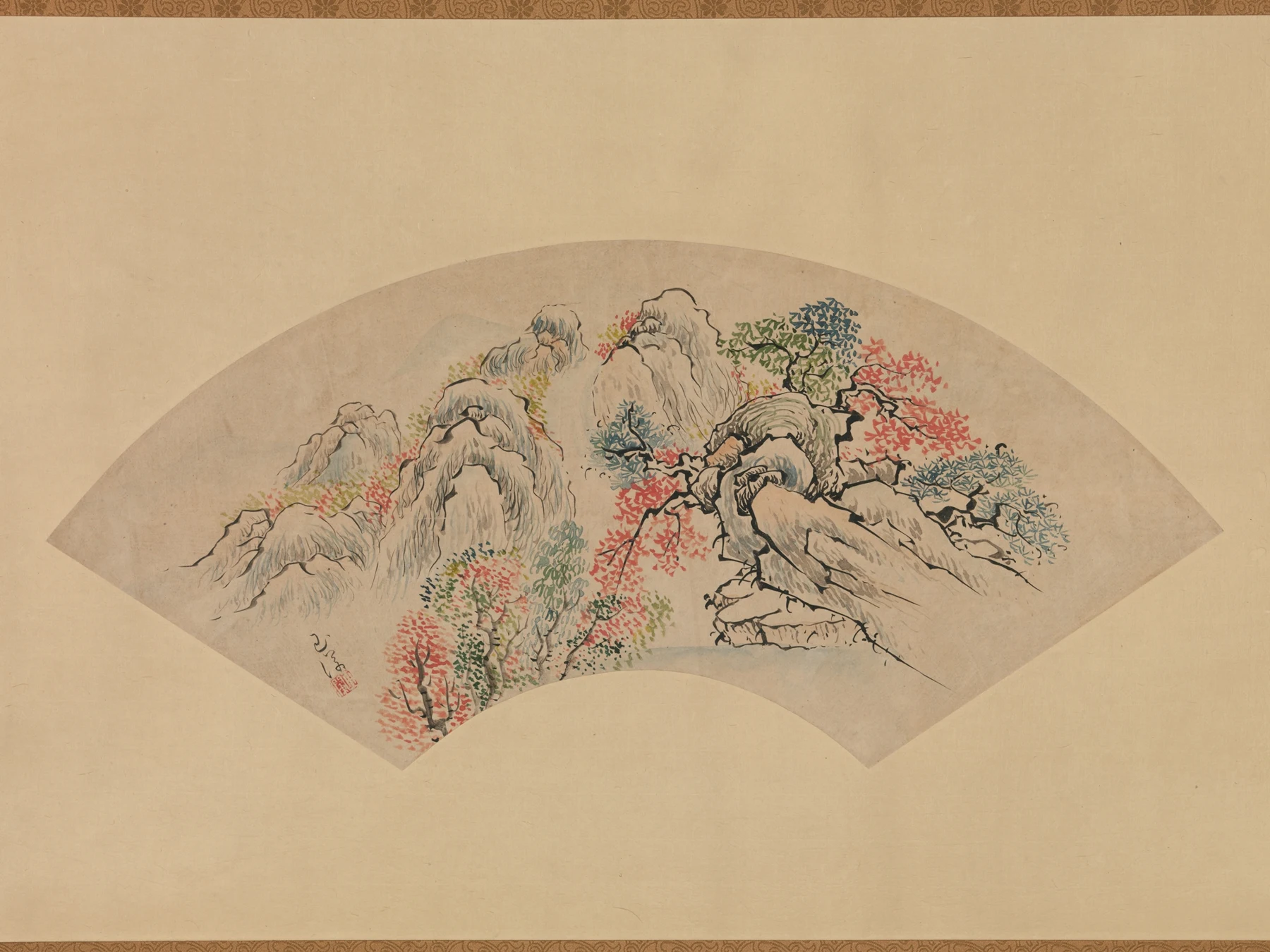
- Compare the thin mountain lines on the left with the strong angular branches on the right.
- Follow the red foliage clusters across the fan and notice their uneven spacing.
- Study how the composition accommodates both the outer arc and the curved gap below.
These observations describe what is visible, not how the artist made the painting.
A fan with a larger life — why it matters
Ike Gyokuran (1728–1784) grew up in Kyoto in a family involved in poetry and the running of a tea shop. The Met identifies her as an important woman artist of the Edo period; her husband was the Nanga painter Ike Taiga. This ink-and-colour landscape occupies a fan later mounted as a hanging scroll. The format matters as much as the subject. It belongs to a Japanese painting tradition, rather than serving as an early example of a British watercolour convention.
A rhythm of different marks
Look from left to right. Pale mountain contours become denser, darker forms around the foreground rock and twisting branches. Red, green and blue-green clusters interrupt the quiet stone colours. In our reading, the foliage behaves almost like punctuation: small marks divide the larger movements without competing with the mountain shapes. The fan’s lower curve takes a bite from the landscape. Instead of treating that missing space as a nuisance, notice how the rising forms gather around it. There is no need for a rectangular window to feel complete.
Let the format make a decision
Try a curved boundary on an ordinary sketchbook page. Plan three mountain or building masses inside it before you draw a single leaf. Then use three families of marks: flowing contours, firm dark accents and small coloured touches. This is an editorial experiment prompted by what we can see, not a claim about Gyokuran’s sequence of work. Keep the coloured touches in clusters. Sprinkling them evenly everywhere tends to turn a landscape into confetti, and the mountains have not asked for a party.
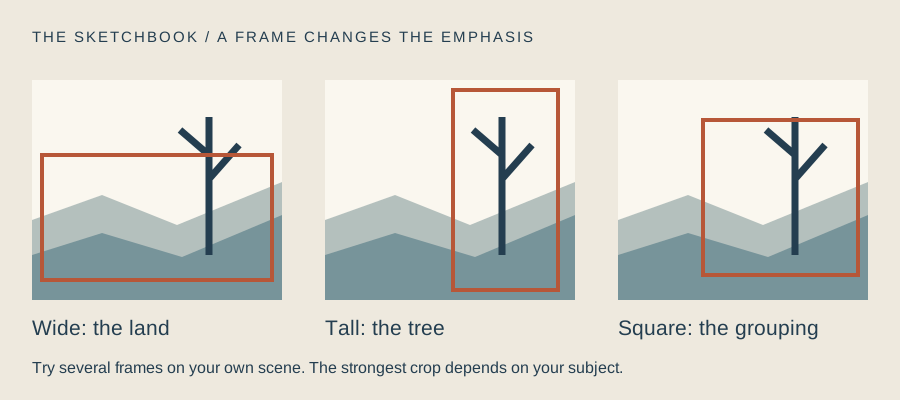
Landscape inside a fan
- Lightly draw a wide fan shape and place three unequal masses within it.
- Use diluted ink or one watercolour for contours, then deepen only a few accents.
- Add two colours in small grouped marks. Leave several generous areas without foliage.
Make this a study of your own subject. These are our practice prompts, not a claim to reproduce an artist’s exact method.
Take a practice sheet →Keep looking
Sources support the factual context; looking notes and exercises are Watercolourist editorial interpretation.
What happened on your paper?
One useful observation beats “lovely work”. Show a study, ask about a decision, or tell us where you disagree.
Join the studio discussion