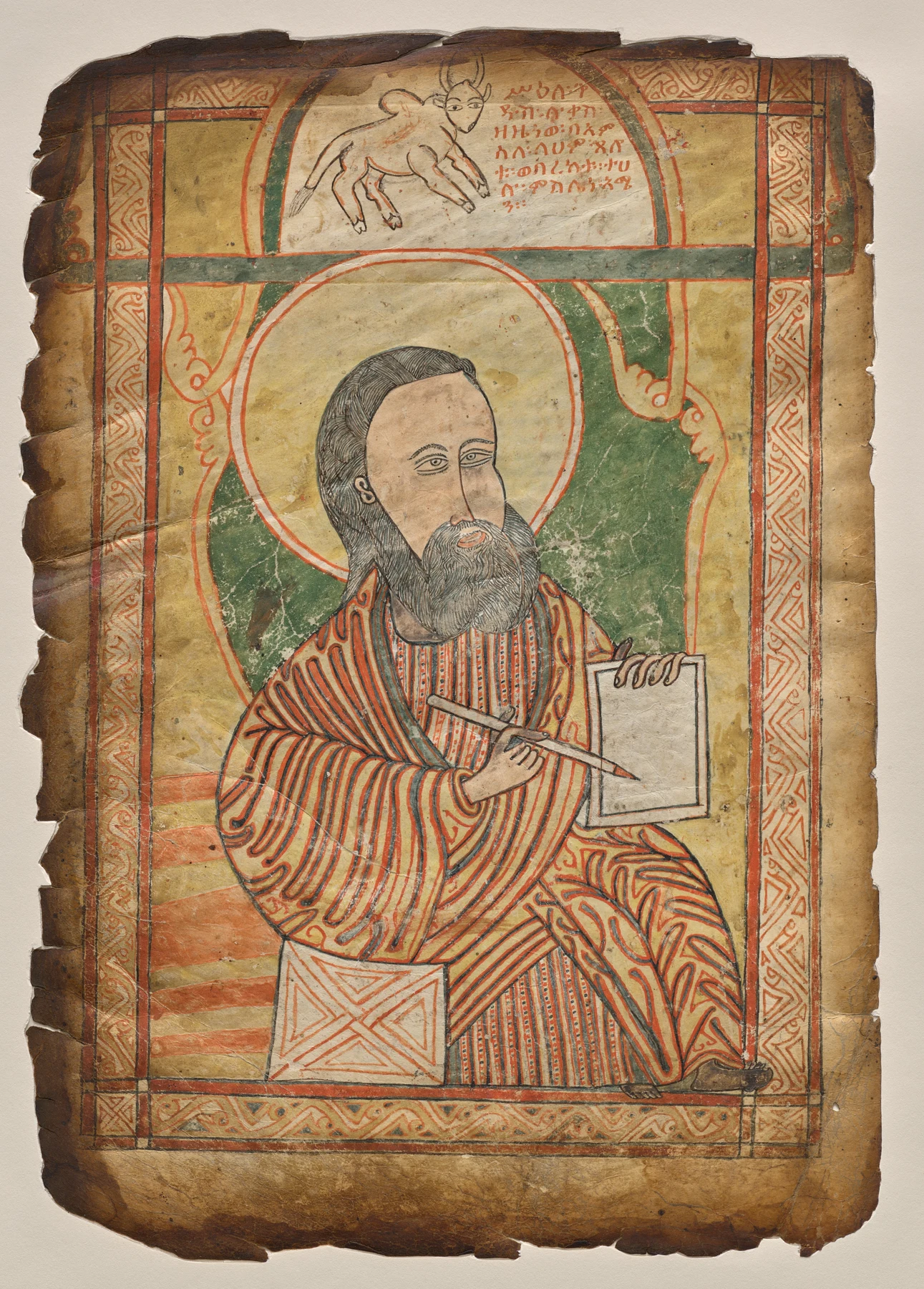
- Compare the patterned garment with the broad halo and background.
- Find the book’s straight edges among the many curved lines.
- Look at how the border establishes a distinct space for the portrait.
These observations describe what is visible, not how the artist made the painting.
What this page is
This fifteenth-century Ethiopian manuscript leaf depicts the evangelist Luke, with his identifying ox above. Cleveland dates it to about 1440–80 and locates it in the Tigray region. Its maker is unnamed in the museum record. The support is vellum and the painting combines ink with tempera. These are manuscript materials, rather than the transparent watercolour on paper familiar from a modern paintbox. The text is in Ge‘ez, the liturgical language of Ethiopian Orthodox Christianity.
Why it belongs in the history
The page brings an African manuscript tradition into view on its own terms. A painter can look at it for colour, line and composition while remembering that the original object served a Christian religious purpose. It also gives us a useful question for our own practice: what happens when the entire page is composed, including the border, the written elements and the figure? Treating the frame as part of the painting changes decisions that we often postpone until the very end.
Look at the changes of pace
The robe is crowded with moving stripes, while the halo and green field provide broader, calmer areas. The drawing of the book gives the eye a firm rectangle among the curves. My visual reading is that the page remains clear because these different kinds of mark have different jobs. Follow the robe with one finger in the air, then trace the book: the change from a restless path to an angular one is immediate. The broad border holds both kinds of movement in the same space.
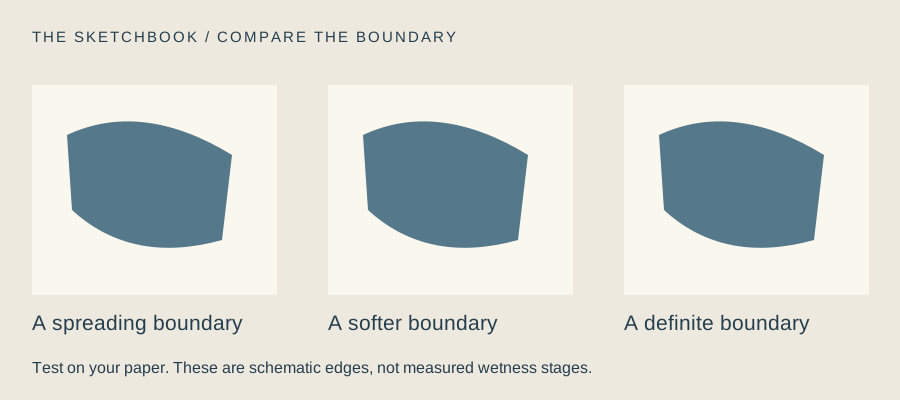
Try the visual question in your own subject
Put a striped cloth beside a plain mug and sketch both inside a simple border. You are testing changes of visual pace, not reproducing sacred iconography or claiming to recover the artist’s working method. Use ordinary watercolour or gouache, and keep the cloth busy while leaving the mug quiet. If everything receives the same amount of pattern, the contrast disappears. Before adding another stripe, ask whether the quieter shape is still getting its share of attention.
Busy cloth, quiet cup
- Arrange a striped cloth and plain mug, then draw a border around your study.
- Paint the mug with two broad values and the cloth with grouped lines.
- Leave one area untouched and compare the balance before adding more detail.
Make this a study of your own subject. These are our practice prompts, not a claim to reproduce an artist’s exact method.
Take a practice sheet →Keep looking
Sources support the factual context; looking notes and exercises are Watercolourist editorial interpretation.
What happened on your paper?
One useful observation beats “lovely work”. Show a study, ask about a decision, or tell us where you disagree.
Join the studio discussion