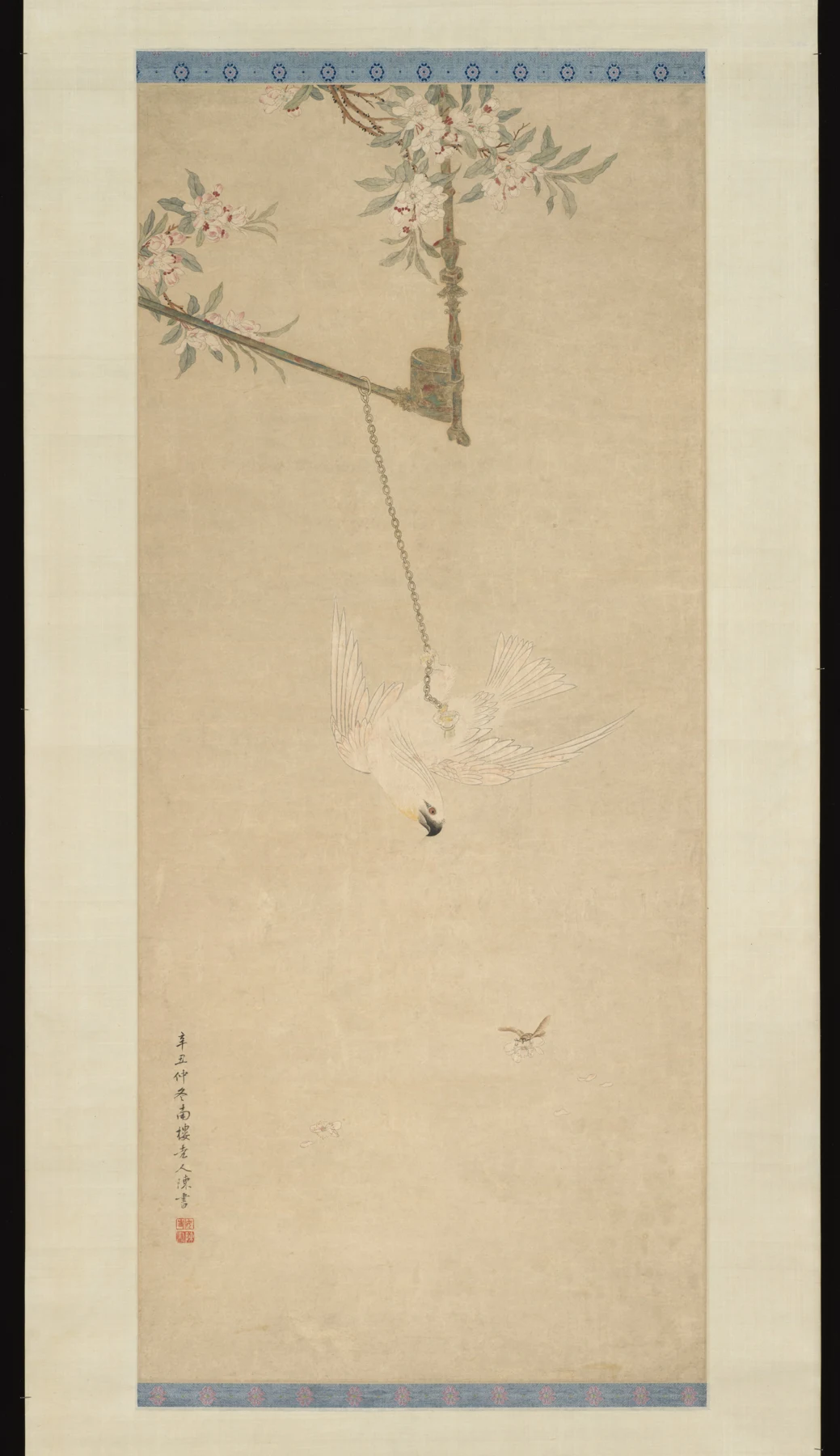
- Track the chain from perch to bird before looking at individual feathers.
- Compare the dark beak with the much paler body: a tiny accent commands attention.
- Notice how the insect, petals, inscription and bird occupy separate parts of the tall field.
These observations describe what is visible, not how the artist made the painting.
A woman painter in Qing China — why it matters
Chen Shu (1660–1736) established a reputation as a painter in a society where relatively few women achieved that recognition. The Met dates this hanging scroll to 1721 and places its making in Beijing. Its curators connect the meticulous bird-and-flower description with earlier Song and Ming court traditions. This is Chinese ink-and-colour painting on paper; the museum does not classify it as transparent European watercolour. Keeping that distinction lets us enjoy a wider history of painting with water without flattening its traditions.
Follow the chain
Start at the blossom-covered perch and follow the narrow chain down towards the cockatoo. That tiny repeated line carries the eye through a huge interval. The bird hangs head down with its wings spread, its pale plumage interrupted by a dark beak and eye. Below it, a small winged insect and scattered petals keep the lower space active. Our reading is that this long separation makes every small event unusually noticeable. Cover the lower half with your hand, then uncover it: the composition suddenly has much more time in it.
Borrow the spacing, not a recipe
For your own page, try placing two modest subjects far apart before filling anything between them. A thin stem, a trailing cord or a direction of gaze might connect them. You do not need to paint a complete background to make the space count. This is our studio exercise in placement, not a reconstruction of Chen’s working method. Let the first version feel a little too empty. The brush is not contractually obliged to visit every square centimetre. Compare it with a crowded version and decide which makes you look longer.
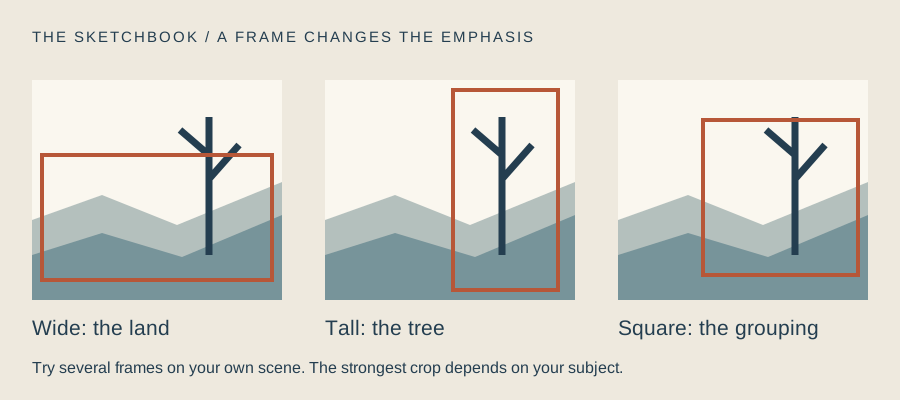
Two subjects, one long pause
- Draw two tall rectangles and place a small leaf near the top and a seed near the bottom of each.
- Connect the first pair with one fine curved stem; give the second a busy background wash.
- Stand back and compare the intervals. Keep the version where the space helps the subjects speak.
Make this a study of your own subject. These are our practice prompts, not a claim to reproduce an artist’s exact method.
Take a practice sheet →Keep looking
Sources support the factual context; looking notes and exercises are Watercolourist editorial interpretation.
What happened on your paper?
One useful observation beats “lovely work”. Show a study, ask about a decision, or tell us where you disagree.
Join the studio discussion