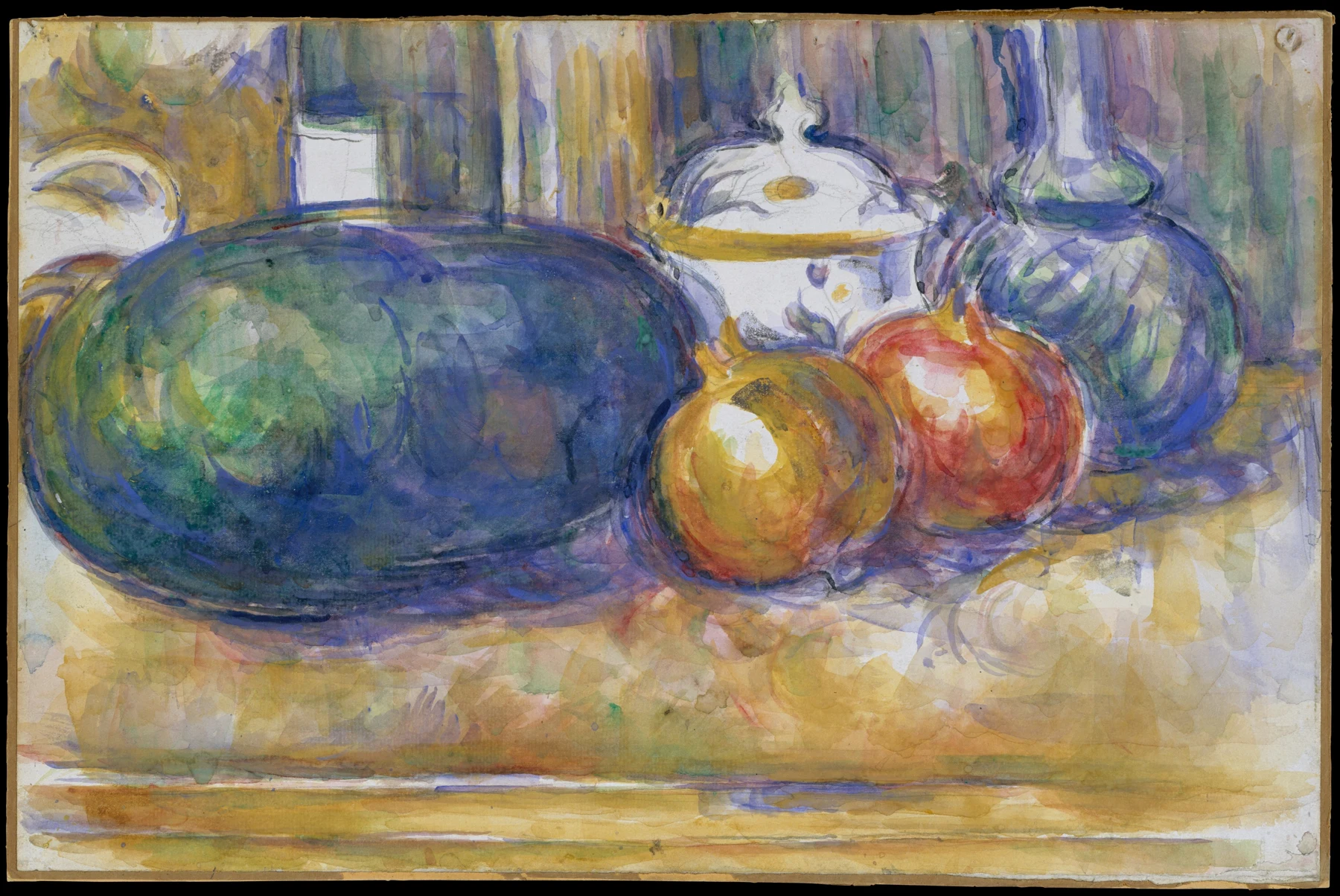
- A large cool oval anchors the left, with smaller warm fruits to the right.
- Repeated curved marks appear around several objects rather than one sealed contour.
- Pale paper remains active in and around the sugar bowl.
These observations describe what is visible, not how the artist made the painting.
What is this painting?
Cézanne made this still life during his final years, between 1900 and 1906. A watermelon, pomegranates, glass vessel and sugar bowl gather on a table. The Met places it among the more developed of roughly twenty late watercolour still lifes, drawing attention to colour reflected between objects and the sugar bowl formed from reserved paper.
Why it matters
For a history of watercolour, the sheet is a particularly clear challenge to the idea that drawing provides a finished container and colour merely fills it. Here the marks continually negotiate the objects. Weight and transparency coexist: the watermelon feels substantial, yet its surface remains a visible accumulation of coloured touches. This is a question raised by the painting in front of us, not a claim that every uncertain contour was a manifesto.
The space is doing some work
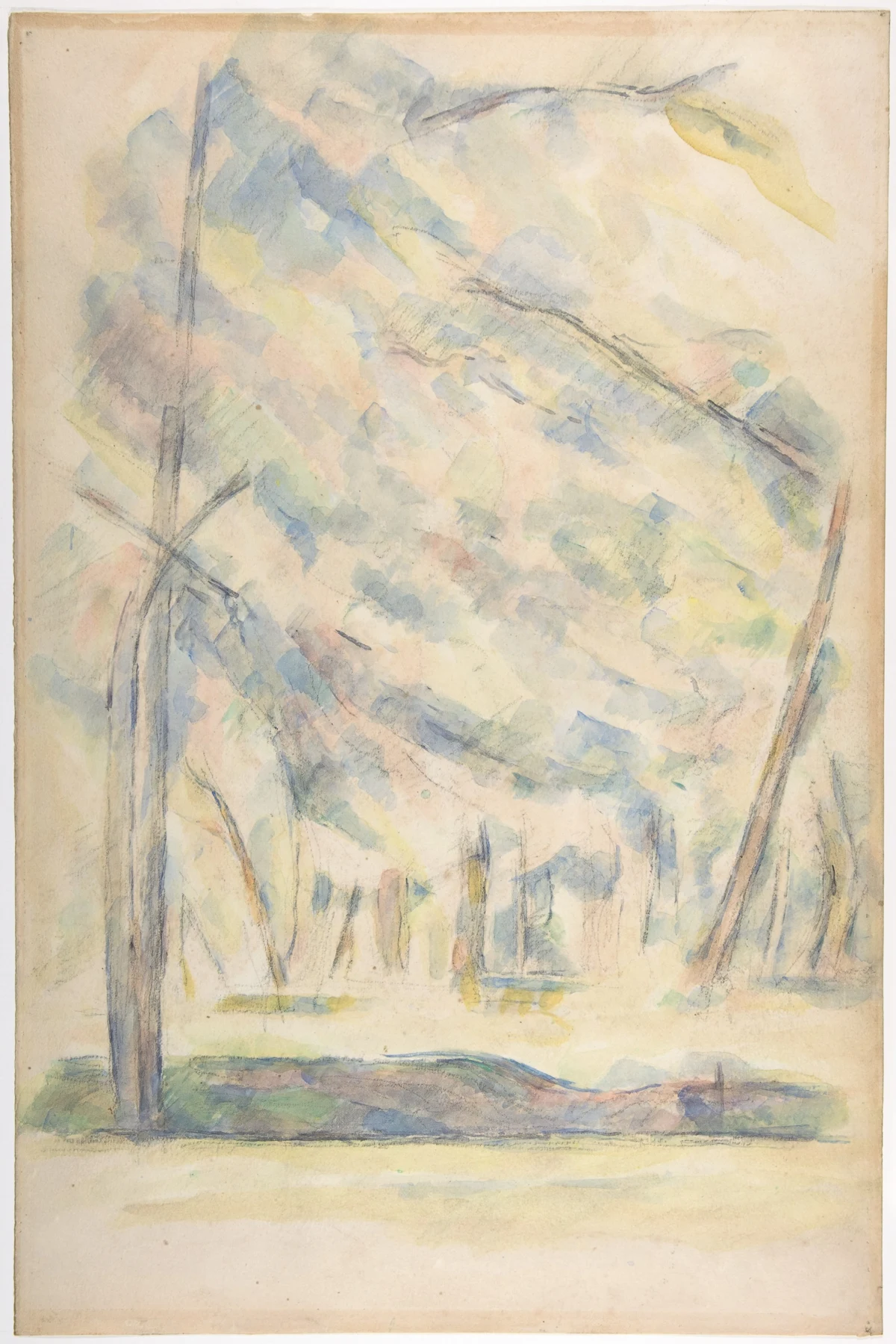
The large blue-green oval pulls left; the smaller warm fruits answer it on the right. Curves repeat through the glass and lidded bowl, while horizontal marks establish the table beneath them. Notice how little pure outlining is needed to suggest the lightest object. Compare the companion landscape: ask where touches of colour gather into a thing and where the paper remains open between them.
A good discussion can start with a disagreement. Is the movement in this picture exhilarating, or does the shifting outline make you want to straighten everything? Either answer gives you something more useful than simply declaring it a masterpiece and moving on to the biscuits.
Colour before the tidy outline
- Arrange one large object and two smaller objects on a cloth.
- Draw lightly, then place six patches of colour that describe the relationships between them.
- Leave gaps. Add only the marks needed to make the forms readable, and compare the untouched paper with the painted shapes.
Make this a study of your own subject. These are our practice prompts, not a claim to reproduce an artist’s exact method.
Take a practice sheet →Keep looking
Sources support the factual context; looking notes and exercises are Watercolourist editorial interpretation.
What happened on your paper?
One useful observation beats “lovely work”. Show a study, ask about a decision, or tell us where you disagree.
Join the studio discussion