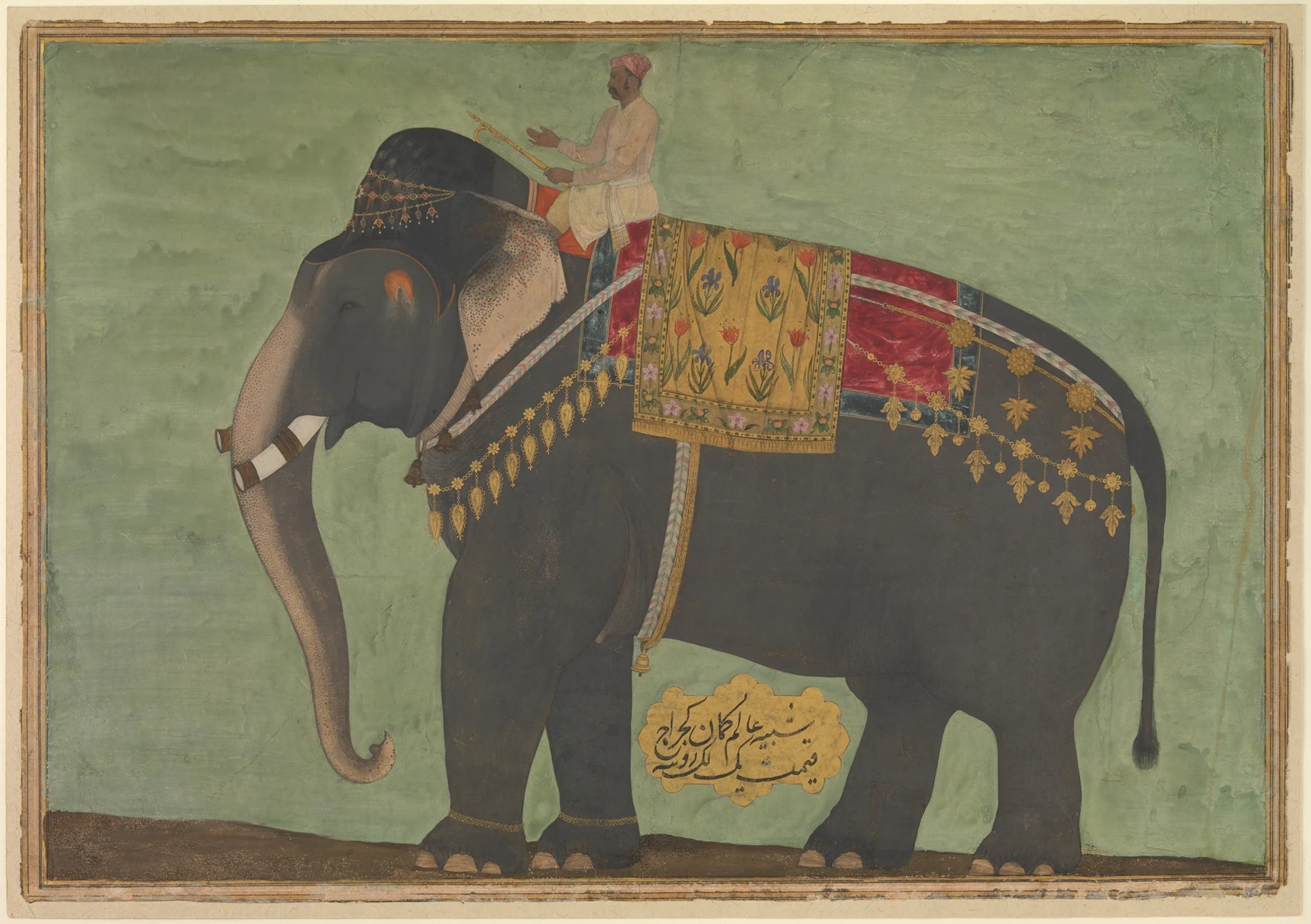
- Read the whole dark body against the green before following the gold chains.
- Notice how the rider establishes scale without dominating the portrait.
- Study the negative shapes around the trunk and between the legs.
These observations describe what is visible, not how the artist made the painting.
A named animal, a court treasure — why it matters
This is a portrait of a particular elephant, ‘Alam Guman, rather than a generic animal study. The Met attributes the painting to Bichitr and dates it to around 1640. Its record explains that the elephant was presented to the Mughal emperor Jahangir in 1614 and situates animal portraits within the court’s practice of documenting prized possessions. The painting’s opaque watercolour and gold support both substantial areas of colour and fine ornament. The uncertain attribution should stay visible; a compelling picture does not need us to make its history tidier.
A great dark shape with small interruptions
Against the green field, the elephant occupies almost the whole width. The rider makes its scale immediately legible. The curved trunk and the gaps between the legs stop the broad body becoming an inert block. Gold chains, the floral cloth and a red textile introduce smaller rhythms across that large dark area. Our reading is that the portrait’s sense of weight depends on the broad shape remaining coherent. Even the most elaborate decoration does not prevent us seeing the animal first. The narrow strip of ground gives those feet somewhere convincing to stand.
Keep the big shape in charge
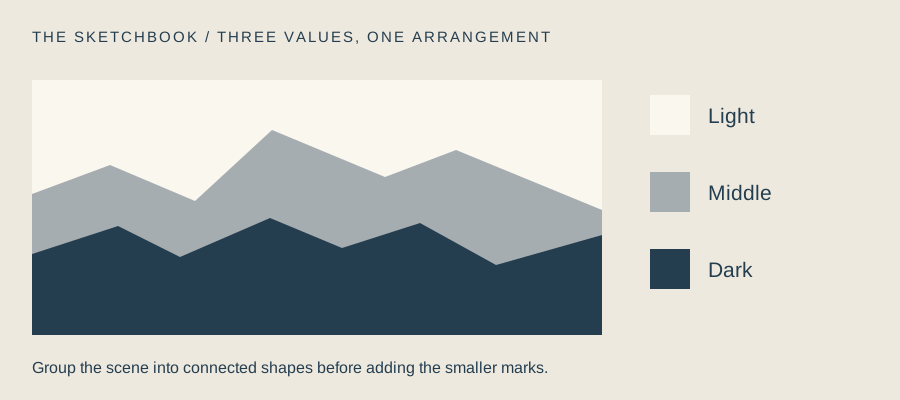
Use the value diagram as a prompt to simplify your next subject into three masses before adding any decorative marks. A coat hanging over a chair can pose the same challenge at a less imperial budget. This is a modern design exercise inspired by looking, not a historical painting lesson attributed to Bichitr. If the main shape dissolves as you add detail, pause and view the page at thumbnail size. A few quiet passages often help more than another round of finishing. Your subject should survive being seen from the other side of the studio.
A large shape that keeps its weight
- Sketch a coat over a chair using only light, middle and dark masses.
- Keep the largest dark connected, then add a small patterned area or a few lighter accents.
- Photograph the study at thumbnail size. Remove or simplify any detail that breaks its main silhouette.
Make this a study of your own subject. These are our practice prompts, not a claim to reproduce an artist’s exact method.
Take a practice sheet →Keep looking
Sources support the factual context; looking notes and exercises are Watercolourist editorial interpretation.
What happened on your paper?
One useful observation beats “lovely work”. Show a study, ask about a decision, or tell us where you disagree.
Join the studio discussion