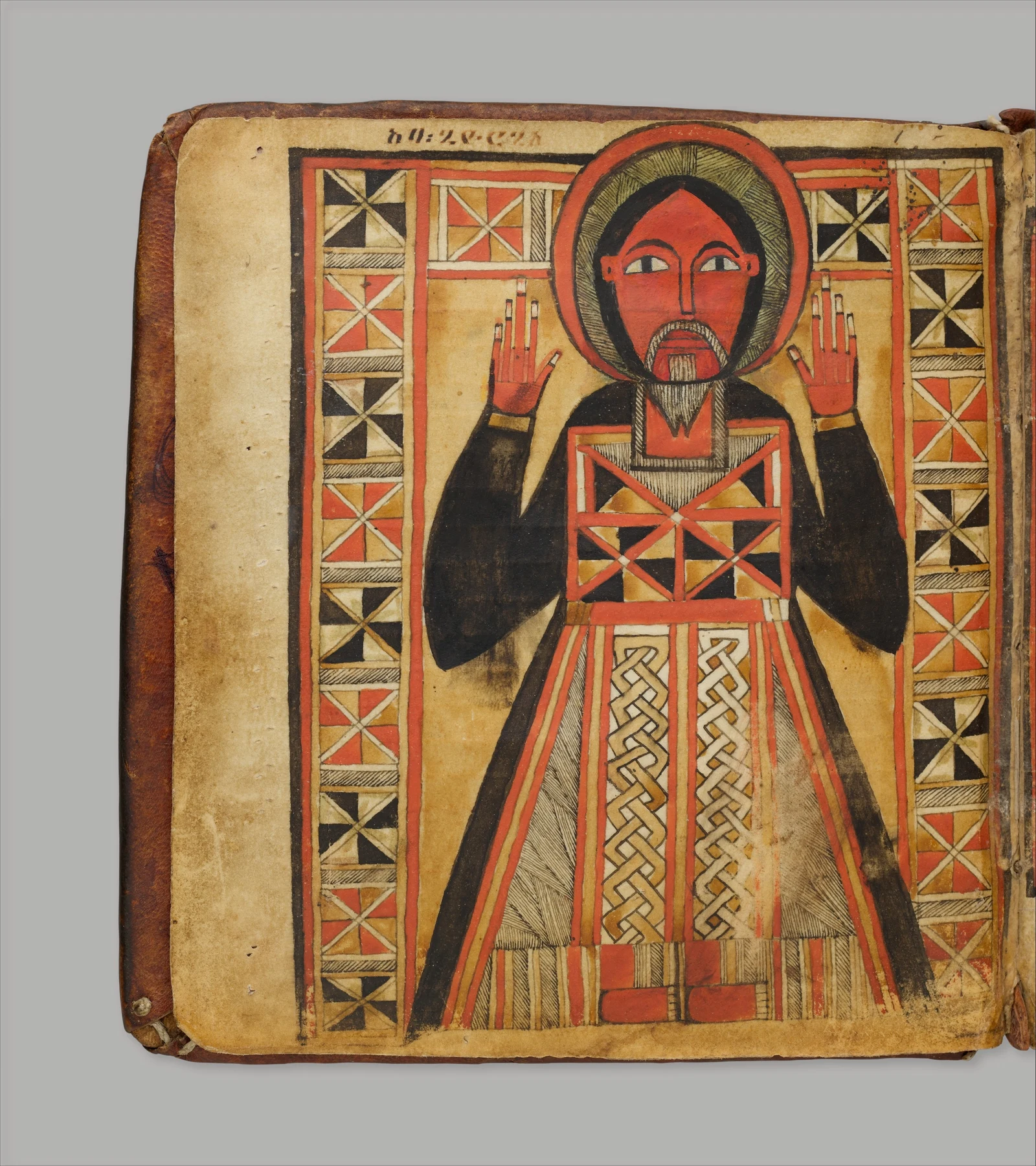
- Read the large dark silhouette before entering the smaller patterned areas.
- Compare broad colour fields with the fine hatching.
- Step back and see which parts remain clear when the smallest marks disappear.
These observations describe what is visible, not how the artist made the painting.
A sacred book with an uncertain attribution
This Ethiopian Orthodox prayer book honours the Virgin Mary. The illustrated figure is Abba Giyorgis of Sägla, traditionally credited with its hymn of praise. The Met attributes the late-seventeenth-century manuscript to Baselyos, associated with the name Ground Hornbill Master. Its scholarly account leaves open whether scribe and illuminator were one person, and whether a workshop shared the style. Keeping that uncertainty visible respects the research. The image is painted on parchment, not a modern transparent-watercolour sheet.
Why the whole book matters
An isolated reproduction can make a manuscript illumination look like a small easel painting. This one belonged to a volume of prayers with other kinds of image and ornament. Its meaning begins with that devotional setting. For today's painter, the useful question is how a small set of visual decisions can remain interesting across a whole body of work. Consistency need not mean making every page identical. You can establish a family resemblance through colour and spacing while giving each page a different rhythm.
Three distances of looking
From across the room, the figure’s dark robe forms a strong triangular mass. Closer up, red and ochre divisions organise the central garment and border. At close range, fine hatching offers another texture. Our reading is that these three scales reward three different distances of looking. Try moving the image farther away: the large silhouette survives after the smallest marks disappear. The composition does not depend on every detail being legible at once, which is a useful test for almost any painting.
A modern exercise in a limited palette
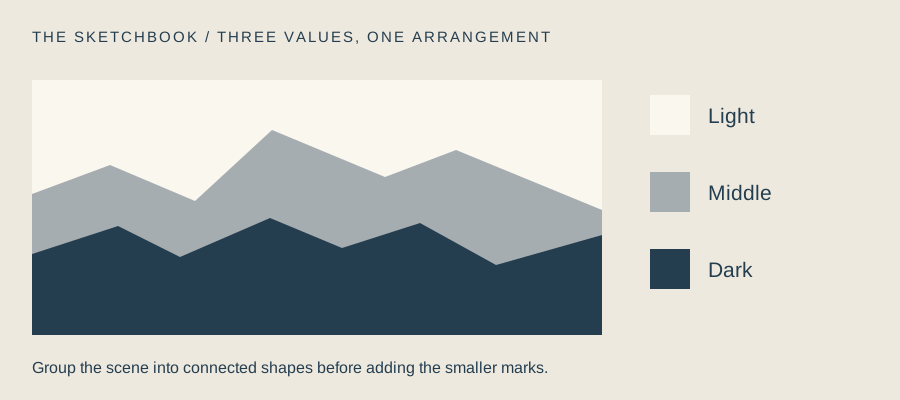
Choose three colours and design a page around an everyday object, such as a teapot. Give it a bold overall shape, one band of pattern and a small patch of fine lines. Invent your own motifs; this exercise addresses visual hierarchy rather than recreating religious imagery. A watercolour version can use reserved paper, while a gouache version can add opaque light shapes. Photograph the result from a distance. If the main object vanishes into its ornament, simplify a band before reaching for another colour.
One object, three scales of mark
- Draw a teapot and choose three colours plus the paper colour.
- Paint a clear large shape, then add one band of an invented pattern.
- Add fine hatching to a small area and test the result both close up and at arm’s length.
Make this a study of your own subject. These are our practice prompts, not a claim to reproduce an artist’s exact method.
Take a practice sheet →Keep looking
- The Met: Arganonä Maryam, catalogue essay and attribution discussion
- The Met: Open Access image policy
Sources support the factual context; looking notes and exercises are Watercolourist editorial interpretation.
What happened on your paper?
One useful observation beats “lovely work”. Show a study, ask about a decision, or tell us where you disagree.
Join the studio discussion