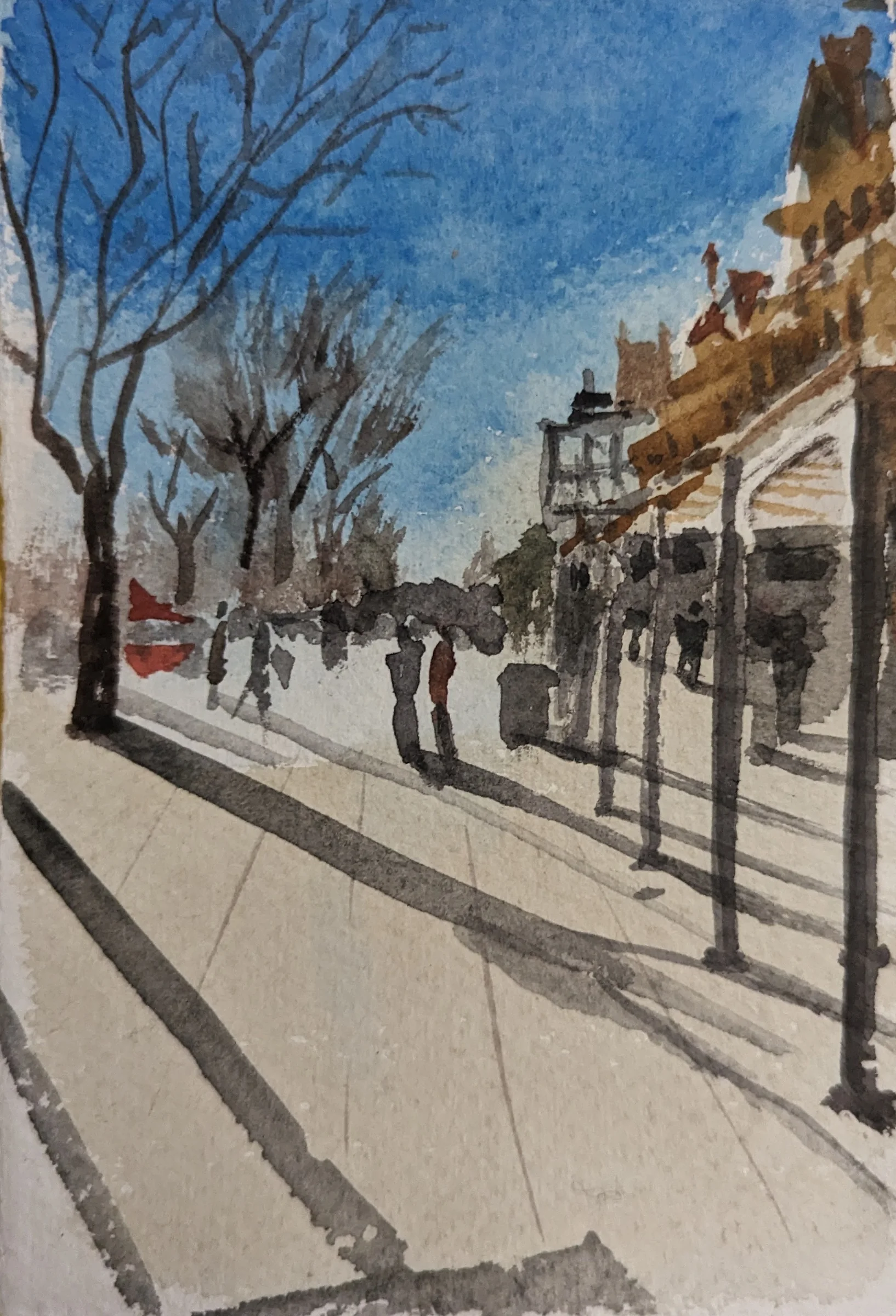
- Long Shadows, Southport uses a tall format that includes a large sweep of foreground pavement and the branching trees above.
- The diagonal shadows cross the pale pavement, while the line of shopfronts and figures narrows towards the distance.
These observations describe what is visible, not how the artist made the painting.
Give the outing a visual question
An appealing place and a workable painting are related, but they are not interchangeable. A grand view may contain no obvious arrangement at the size of your sketchbook. A patch of pavement may contain a superb one. Before choosing a position, name what caught your eye: the shadow pattern, the gap between buildings, the colour of a wall against the sky.
Joseph Zbukvic's official introduction to Planning Your Painting places subject selection, observation and drawing before the finished watercolour. Our outdoor routine develops that priority into a practical scouting exercise. The first useful thing you can make is a decision. The equipment can remain in the bag until the scene has offered something more persuasive than a convenient bench.
Change position before changing the picture
Look from three nearby positions. Take a few steps sideways, then try a higher or lower eye level where comfortable. Observe what overlaps, which gaps open and whether a distracting object separates from the main subject. Small movements can change the arrangement more decisively than an elaborate plan to remove things later.
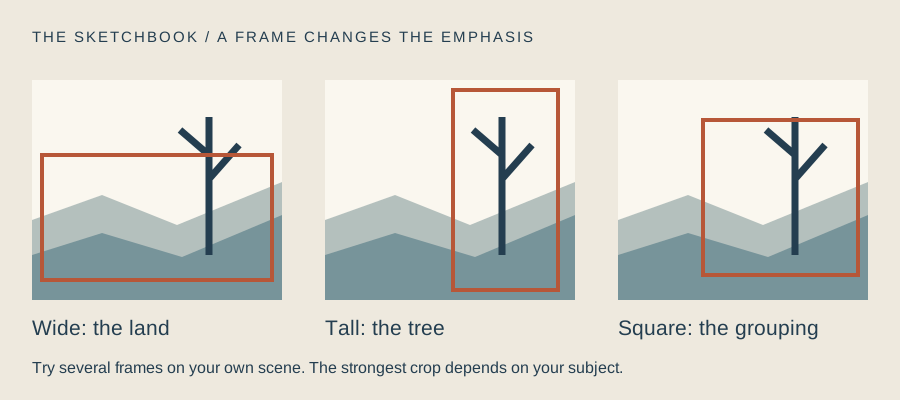
Use two pieces of card as a movable frame, or make a rectangle with your hands. Try a tall crop, a wide one and a tighter section. Keep the frame's proportions similar to the paper you will use. A composition that works beautifully in a long strip may become quite ordinary when squeezed into a square.
Check the edges as well as the centre
In Long Shadows, Southport, the tall format makes room for both the trees and a generous foreground crossed by shadows. Cover the lower part of the image with a piece of paper and compare the effect. Then cover some of the sky. You are testing the contribution of each area, not improving Mark's painting on his behalf.
Apply that experiment to your own view. Look along all four proposed edges. Does a large shape stop awkwardly just before the boundary? Is a thin strip of sky doing anything useful? Does a foreground object occupy a corner without helping the subject? Make a new crop that answers one specific problem, then compare it with the first rather than automatically preferring the latest version.
Commit to a moment and a purpose
Once you have chosen a frame, draw a small map of its major boundaries and mark the direction of the shadows. Note the time. Decide whether you are recording the location as observed or making a freer composition from it. Urban Sketchers' published principles emphasise drawing on location and being truthful to the scene; that is a useful distinction if you intend to share a work as an urban sketch.
Now paint the feature that made you stop. If the shadows move, refer to your initial note instead of continually redesigning the page. Keep a few written colour observations for anything you cannot finish. Back indoors, assess whether the chosen crop served the original question. A successful scouting session may end with three promising arrangements and no finished painting. That is still considerably more useful than hauling home a very detailed view you never wanted to paint.
Three positions, one decision
- Name one feature that attracts you before unpacking.
- Compare three positions and three different crops.
- Check all four edges and make a small map of the chosen frame.
- Record shadow direction and time, then paint the feature that prompted the choice.
Make this a study of your own subject. These are our practice prompts, not a claim to reproduce an artist’s exact method.
Take a practice sheet →Keep looking
Sources support the factual context; looking notes and exercises are Watercolourist editorial interpretation.
What happened on your paper?
One useful observation beats “lovely work”. Show a study, ask about a decision, or tell us where you disagree.
Join the studio discussion