Look up, then crop harder
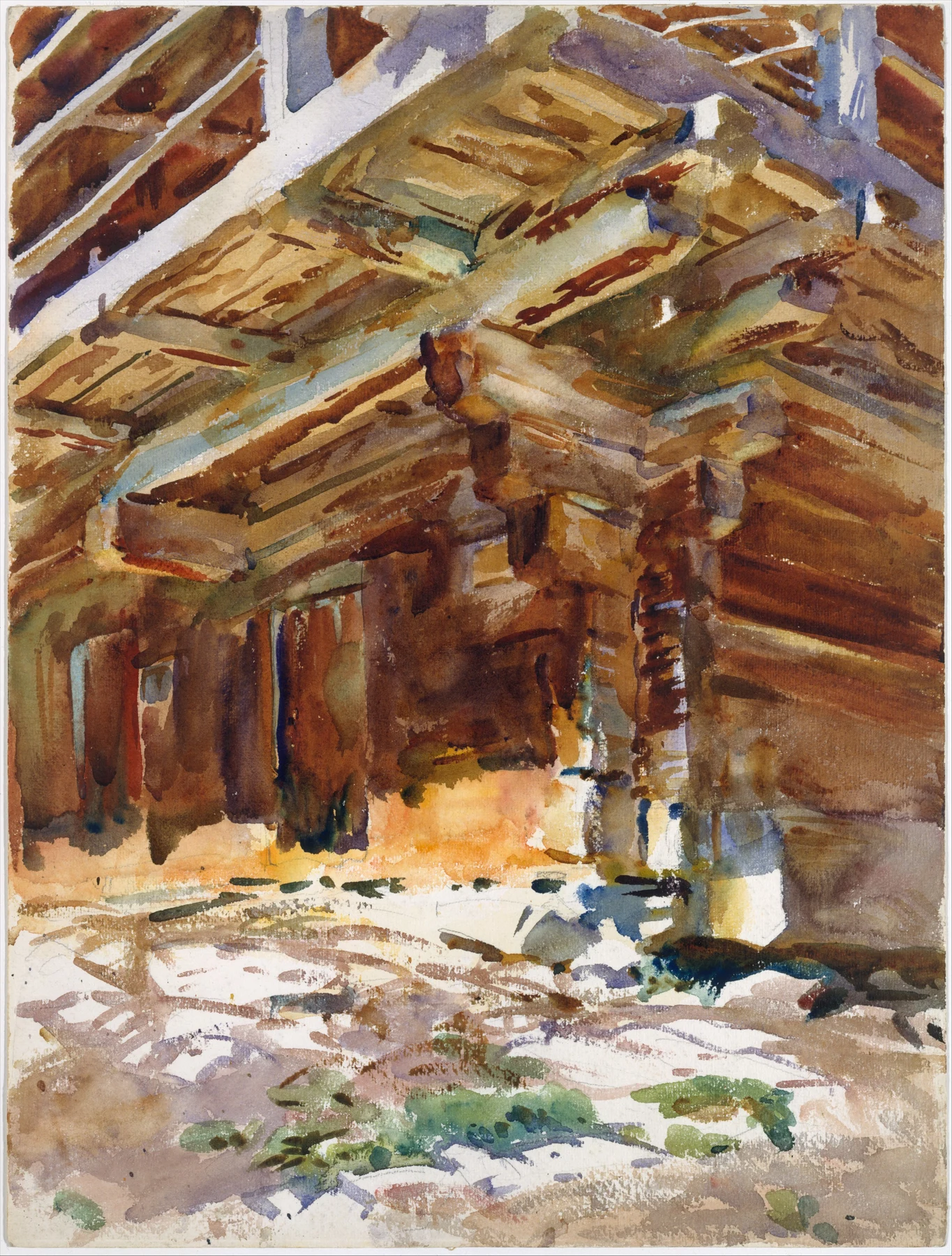
Sargent's Abriès, dated about 1912 by The Met, fills the sheet with a close view of timber architecture. You don't get a polite building standing neatly inside a margin. Roofs and beams push out beyond the edges. Warm browns meet cooler violet and blue passages, while broken light runs across the lower part of the picture. The arrangement has plenty to say before you identify a single construction detail.
Sargent was an American artist born in Florence in 1856, and his watercolours encompass a wide range of handling. The Met's study of his work describes transparent and opaque paint, wet and dry approaches, and both paper reserves and added white. An insistence on one approved technique would make a rather small box for this painter.
The mark has a job
Our reading of Abriès is that many marks describe both a plane and a direction. A broad diagonal gives the roof weight; a dark interruption beneath it suggests depth. The brushwork remains visible, but the structure is convincing. That is an excellent ambition for a study: marks that carry information while still looking like paint.
Choose a nearby subject with strong overlapping shapes. A garden shed, staircase or chair beside a window will do. Frame it tightly enough that something important leaves the picture. Draw the biggest angles and the main divisions of light and shade. Resist drawing every component. A preparatory sketch can become a contract you spend the next hour reluctantly colouring in.
Make fewer promises to the paper
Before each substantial stroke, decide its width, direction and value. Test the mixture in the margin. Load enough paint to complete the shape without repeatedly returning to the palette, then put it down and look. A fresh stroke can carry a useful change of colour or density. Immediately scrubbing it into uniformity may remove the very thing that made it interesting.
This is our exercise in decisive shape painting, not a claim about the exact order Sargent used. Keep a second scrap nearby and practise the awkward angle there first. Rehearsal does not invalidate spontaneity. It merely stops the main sheet receiving every first draft of your hand's conversation with the brush.
Make the quiet parts useful
Keep some passages broad and unresolved. The eye needs places to rest between the sharper statements. If all the timber receives an equally dark outline, the painting becomes a diagram. If the shadow joins across two forms, let the shared value establish that connection before considering a separating mark.
Judge the study from across the room, then close up. At a distance, the large shape pattern should still read. Nearby, you can enjoy the broken edges, overlaps and traces of paper. If the distant reading fails, additional texture is unlikely to rescue it. Make a second study with a better value arrangement. Sargent is a useful prompt to be bolder about the view you choose and more exact about the shapes you actually put down.
A tightly cropped corner — an editorial study
- Frame your own architectural subject so that major forms leave two edges.
- Draw only the principal angles and three value groups.
- Practise one broad angled stroke on scrap, then paint the largest shapes.
- Add a few structural darks; check the result from across the room.
Make this a study of your own subject. These are our practice prompts, not a claim to reproduce an artist’s exact method.
Take a practice sheet →Keep looking
- The Met: Abriès, about 1912 — object record
- The Met: John Singer Sargent, a selection of drawings and watercolours
Sources support the factual context; looking notes and exercises are Watercolourist editorial interpretation.
What happened on your paper?
One useful observation beats “lovely work”. Show a study, ask about a decision, or tell us where you disagree.
Join the studio discussion