Start with what stays empty
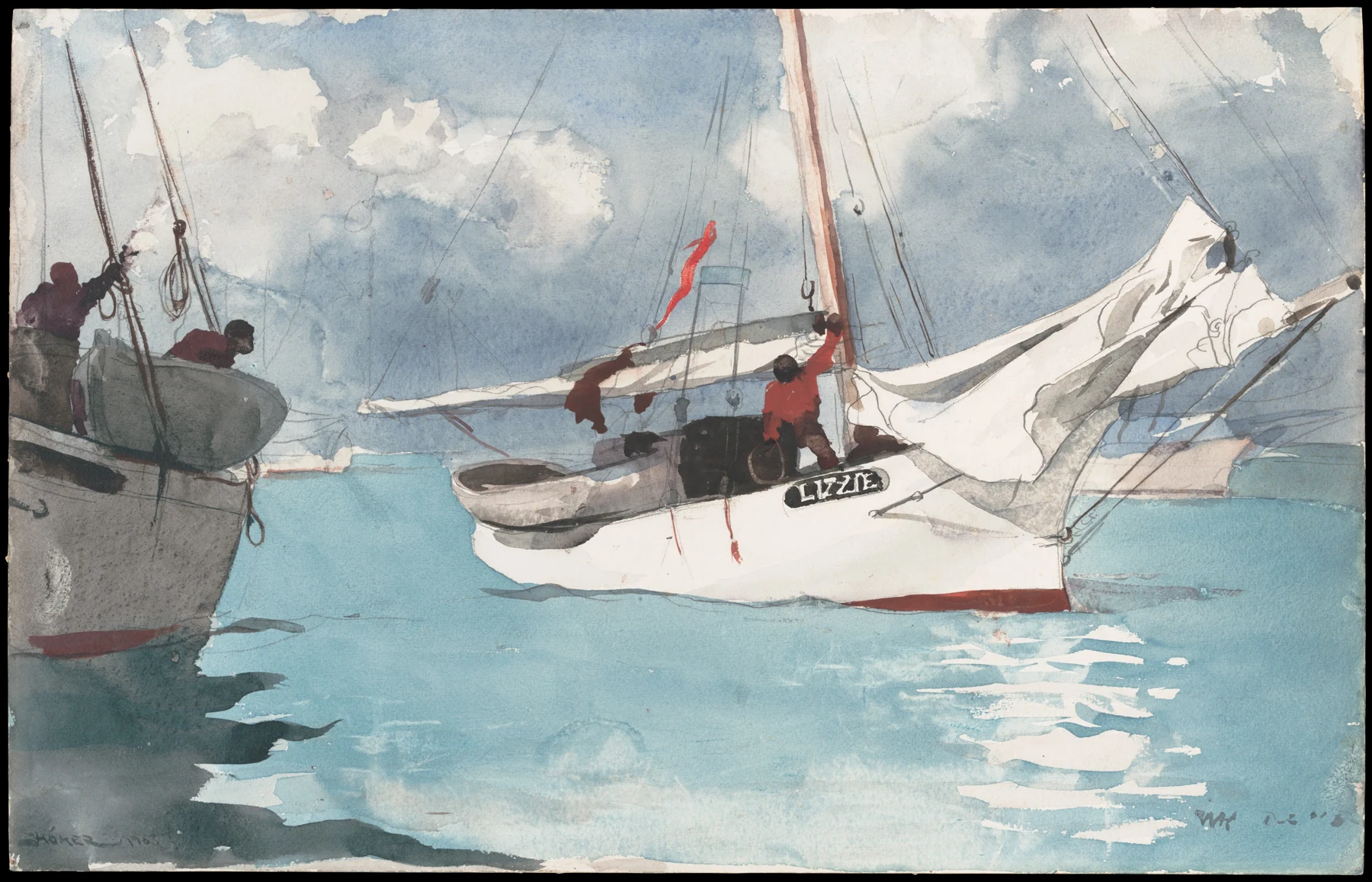
In Winslow Homer's Fishing Boats, Key West, the pale hull and sail hold their own against a clouded sky and blue-green water. The painting dates from 1903. The Met draws attention to Homer's reserved paper, fluid washes and visible graphite. That combination is wonderfully practical: a pencil line can remain a line while the light does the glamorous work.
The museum also notes that, despite the title, the vessels appear to be typical Bahamian fishing boats. The wider history includes movement between the Bahamas and Florida and the work of Black Bahamian communities. These are working boats with people aboard. Looking carefully means attending to the human subject as well as admiring a particularly good blue.
Give the white a shape
Our reading of the picture begins with the irregular white sail and the longer hull below it. Their shapes differ, and darker passages separate them enough to make the structure readable. The bright reflection below is broken into horizontal pieces. The eye accepts the connection without a tidy mirror image. Water has declined your request for perfect symmetry.
In your own study, decide which light shapes matter before laying a wash. Draw their boundaries lightly. Don't reserve a scattered handful of white flecks simply because sparkle seems desirable. Give the largest light a clear role, then let smaller interruptions support it. A white patch needs a neighbour of sufficient value to become visible.
A harbour study without a harbour
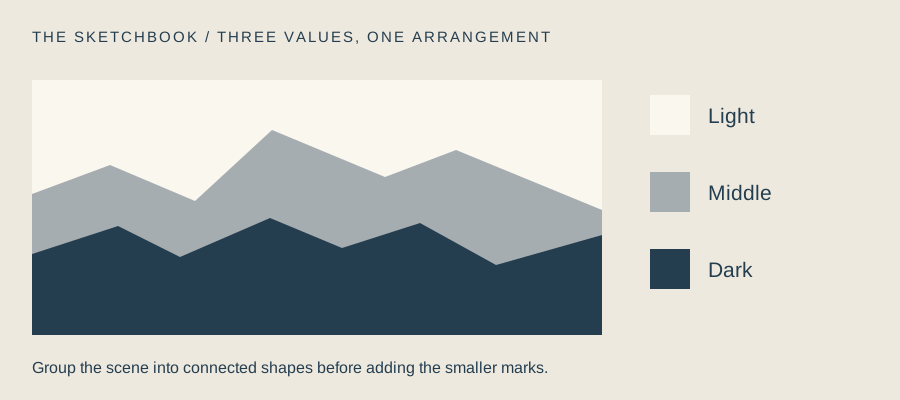
You can practise the underlying problem with a white jug on a cloth beside a window. Choose a view with a clear lit side, a darker shadow and a background that helps the silhouette. Paint around the principal light. Let the background dry, then add the jug's shadow as one connected shape before attending to the handle or rim.
For a water study, use your own reference and draw one boat large enough to simplify. Leave the lightest hull area untouched. Put down a broad water wash around it, allowing a few broken reserves below. Once dry, add a limited number of darker horizontal marks. This is an editorial exercise derived from looking at the painting, rather than a documented Homer demonstration.
Keep a bit of the drawing alive
A visible pencil mark is useful when it contributes direction or structure. You do not have to conceal every bit of preparation to prove that you have finished. Equally, a thick outline around the entire boat may fight the light. Make deliberate choices about which lines remain active and which are allowed to disappear beneath a wash.
At the end, cover the fussiest corner with a piece of spare paper. If the picture suddenly improves, you have found tomorrow's exercise. Make another version with fewer marks in that area and compare the two. Homer's example encourages a productive kind of restraint: let a clear value relationship carry the subject, let the paper supply brightness, and give the viewer enough room to recognise the breeze.
Reserve the light — an editorial study
- Choose your own simple boat reference or a white jug beside a window.
- Draw and preserve the principal light shape before adding any wash.
- Build a connected middle tone around it; dry, then add a few dark accents.
- Check whether the light reads from a distance before adding detail.
Make this a study of your own subject. These are our practice prompts, not a claim to reproduce an artist’s exact method.
Take a practice sheet →Keep looking
- The Met: Fishing Boats, Key West, 1903 — object record and historical context
- Museum of Fine Arts Boston: Of Light and Air, Winslow Homer in Watercolor
Sources support the factual context; looking notes and exercises are Watercolourist editorial interpretation.
What happened on your paper?
One useful observation beats “lovely work”. Show a study, ask about a decision, or tell us where you disagree.
Join the studio discussion